
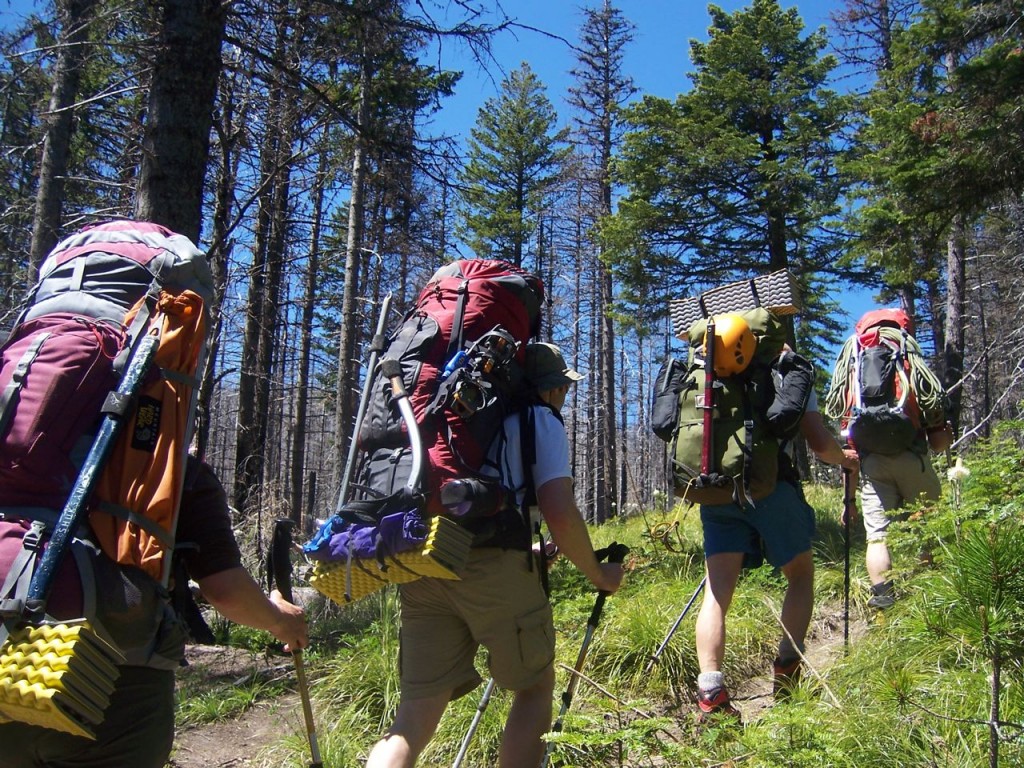
 Everything you need to know about life you can learn from backpacking and camping… Back in the day, I used to camp and backpack in Virginia and West Virginia. Generally it was just for a weekend – maybe two or three days. We would carry everything in/out. I remember having fun, enjoying it all, but I always felt like I need a day to recover. There was always a stiffness about my neck, arms, shoulders, upper back and all the rest that is connected to those parts. I could still feel the after effects of the pack’s burden. “Come to me, all you who labor and are burdened, and I will give you rest.” – There were treks when I would have been more than happy to let Jesus carry that burden.
Eventually our camping crew headed to the Rockies for the “real camping.” Our first adventure was in the mountains north of Steamboat Springs. We hired a local guide, Kevin. I remember being at the trail head, backpack up and ready to go, and Kevin looking at me and the way I was carrying the pack. He pointedly said, “Are you serious….? Take that pack off.” You know all those straps and buckles – they have a purpose. Kevin began to teach me about the way to adjust the pack, to make the load – not less heavy – but less burdensome. “Try this for a few miles.” A few miles later we stopped. I would assess, make choices, make some adjustments, and carry on. All along the way, there was a tweak here and there, and at the of the day-long trek I was relatively rested. Our trips got longer; two days became five became a week, became two weeks. We hiked the 10th Mt Division Trail, the Wind River Range, and took on Yellowstone in Winter. We were in God’s country, yoked to 75 pound packs, unburdened and free – with an open trail before us for the journey.
Take my yoke upon you and learn from me. It was a lesson for life. No matter what you do in life, there will be some part of you that is joined, is yoked, to commitments, choices, and decisions. You learn from others, you adjust, you move on to journey’s end. But at journey’s end, what will you discover? Will you be burdened beyond hope? Or will you arrive free of all those burdens?
About 1000 years ago, Anselm of Canterbury wrote about the intersection of freedom and burdens. While so often we think of freedom as the ability to choose, it is more. Anselm acknowledged choices along the way, but he holds out that there is more. He describes being truly freedom as being unburdened. As having no internal or external barrier, obstruction, or hurdle that impedes your journey to God, so that you can arrive at God and experience the great paradox: to be truly free is to have no choice at all. Such is the nature of the deep abiding love.
Such is the nature of couples as they approach the altar to exchange their vows of Holy Matrimony. Sure, they know there are a lot of other people out there who could make them happy, but that is now unimaginable. They can only imagine being with each other. In a way, there is no choice. Paradoxically, the church says, now they are truly free to marry. And so the journey begins. They will assess their married life, make choices and adjustments, and carry on. But who will teach them about the demands of deep abiding love?
St. John Chrysostom, writing to a young man on the eve of his wedding some 1500 years ago, told him to take Christ as their teacher. They urged them to always have Christ in the midst of his marriage that together his bride and he might learn from the life of Christ, especially what it means to seek the good of the other – at whatever the cost. To take as the teacher the One who lived and died as a matter of love, of freedom, of his unquenchable desire for our good. “Come to me, all you who labor and are burdened, and I will give you rest.”
The teacher we choose is important. Take my yoke upon you and learn from me, for I am meek and humble of heart. I think of the teachers I have known. There were many who were quite knowledgeable and yet I do not recall their names. The ones I remember were the one who sought the good of their students in a way that they were yoked to our learning. I think they were the ones whose experience of the journey of love, true freedom, and the desire of the good for the other, shone through. I mean, who would choose a job where the hours at home preparing seem to equal the hours in the classroom teaching? And then attend to all the administrative, parental, and other necessary tasks outside the classroom? But when you ask them about their choice of professions you hear the passion and love, even among the burdens. You understand there is almost nothing they would not do for their students. They yoke themselves to their students and in those moments when recognition shines forth in their student’s eye, it is all just a little easier. The work load is no less, but the burden almost disappears.
I have been thinking about this fusion of love, freedom, and the desire for the good of the other – and sometimes it leads us to a choice that is costly beyond measure. Take my yoke upon you and learn from me – the phrase “learn from me” could also be translated as “learn about me.” One of the lessons is given in the Garden of Gethsemane, when Jesus knowing what the morn would bring, tells his disciples “Pray that you may not undergo the test.” He then prayed saying, “Father, if you are willing, take this cup away from me; still, not my will but yours be done.” There is a lot to learned from that small scene of Jesus’ life about intersection of love, true freedom, and the desire of the good for the other.
Indeed, we should all pray that we not undergo the test facing the parents in the so-called “Northern Triangle” of El Salvador, Honduras and Guatemala. We have read about their test in the news coverage about their unaccompanied children appearing at our borders. But it is not just our borders. It is also the borders of Panama, Nicaragua, Costa Rica and Belize. Those countries have experienced a 700% increase in asylum applications from children from the Northern Triangle.
This did not begin last month or even last year. These reports have been coming from Church and its missionaries since 2011. For three years there have been increased reports of the desperation of parents to save their children from the gang violence and the vigilante death squads who enter neighborhoods known for gang violence and indiscriminately execute young people. While the death squads are local, the gangs are transnational, and have infiltrated all elements of civil society.
Can you imagine being a parent in the Northern Triangle and sending your child north or south, east or west, to anywhere but home. I can’t imagine the burden of such a life-and-death assessment, the choices, and knowing that long anxious nights that are coming. There is a terrible side to love, freedom, and the desire for the good of the other. In order that their child be truly free, they, the parents have no choice but to send them away. It parallels the experience of our heavenly Father. In order that we be truly free, God the Father sent his only Son.
I do think Anselm had it correct, to be truly free is to have no choice at all. Those moments of life terrible and joyful will come. On our best days we will respond from love and the good of the other – as if we could not imagine another option – as thought we had no choice. Take my yoke upon you and learn from me – we need a teacher for those moments. One whose promise is true: “Come to me, all you who labor and are burdened, and I will give you rest.” The backpack of our life’s journey may in fact get heavier, but still have the possibility of being less burdensome. That comes in the way we assess: love and desiring the good of the other. The adjustments we make. The path we walk. And choices we make on the journey. The Guide we choose.
Discover more from friarmusings
Subscribe to get the latest posts sent to your email.
 friarmusings