
The Challenge of Forgiveness

Note: this weekend Deacon Mike is preaching. This is a homily from the 10th anniversary of 9-11


Today’s readings offer an uncomfortable, but clear challenge to us on this anniversary of the September 11, 2001 terrorist attacks: the challenge of forgiveness.  

  • A woman @ Mass – she can’t forgive and no longer expects God’s forgiveness
  • A marine @ Fallujah – And now he wondered how that boy’s mother or God could ever forgive him for shooting a child.
  • Lloyd LeBlanc at his murdered son’s side – as he prayer the Lord’s Prayer  he realized the depth of the commitment. He would have to forgive the person who had done this heinous crime and taken his son’s life.  He wondered how he could not overcome bitterness and feelings of revenge that would surely wash over him day-by-day. LeBlanc said that each day, for the rest of his life, forgiveness would have to be prayed for and struggled for and won.
  • And the families and survivors of 9-11 each have their own stories – and the struggle with forgiveness – and forgiveness’ attendants:  healing and wholeness.

Forgiveness is a challenge – even for we who live well away from the boundaries and intensity of these stories.  Like them we are called to be people who truly seek wholeness and completeness in this life through Christ – the one who commands that we forgive our brother from the depths of our heart.

And we are left to navigate the maze of the complexity that is forgiveness.  And it seems to me there are lots of instances when our forgiveness is all too human and partial….

  1. No need to apologize – there is nothing to forgive …. But I wonder if I am really just in the state of denial at the moment and maybe this will all catch up with me later.
  2. Forgiveness?  This isn’t about forgiveness, this is about justice… or maybe its vengeance/ revenge
  3. You have not asked yet and maybe you never will – and you may not even think you have done something wrong, but I forgive you….  But I wonder how real that is
  4. I forgive you – but inside I am still madder-than-a-wet-hen and I just forgave you because I am supposed to but I really do not feel like it.
  5. I forgive you because it’s my Christian duty to forgive, but you don’t deserve it.
  6. I forgive you – but in truth I really do not know what I am supposed to do with what I am feeling – I don’t want to feel this way.
  7. I forgive you – and I mean it …. really, …but I won’t forget and I will hold you responsible for changing so that if you do this again, I will remind you of your former malfeasance. 
  8. I forgive you – but that is it …. We can no longer be friends.  I can have nothing to do with you.
  9. I am not ready to forgive you … maybe later.
  10. I can’t forgive you – what you have done is so horrific that I can never trust you again – and I will never forget.

That’s just my list.  I am human and limited in my love and in my forgiveness. I seem to be re-learning how hard it is forgiving people who have sinned against me – to know what to do when my heart is filled with anger and a desire for revenge – even as I struggle to let God’s mercy and justice fill my soul. I don’t have any clear answers.  

Without mercy and forgiveness for others, how can I expect mercy or forgiveness from God?

This Sunday as Americans take time to remember the events of September 11and we are saddened – but are called as Christians to remember the events of 2000 years ago when God’s own Son, surveying a field of broken lives and desolate hearts, chose to call down from heaven not vengeance – but forgiveness.  

He by doing so opened a future marked 

  • not by judgment but by mercy, 
  • not by calculations of retribution but trust, 
  • not by despair but hope, 
  • not by fear but courage, 
  • not by violence but healing, 
  • not by scarcity but abundance, wholeness, 
  • not by hate but love, 
  • and not by death but by new life. Newness of life.  

That’s what forgiveness can do. 

May God lead us through this maze of broken lives and give all of us a palpable sense of the forgiveness in which – and by which – we live.  

May God grant us the faith and courage to walk into the future such forgiveness creates.  

Amen
What goes around…

This coming Sunday is the 24th Sunday in Ordinary Time.

31 Now when his fellow servants saw what had happened, they were deeply disturbed, and went to their master and reported the whole affair.32 His master summoned him and said to him, ‘You wicked servant! I forgave you your entire debt because you begged me to.33 Should you not have had pity on your fellow servant, as I had pity on you?’34 Then in anger his master handed him over to the torturers until he should pay back the whole debt. 35 So will my heavenly Father do to you, unless each of you forgives his brother from his heart.”

We are not told what motivated the other slaves to take up the case. Imprisonment for debt was not in itself illegitimate (cf. 5:25–26); the first slave was acting within his rights. What shocked them was his failure to exercise toward his fellow-slave even a little of the generosity with which he himself had been treated (cf. 7:12). And that is the charge the king now puts into words. The phrase “entire debt” puts it all in perspective and prompts the hearers to reflect on the extent of their own indebtedness to the grace of God.

The king tells the servant that what he received (pity/mercy) he should have paid forward to his fellow servants. “Blessed are the merciful, for they shall be shown mercy.” (Mt 5:7) If mercy is the characteristic of the king/God, it should also be the characteristic of his servants/people. Conversely, where God’s people do not show mercy they cannot expect to receive it (Jas 2:13).

The forgiveness which was freely granted is now withdrawn, not because the servant is any more likely to be able to pay the debt, but because he has proved himself unworthy of his master’s mercy. And this time it is worse: in place of being sold, he is to be tortured.

“But if you do not forgive others, neither will your Father forgive your transgressions.” (Mt 6:15) – as already made clear, God, whose generosity is beyond measure, will nonetheless not forgive the unforgiving. They must expect the punishment which their unforgiven sin deserves. And the forgiving-ness which he expects of his people is not a reluctant or merely verbal concession which leaves the underlying problem unresolved, but a genuine, warm forgiveness “from the heart” so that the broken relationship is fully restored. Those who will not forgive must not expect to be forgiven; the measure they give will be the measure they get back (7:1–2).


Image credit: Raphael, Handing-over the Keys, 1515, Victoria and Albert Museum, London | Public Domain

Unto others…

This coming Sunday is the 24th Sunday in Ordinary Time.

28 When that servant had left, he found one of his fellow servants who owed him a much smaller amount. He seized him and started to choke him, demanding, ‘Pay back what you owe.’29 Falling to his knees, his fellow servant begged him, ‘Be patient with me, and I will pay you back.’30 But he refused. Instead, he had him put in prison until he paid back the debt.

Clearly the first servant has authority as indicated by his ability to place the second servant in debtor’s prison (v.30). It is not clear if the first servant recognizes the great mercy shown to him. Just having been forgiven “a zillion dollars,” he brow beats a fellow servant about “a much smaller amount,” literally, a hundred denarii – perhaps a 100 days of wages. Not insignificant, but certainly in the realm of being able to be repaid. (For the record, it represents only one six-hundred-thousandth of the debt the first slave has just been forgiven.)

It should not be lost that the pattern and the words of appeal matches the earlier exchange of king-and-servant. Yet, the second servant does not ask for anything but patience. But for naught. For his troubles, the servant is choked and put in prison. There is no compassion, mercy or justice. The first servant offers no part of what he had already received.


Image credit: Raphael, Handing-over the Keys, 1515, Victoria and Albert Museum, London | Public Domain

The Debt

This coming Sunday is the 24th Sunday in Ordinary Time.

24 When he began the accounting, a debtor was brought before him who owed him a huge amount.25 Since he had no way of paying it back, his master ordered him to be sold, along with his wife, his children, and all his property, in payment of the debt.26 At that, the servant fell down, did him homage, and said, ‘Be patient with me, and I will pay you back in full.’27 Moved with compassion the master of that servant let him go and forgave him the loan.

What v.24 describes as “a huge amount” is literally, “ten thousand talents.” The talent was a unit of coinage of high but varying value depending on its metal content (gold, silver, copper) and its place of origin.

As France [706] writes: “A talent was originally a weight (probably about 30 kg.) of metal; when used as a monetary term without specifying the metal involved it would probably have been understood to be of silver. While the exact amount varied, a talent of silver was conventionally reckoned at 6,000 denarii. If one denarius was an acceptable day’s wage for a laborer (see 20:1–15), a single talent would then represent what a laborer might hope to earn in half a lifetime. It was, at all events, a very large sum of money. Ten thousand talents (sixty million denarii; or some 300 tons of silver!) is therefore a sum far outside any individual’s grasp.  Ten thousand (myria, hence our “myriad”) is the largest numeral for which a Greek term exists, and the “talent” is the largest known amount of money. When the two are combined the effect is like our ‘zillions.’ What God has forgiven his people is beyond human calculation.”

A debt of ten thousand talents is far beyond what any individual might owe the king, much less a slave. But then, it is a parable and so it is not necessary to reflect a real situation. The huge amount has a purpose to play: engender amazement both at the unheard-of generosity of the master and at the stupidity of the slave.

In v.25, the king intends to serve justice by selling the servant, his family and property, in payment of the debt. The scholar Jeremias reports that the top price for a slave was 2,000 denari. Thus if one does that math, unless the servant has 30,000 children and/or lots of property, the king will not recover the amount of the loan (v.27). The servant throws himself on the mercy of the king even giving him an empty promise of repaying the debt in full (v.26). The absurd proposal only serves to underline the generosity of the master who, far more than simply giving him time, freely writes off the whole debt out of compassion. The parable thus speaks of the totally unmerited grace of God which forgives his people more than they could ever imagine because they are unable to help themselves.


Image credit: Raphael, Handing-over the Keys, 1515, Victoria and Albert Museum, London | Public Domain

Parable of the Debtors

This coming Sunday is the 24th Sunday in Ordinary Time. 23 That is why the kingdom of heaven may be likened to a king who decided to settle accounts with his servants. The parable which makes up most of the rest of the discourse underlines the principle of unrestricted forgiveness which Jesus has just enunciated. Most of Matthew’s parables are introduced as illustrations of “the kingdom of heaven” (13:11, 24, 31, 33, 44, 45, 47, 52; 20:1; 22:2; 25:1). Here that formula is especially appropriate, since the parable concerns a king and his subjects:  this then is how God rules. That application of the story will be made explicit in v. 35: the king’s action represents how “my heavenly Father” will deal with you.

The second part of Jesus’ dialogue, in response to Peter’s question, is a long parable, enforced with a brief explanatory comment in v. 35. In short, the parable is a comparison of God’s operation of forgiveness and ours. Because there is no limit to God’s generosity to his undeserving people, they in turn cannot claim the right to withhold forgiveness from their fellow-disciples. A community of the forgiven must be a forgiving community.

The parable is about a king and his slaves in order to explain how the kingship of God operates: 23 That is why the kingdom of heaven may be likened to a king who decided to settle accounts with his servants. The NAB translates doulos as servants. To be clear, these are not employed persons; they are owned. In the ancient world slaves, while not free to determine their own lives or to offer their service to anyone but their owner, could become highly responsible and trusted members of the household; a king’s slaves might hold positions of authority which today might be taken by civil servants, but they are at best indentured servants. I make this point to underscore the points made later on in the parable.

The parable’s characters are clear. The actions of the king in the parable indicate that he is to be identified with God. He demands a reckoning (v. 23), is approached as lord (v. 26), and shows great mercy in writing off the huge debt (v. 27). Yet the merciless servant failed to learn from the example of the king, and his cruelty toward his fellow servants results in the revocation of his own forgiveness (vv. 28–34).

Note the use of the term “fellow servant” (vv.28,29,31,33) makes it clear that these servants form a community as do the disciples of Christ. The parable assumes that disciples are, by definition, forgiven people. It makes it unmistakably clear that the initiative is with God: it is because he has first forgiven that we can be expected, and indeed enabled, to forgive. It is with the compassion that disciples have been forgiven that they are expected to show that same compassion in forgiving others.

As France [703] notes, the parable is in the tradition of the prophet Nathan’s parable of the ewe-lamb (2 Sam 12:1–7) told to King David. David reacts with indignation at the injustice of Nathan’s parable and wants the villain punished. It is then that Nathan reveals the villain as he tells David, “You are the man!” In this same way, we the listener of Jesus’ parable was heartened when we hear the unforgiving servant get his just desserts in v.34, only to be brought up short in v.35 to know that “We are that man!”

It should be noted that the language herein will echo the “Lord’s Prayer” in Mt 6:12, “and forgive us our debts as we forgive our debtors.” The parable in Mt 18 picks up that same language using “debt” for the sin which needs to be forgiven. This parable thus spells out what Jesus has stated in a stark propositional form in his comment on 6:12 in 6:14–15, that forgiveness must be reciprocal, so that God cannot be expected to forgive the unforgiving. It should also be noted that the imagery of the settling of accounts is not meant to represent the last judgment but forgiveness that has already taken place. But the forgiveness we have already received may be forfeited by our failure to forgive in our turn. It was freely given, but it must not be presumed on. The parable often has the effect on listeners of blending our natural fear of punishment with the more fundamental motive of gratitude and imitation of the grace of God.


Image credit: Raphael, Handing-over the Keys, 1515, Victoria and Albert Museum, London | Public Domain

How much forgiveness?

This coming Sunday is the 24th Sunday in Ordinary Time. As mentioned in the previous post, we are in a part of Matthew’s gospel in which the focus is forming the community of disciples for their post-Resurrection mission to the world. Jesus has just finished speaking to the disciples about what to do if a brother sins against them. The verses leading up to our passage (vv.15-20) outline the manner in which the individual and the faith community are to deal with the incorrigible members caught in the life of sin. The focus of the teaching is about forgiveness, reconciliation, and doing what is needed to bring the brother back to the community and the fullness of the Faith.

Our gospel follows upon the “last resort” in dealing with his individual, which the earlier approaches have been designed to avoid.  To “tell the church” in the first centuries was often a public statement when the community is gathered, something inevitable if the problem is not solved in conversation. The object of the gathering is not to pronounce judgment but to strengthen the pastoral appeal, in the hope that the offender may yet “listen” (akouo). The offender, faced by the disapproval of the whole local disciple community, ought surely to recognize that this was not just a personal grievance on the part of the initiator. Anyone who is not willing to accept such united testimony may then properly be regarded as no longer a fit member of the community. “You” (singular, referring to the individual who raised the issue, not, at least explicitly, to the community as a whole) should then treat them as “a Gentile and a tax-collector.”  While the term excommunication raises all manner of concern, for indeed by their refusing the offered guidance from the church, they have place themselves “outside the fellowship,” but they are also people for whom the church had a special concern to bring them gospel so that they might repent and become part of the fellowship again.

21 Then Peter approaching asked him, “Lord, if my brother sins against me, how often must I forgive him? As many as seven times?”22 Jesus answered, “I say to you, not seven times but seventy-seven times.

Now the discourse turns to the more ordinary experience of forgiveness and reconciliation within the community. One should note that the passage begins with the same sense as 18:15 – a brother or sister has sinned against another member of the community. In this case, however, the person listened to the individual, group or the church and (presumably is seeking reconciliation) – but what is this is a recidivist person, continually seeking reconciliation for the same transgression. How many times should such a person be forgiven? Once again Peter serves as the spokesman for the group and gives what he imagines to be conventional or perhaps a very generous answer to his own question: seven times (v.21).

If Peter’s reply in convention, Jesus’ opening response, “I say to you…” echoes the language of the Sermon on the Mount in which Jesus says, “you have heard it said, but I say to you” indicating there is a new wisdom, a new convention, a new teaching – leaving the righteousness of the Pharisees and scribes behind. Jesus corrects Peter and answers: seventy-seven times. The increase from seven to seventy-seven echoes the boast of Lamech in Gen 4:24: “If Cain is avenged sevenfold [cf. Gen 4:13], then Lamech seventy-sevenfold.” The reference to Cain gives added points to the concept of forgiving a “brother.” Jesus’ referent is that the disciple must be as extravagant in forgiving as Lamech was in taking vengeance. The point is that Christians are not to place a limit on forgiveness.

“Some commentators notice a tension between vv. 21–22 with their demand for unlimited forgiveness and vv. 15–17 where the end-result may be a breaking off of relationships. But that tension is caused by including the phrase “against you” in v. 15 (see p. 689, n. 3) and so failing to see that the subject has now changed. There is no incompatibility between a robust pastoral concern over another disciple’s sin and willingness to forgive offences against oneself. Verses 15–17 are about how to prevent the loss of a member of the disciple community; vv. 21–22 are about the danger of allowing personal animosity to poison that community. In vv. 15–17 the concern is with the spiritual wellbeing of the offending member; in vv. 21–22 it is with the willingness of the individual not to insist on his or her own right to redress. In each case the “sin” is assumed to be real and culpable, but in the first case what is considered is the effect on the sinner, in the second case the response of the one sinned against.” [France, 699-700]

Some translations render the underlying Greek as “seventy times seven” (i.e. 490 times, e.g. KJV). That rendering is a literal reproduction of the underlying Greek. Its translation here is determined by the clear allusion to Gen 4:24, where the same phrase in the LXX translates the Hebrew “seventy-seven.” But in any case, this is the language of hyperbole, not of calculation. Those who are concerned as to whether the figure should be 77 or 490 have missed the point. The benchmark is provided by the unimaginable scale of God’s forgiveness of his people illustrated in the parable to follow (vv. 24–27). In other words, there is no limit, and no place for keeping a tally of forgivenesses already used up. Peter’s question was misconceived: if one is still counting, however “generously,” one is not forgiving.


Image credit: Raphael, Handing-over the Keys, 1515, Victoria and Albert Museum, London | Public Domain

Location in Matthew’s Narrative

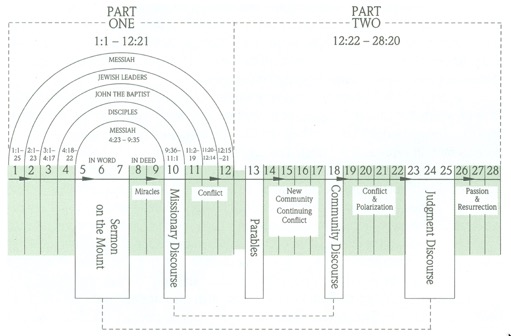
This coming Sunday is the 24th Sunday in Ordinary Time, Lectionary Cycle A. The gospel it taken from Mt 18:21-35. There is a large jump in our Sunday gospels as we move from the 22nd Sunday in Ordinary Time –Year A (Mt 16:21-27) to the 23rd and 24th Sunday – in fact, the entirety of Matthew 17 is passed over. As shown in Boring’s diagram [“The Gospel of Matthew” 117], we are in a part of Matthew’s gospel in which the focus is community.

Mt Gospel structure2

Mt 16:13-28 The Confession for Jesus (Jesus as Son of God, Peter as Rock, first passion prediction, Peter as a stumbling stone, the cost and promise of discipleship)

Mt 17:1-27 Moving to Jerusalem (Transfiguration, lessons of faith, second passion prediction, and payment of the Temple tax)

Mt 18:1-35 Life in the Community

vv.1-14 (greatest in the kingdom, temptations to sin, parable of the lost sheep)

  1. 15-20 (if a brother sins against you)
  2. 21-35 (forgiveness and the parable of the unforgiving servant)

From the beginning of Matthew 16 and continuing through to entry into Jerusalem (Mt 21), Jesus is preparing and readying his disciples for life in a community of faith once Jesus is no longer with them. The way forward is founded on the revelation about Jesus (cf. Mt 16:15-16 and Mt 17:5) and all the implications that it has for life in the nascent community of faith. Chief among the implications of the life, death, and resurrection of Jesus is the charge for the community to understand the depth and breadth of forgiveness.


Image credit: Raphael, Handing-over the Keys, 1515, Victoria and Albert Museum, London | Public Domain

The Bulwark

We should certainly hear an echo of the Lord’s Prayer in today’s gospel: ““Lord, if my brother sins against me, how often must I forgive him? As many as seven times?” Jesus answered, “I say to you, not seven times but seventy-seven times.” The mention of “forgiveness” should echo Jesus’ teaching about prayer. In the Lord’s prayer we are told to forgive others as we are forgiven: “If you forgive others their transgressions, your heavenly Father will forgive you. But if you do not forgive others, neither will your Father forgive your transgressions.” (Mt 6:14-15)

Continue reading →

A Barrier to Evil

We should certainly hear an echo of the Lord’s Prayer in today’s gospel: ““Lord, if my brother sins against me, how often must I forgive him? As many as seven times?” Jesus answered, “I say to you, not seven times but seventy-seven times.” The mention of “forgiveness” should echo Jesus’ teaching about prayer. In the Lord’s prayer we are told to forgive others as we are forgiven: “If you forgive others their transgressions, your heavenly Father will forgive you. But if you do not forgive others, neither will your Father forgive your transgressions.” (Mt 6:14-15)

OK, the principle is clear, but the practical outworking still needs to be clarified, since its open-ended demand may easily be exploited by a manipulative person; surely there must be a limit? If Mishna B. Yoma represents rabbinic teaching, three times was regarded as sufficient. So, Peter’s proposal of up to seven times is probably intended to express a new limit of generosity. Or maybe it is a reference and contrast to sevenfold vengeance in the case of Cain (as in Cain and Abel). When Cain, doomed to wander homeless, worries that “Anyone may kill me at sight” (Gen 4:14), the Lord promises “Not so! the LORD said to him. If anyone kills Cain, Cain shall be avenged seven times.” (Gen 4:15) 

And so Jesus’ reply in our reading is all the more startling: “I say to you, not seven times but seventy-seven times.” (Mt 18:22)

Continue reading →

The Things We Store Away

The Rich Fool of our parable gets a bad rap.  Compared to other parables, there is no wrongdoing, no theft, inflating invoices, skimming off the top, no taking advantage of workers in the vineyard. Maybe he is just preparing for his retirement where he and his family can finally rest and relax, – and sure, eat, drink, and be merry. His goals seem similar to our own concerns with our savings and retirement plans.

Let’s be honest if you or I had a bumper crop like the Rich Fool we would be figuring out ways to store and preserve our good fortune. Maybe not the way in which the Rich Fool does.  Hopefully we would thank God for his harvest, from his fields, via his rains. Hopefully we would not consume and possess things indiscriminately, relentlessly grabbing for all that we can, hoping to insulate ourselves from our insecurities and our fears.  Those are the concerns of this life, but what about eternal life?

Continue reading →