I think it is fair to say that I am a card-carrying, fully committed Bible nerd. If you are a regular reader of friarmusings.com then you have probably realized I write biblical commentaries for fun. I even know Bible dad-jokes! When God created Adam from the clay of the earth, what time of day was it? ….just a little before Eve. [groan…] Anyway… I have been at this for a while and it is only recently that I spent time with the Book of Chronicles. I remember when I first encountered it my reaction was, “This is a repeat of the Book of Kings” … turn the page. My bad. Chronicles is a great book to read during the season of Lent.
Chronicles is one of the last books of the Old Testament to reach final written form. And while it does repeat information found in the Book of Kings, it includes new materials, and all with a purpose in mind. Being written last, it is really an overarching assessment of the chosen people beginning in the age of the Kings of Israel and Judah.. The assessment only has one criteria of judgment: were the people and the kings faithful to God and the Covenant with Him? There are moments of hope and promise in the days of King David, early King Solomon, Hezekiah, and Josiah. But those moments are few in the 400 plus years of the kingdom. There are too many kings like Manasseh willing to follow other gods, money, and political power and corrupt the people and Temple along the way. He even sank so low as to institute child sacrifice.
In today’s first reading we are heard the end of the Chronicles, a final assessment: “In those days, all the princes of Judah, the priests, and the people added infidelity to infidelity, practicing all the abominations of the nations and polluting the LORD‘s temple.” That pretty much sums it up. The Book of Chronicles is a history of sin and choosing something other than God. At the same time, it is a story of God who never gave up on his people. Chronicles is also a catalog of the Lord sending prophets, messengers and forever wooing the people and their kings back to covenant faithfulness and true worship. It’s an all-star list: Isaiah, Elijah, Elisha, Jeremiah, Ezekiel, Hosea, Joel, Micah and more. But, alas… people are capable of such wonder and yet also such folly.
“Early and often did the LORD, the God of their fathers, send his messengers to them, for he had compassion on his people and his dwelling place. But they mocked the messengers of God, despised his warnings, and scoffed at his prophets, until the anger of the LORD against his people was so inflamed that there was no remedy. Their enemies burnt the house of God, tore down the walls of Jerusalem, set all its palaces afire, and destroyed all its precious objects. Those who escaped the sword were carried captive to Babylon.” (2 Chron 36:15-20)
God never gives up on his people. The Lord uses the King of Persia to restore the people to the land, to Jerusalem, and to rebuild the Temple. God desires that all be saved even if we have turned out back on Him. He never gives up. Remember King Manasseh, the worst of the worst? God never gave up on him, and Manasseh repented and was restored to God’s grace.
We could each write our own Book of Chronicles. In our Lenten reflections, we could write our own stories of “I can’t believe I did that,” “I can’t believe I said that,” “If only I could make that choice again.” We might capture a moment of doubt bordering on despair – when we thought: “I don’t deserve God’s love or mercy.” Deserve? – as in ‘I haven’t earned it’?” Who earns love? Who deserves love? No one, that is the great thing about love. It comes as a pure and simple gift. It comes when we aren’t loving. It comes when we are ready or not.
The Book of Chronicles is a story of the infinite richness of God’s mercy which always seems to have the final word – not an indictment of sin, but the last word that comes wrapped in the gift of mercy and love. St Paul, in the second reading understands that as he writes: “God, who is rich in mercy, because of the great love he had for us, even when we were dead in our transgressions, brought us to life with Christ”
How blessed are we? In these last days, God sent his only Son: “For God so loved the world that he gave his only Son, so that everyone who believes in him might not perish but might have eternal life.”
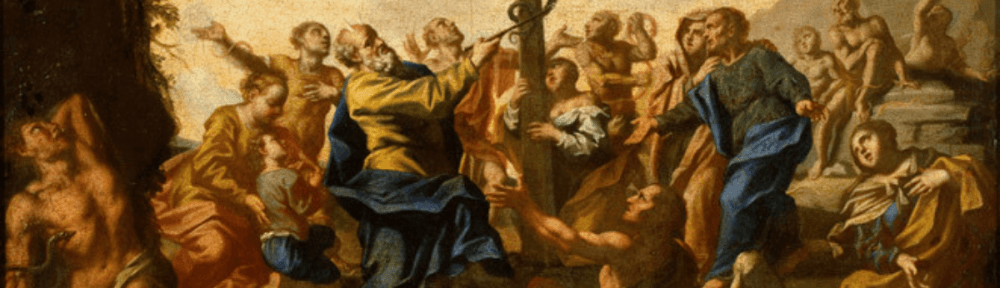
God so loved the world, he held nothing back but is all-in, whatever it takes to get us to receive His mercy, to help us write a new ending to our own book of Chronicles. To capture the moment when we raise our eyes to Jesus lifted up high on the cross. To look in humility at Crucified Love, arms open wide – and allow ourselves to be loved, to receive mercy, to be forgiven. “For by grace you have been saved through faith, and this is not from you; it is the gift of God.”
Lent is a time of remembering and reconciliation. Remembering that no human evil is beyond the pale of God’s love even if, like the Israelites, we have added infidelity to infidelity. Remembering even then God so loved them and brought them home.
Home to be reconciled in the Sacrament of Confession. Home, where the light is on and the home fires of mercy and love blaze. Let the ending of your chronicles be a renewal in the warmth of God’s love and mercy.
Image credit: Moses and the Bronze Serpent by Francesco Campora, 18th Century | Museu Nacional de Belas Artes, Rio de Janeiro | PD-US
Discover more from friarmusings
Subscribe to get the latest posts sent to your email.
 friarmusings