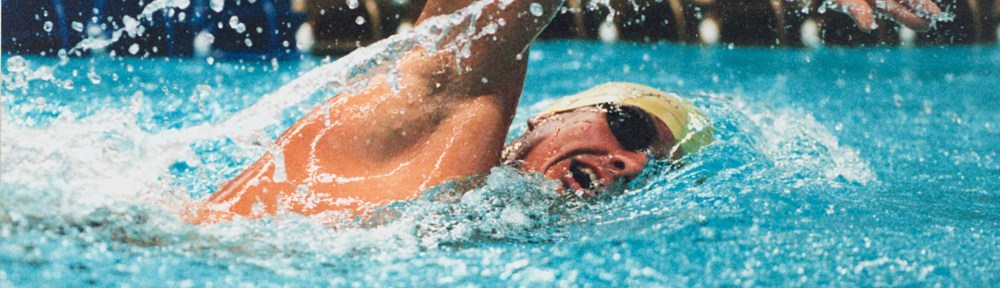
I swam competitively most of my life: high school, college, and then later in life with the U.S. Masters swim program. I wasn’t gifted with fast-twitch muscles and so have never had a very good sprint. The middle distance events were my best events. My quip was that I was given a distance stroke with a sprinter’s endurance. A couple of years back I competed in a meet and for some reason signed up for the 1500-meter freestyle – a little outside my usual range, but certainly do-able.
Turns out I was seeded in the same heat with a man, about my age, who was the reigning National Champion in the event (for our age group). I thought, “OK, I will just pace myself off of him and we’ll see how it goes.” So, the race starts and at the 100-meter mark I am right on his hip. But I noticed at the 200 meter point I had actually pulled even. I began wondering if I was just having one of those great days. I felt smooth, relaxed, and it seemed to be coming together. By 300 meters I couldn’t “find” him; but that sometimes happens. By now I am having all kinds of delusions of grandeur about this particular race. Maybe it was just my day.
Well, it was my day until about the 800-meter point. In swimming we have various descriptions of what was happening at that point: “the elephant”, “piano man” – code for that point when you just passed your limit. And then the tank was empty. What was once smooth and relaxed became suffering and “when will this be over.” The remainder of the race became a series of looking for the next wall, reaching it, doing a flip turn, and then looking for the next wall. Nothing more; nothing less. Eventually it was over. What happened to the other fellow? He had a horrible day and very uncharacteristically got out of the pool at the 200-meter mark.
I think about that race when I read this account in the gospel. There we were: two trained, experienced swimmers, ready to race, and yet on that day, one swimmer walked away from the race – the other finished the race. The finish wasn’t pretty, there were doubts along the way, and the race took its toll. But what was the difference between the two on that day? It is the same question we should ask about the disciples in today’s gospel.
Some disciples turned away. How could they? They had come so far. Why couldn’t they be like Peter? He hangs tough. Well… he hangs tough for now. Later on, he will deny Jesus, abandon him to the Cross when things became hard, when everything was too difficult to accept. Maybe we need to reconsider those who walked away in doubt. Everyone’s breaking point is different.
I mean, who here has not at one time or another wondered whether your belief is out of gas? A morning starts and again we are reminded that a spouse or parent is no longer part of our daily life. A day spent looking for needed work and wages. Another “no thank you” letter. An afternoon filled with a tumble of unending frustration, anger, helplessness, and dread of what will go wrong next. An evening and night spent at the bedside of a child wondering why God would let this happen. A horrific report about one thing or another – and you know other reports are coming. When is enough, enough – and you just want to walk away and call it quits?
Those moments when we are tempted to conclude that the promises we trusted were empty and the faith we nourished seems so…so absent. Our prayer life becomes erratic, our life becomes a little less compassionate, we are more reluctant to help others, and, in the end, we are not in church, we do not pray, and we are like the disciples in today’s reading. We have walked away.
It is a tough gospel to think about faithful disciples who walked away. Yet….at the same time, the gospel is also one of belief, of courage, and of faith. After many disciples drew back and no longer followed him, “Jesus said to the twelve, “Do you also want to leave?”’ Simon Peter answered him, “Master, to whom shall we go? You have the words of eternal life. We have come to believe and are convinced that you are the Holy One of God.’”
What makes Peter and the others find the belief, the courage and faith to stay? What makes them different from all those who gave up on Jesus and went away? Peter and others were also plagued by doubt and fear, they suffered at times from an over abundance of pride and a lack of courage, and they, too, eventually deserted Jesus, and at the very time he needed them the most. So if they aren’t smarter, or more faithful, or more courageous, or, in short, any better than the rest of Jesus’ disciples – then or now – then what it is that sets them apart.
What enabled me to keep swimming in a race in which I suffered and struggled? I was not a better distance swimmer, but I knew where to look. I just looked for the next wall.
What enabled Peter to keep going? I wonder if it is as simple as Peter knew where to look. And I would suggest this is perhaps the capstone message about the importance of the Eucharist in our lives. It is the one place for us, in our darkness moments, to look and know for sure that we will find Christ there for us.
Each of us knows there are times when families are not safe havens from the storms, when all the things we usually count on come up empty and we no longer know where to turn. We reach a tipping point. Will we walk away or hang in? What kind of disciple will we be on that day? Be the kind that will look for the next wall. Look to the precious Body and Blood of Christ.
Amen.
Discover more from friarmusings
Subscribe to get the latest posts sent to your email.
 friarmusings