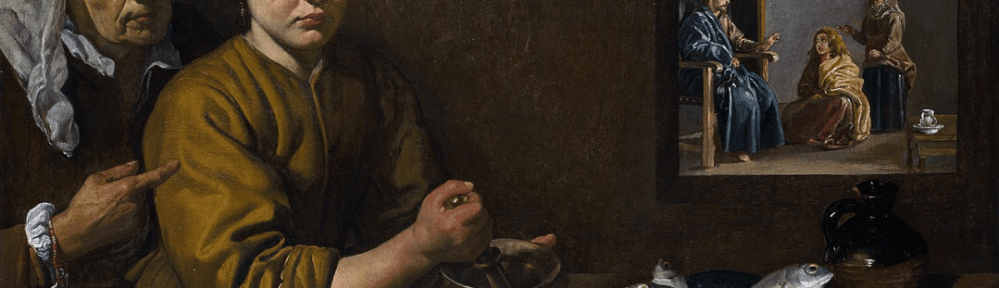
There is a contrast between our first reading and the gospel. In the first reading (Genesis 18:1–15) Abraham is praised for his generous hospitality to the three visitors who are often interpreted as angels or a theophany of God. In the gospel (Luke 10:38–42), Martha is busy serving Jesus but is gently corrected for being “anxious and worried” rather than sitting and listening to the Lord like Mary. It might raise the question: why is Abraham’s activity in service to the guests rewarded while Martha’s service to the guests is gently admonished? Let’s explore that question.
Abraham’s hospitality is framed as a model of ancient Near Eastern virtue. He rushes to provide water, organize bread, meat, and rest — crucial life-saving gestures in a desert setting. That is what Abraham offers. Did the visitors offer anything other than their presence? Yes, in the end they offer the divine promise of a son in response to that hospitality. The reading underscores the virtue of hospitality as a means to encounter God – and in the encounter to enter more deeply into the covenant promises and so step on the path to completeness.
Martha’s hospitality, by contrast, occurs in the presence of Jesus, who is not in need of food or comfort but is instead He is offering divine teaching. The issue is not that she serves, but that she is “distracted” and anxious, missing the moment of communion with Christ. In fact the verb used, perispato, means “dragged around” or “drawn away.” It was not her cooking, cleaning, or serving that bothers Jesus. Jesus names the problem: “Martha, Martha, you are anxious and worried about many things.” She is in such a state that she is being rendered asunder, being torn apart, pulled in all directions – and feels alone, unappreciated, and ignored. She is so agitated that she could not enjoy Jesus’ company, enjoy his presence, find inspiration in her work, or receive anything he wished to offer her. Instead, all she could do was question his love (“Lord, do you not care?”), fixate on herself (“…my sister has left me left me by myself to do the serving” and triangulate Jesus into place as a solution (“Tell her then to help me.”) This is not a trajectory that puts her on the path to completeness.
We can see the contrast of roles between the two readings. Whereas Abraham and Sarah were serving God as guest, in the Gospel Jesus is serving the hosts. Together both narratives affirm that God is encountered in both action and contemplation, but the “better part” at a given moment depends on recognizing what God is offering in that moment — whether it is promise (Genesis) or presence (Luke).
The Bible offers several other passages where the balance (or tension) between action and contemplation, between service and attentiveness to God, is explored. Like the Abraham-Martha/Mary pairing, these texts affirm that God can be encountered in both realms, but discernment is needed to recognize what God is offering or asking in a particular moment.
In the account of Moses and the Burning Bush (Ex 3:1-12), Moses stops and looks at the burning bush. Only after that moment of still attentiveness does God call to him by name and give his mission. Moses is then sent to free the Israelites. His call begins in contemplation, but leads to service and leadership. We also need moments in our lives when we are still enough to hear God’s call before we know what action to take.
When the young boy Samuel is called to serve the Lord (Samuel 3) he follows Eli’s advice and stills himself, listening for the voice of the Lord. Once he understands the call (“Speak, Lord, your servant is listening“), Samuel then begins to grow into his prophetic role.
When Jesus first calls the disciples (Luke 5:1–11), Peter first listens to Jesus teach from the boat — a passive moment. Only then he is called to “put out into the deep” and later to “follow me.” Discipleship starts with listening to the Word and then moves to mission. This same pattern is played out in the Annunciation to Mary.
What about when a person, already engaged in action, unexpectedly encounters God or receives divine revelation in the midst of that activity, rather than through prior stillness or contemplation? Think of St. Paul on the road to Damascus. On his way to arrest Christians he is arrested by grace and chooses to surrender
God is not limited to being found in silent prayer or quiet places, but can break into human lives during work, service, or even flight. Both service and stillness are ways of responding to God. What matters is discerning what God is offering—and asking—at a particular moment.
We all have points at which our life feels like we are being pulled apart, so much so that remembering to share love, compassion and charity are a struggle, more likely a distant thought. Times we flash react to a rather normal situation with annoyance. Times we are so busy that the ones we are supposed to love and serve become another task on a growing list. There is little time for intimacy with God or with others. It is as though the very person we want to be, the person God calls us to be, is coming apart at the seams. Perispato – life is dragging us around – just like Martha.
In these readings today it is very clear that we are called to action and prayer; we need both. The story is about being whole, not balanced. Allow a little poetic license here, but Christianity is not about balance. It is about doing what needs to be done to become whole, become complete – and doing so with a single-mindedness. Think of Jesus’s most evocative parables; they all point in this same direction. The pearl of great price. The buried treasure in the field. The lost sheep, the lost coin, the lost son. Christianity is not about balance; it’s about extravagance. It’s not knowing what is needed at the moment so that you are on the path to being deeply in love with Jesus – and then pursuing that love with a single-mindedness, knowing that complete love will bring along with it the right balance.
The readings are about choosing not just any part, but the better part – the best part that will make you complete. Choose well.
Image credit: Jesus at the home of Martha and Mary | Diego Velázquez, 1618 | National Gallery, London| PD-US
Discover more from friarmusings
Subscribe to get the latest posts sent to your email.
 friarmusings