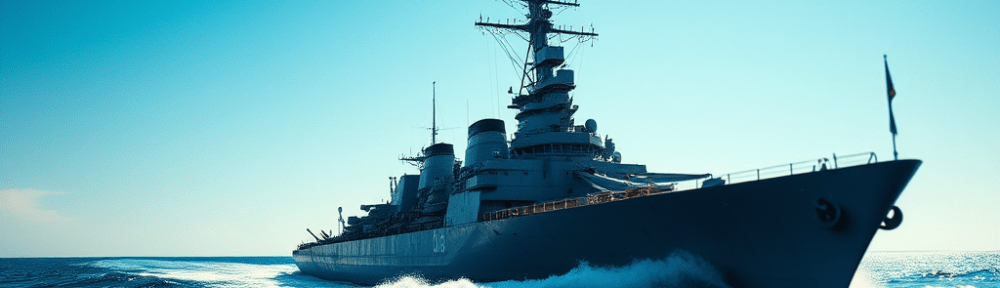
On this day is history the cruiser USS Indianapolis (CA-35) was sunk by a Japanese submarine. Indianapolis had departed Hunters Point Naval Shipyard (San Francisco) on July 16 with the destination of the Naval Base on Tinian Island in the Marianas.
Indianapolis received orders to undertake a top-secret mission: transporting major parts of the atomic bomb that was later dropped in Hiroshima, Japan. The parts included the complete non-nuclear assemblies, several hundred pounds of scientific instruments and tools, and 85 lbs of enriched uranium. The materials were delivered and off-loaded at Tinian on July 26th, Indianapolis left the same day and sailed to Guam where a number of the crew who had completed their tours of duty were relieved by other sailors. Leaving Guam on 28 July, she began sailing unescorted toward Leyte in the Philippines. On July 30th she was attacked by Japanese submarine I-58 who launched two “Long Lance” torpedoes each carrying 1,000 lb high explosive warhead. The Indianapolis sank in 12 minutes.
Emergency radio messages were sent from the cruiser. In the first official statement, the Navy said that distress calls “were keyed by radio operators and possibly were actually transmitted” but that “no evidence has been developed that any distress message from the ship was received by any ship, aircraft or shore station”. After 1995 when WWII records were declassified, it came to light that three stations received the signals but none acted upon the call. One station commander was reported to be inebriated, another had ordered his men not to disturb him, and a third thought it was a Japanese trap. (Source: For the Good of the Navy by Timothy W. Maier – magazine article from Insight on the News, Vol. 16, No. 21 -June 2000)
300 of the 1,195 crewmen aboard went down with the cruiser. With few lifeboats and many without life jackets, the remainder of the crew was set adrift.
The Navy did not know of the ship’s sinking until survivors were spotted in the open ocean three and a half days later. At 10:25 on 2 August, a light bomber in transit. They could only report the sighting. About the same time a PBY-2 Catalina spotted the men adrift while on a routine patrol flight. They immediately dropped a life raft and radio transmitter. After their report, the Navy launched a massive search and rescue effort.
Many of the survivors were injured. All suffered from lack of food and water, exposure to the elements (dehydration compounded by hypothermia at night, as well as severe skin inflammation and peeling due to continued exposure to saltwater and bunker oil. There were also wide spread shark attacks (reports of attacks on surviving sailors range from 15-150). It was reported that the sharks first feed on those who had already died, only later attacking living survivors.
Only 316 of the 890 men set adrift after the sinking survived.
The archives of 6-News Richmond VA carries an interview with one of the survivors.
Image credit: WordPress AI
Discover more from friarmusings
Subscribe to get the latest posts sent to your email.
 friarmusings