
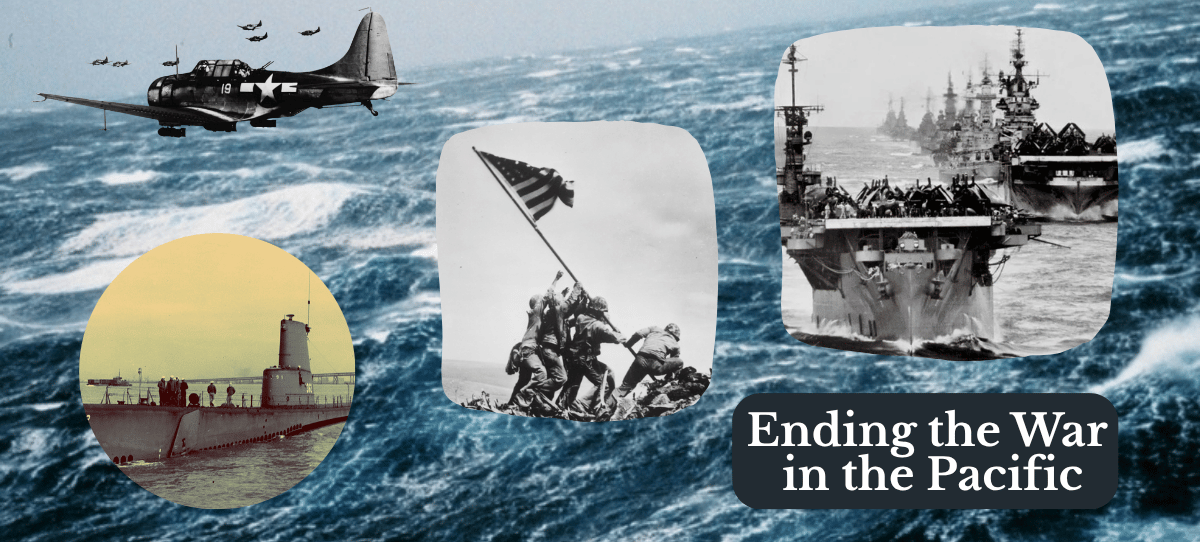
By early 1942, Japan had established a vast defensive perimeter across the western Pacific, including the Philippines, Dutch East Indies, and parts of New Guinea. After seizing Tulagi in the southern Solomon Islands in May 1942 the Japanese began construction of an airfield on Guadalcanal an island near the southwest end of the Solomon chain. Completion and operation of this airfield would threaten Allied supply and communication lines between the U.S., Australia, and New Zealand – effectively isolating the Allies from each other and placing Australia at risk of invasion.
The U.S. victory at Midway in June 1942 represented the first time Japanese offensive power had been thwarted and opened the possibility for limited Allied offensives. Admiral Ernest King, Commander in Chief of the US Fleet, proposed an offensive in the Solomon Islands and New Guinea. The Joint Chiefs of Staff approved the plan in July 1942. The first phase was the seizure of Guadalcanal, Tulagi, and surrounding islands to deny Japan their strategic airfield. The Guadalcanal operation was codenamed Operation Watchtower. Military historians have suggested that it should have been called Operation Shoestring. Initially planned as a limited operation by the U.S. Marines to preempt the Japanese airfield on Guadalcanal, it evolved into a protracted campaign that lasted from August 1942 to February 1943.
The initial amphibious landings on Guadalcanal were virtually unopposed and the Marines quickly captured the airfield, naming it Henderson Field; defensive perimeters were established. It was the beginning of a long, protracted campaign to hold the airfield.
The Japanese realized the importance of Guadalcanal and subjected the 1st Marine Division (the “Old Breed”) to routine daytime aerial bombardment and nighttime naval shore bombardment, all the while adding troops and supplies to the Japanese forces. The Japanese were not the only “enemy.” Marines suffered from hunger, dysentery, and all manner of tropical diseases. While enduring these maladies, fought battles that to this day resound in the collective memory of the U.S. Marine Corps: Alligator Creek, Bloody (Edison’s) Ridge and the Battle for Henderson Field. It was in the latter battle that Sgt. John Basilone was cited for the Medal of Honor. His citation reads:
For extraordinary heroism and conspicuous gallantry in action against enemy Japanese forces, above and beyond the call of duty, while serving with the 1st Battalion, 7th Marines, 1st Marine Division in the Lunga Area, Guadalcanal, Solomon Islands, on 24 and 25 October 1942. While the enemy was hammering at the Marines’ defensive positions, Sgt. BASILONE, in charge of 2 sections of heavy machine guns, fought valiantly to check the savage and determined assault. In a fierce frontal attack with the Japanese blasting his guns with grenades and mortar fire, one of Sgt. BASILONE’S sections, with its gun crews, was put out of action, leaving only 2 men able to carry on. Moving an extra gun into position, he placed it in action, then, under continual fire, repaired another and personally manned it, gallantly holding his line until replacements arrived. A little later, with ammunition critically low and the supply lines cut off, Sgt. BASILONE, at great risk of his life and in the face of continued enemy attack, battled his way through hostile lines with urgently needed shells for his gunners, thereby contributing in large measure to the virtual annihilation of a Japanese regiment. His great personal valor and courageous initiative were in keeping with the highest traditions of the U.S. Naval Service.
The citation leaves out much of the heroic detail of the action. The 1917 Browning Machine Gun was not a light weapon. It required two men to move the weapon: one to carry the base, the other to carry the weapon – which it had been recently fired, required protective gloves to pick up. When moving to a new position, Basilone carried both, injuring his hands. Along the way, he continued to fire the weapon at the approaching enemy.

After Guadalcanal Basilone was sent home as a national hero and to assist in the War Bond drive. He consistently requested to be sent back into action, a request that was eventually granted. Basilone died in the Battle of Iwo Jima in an action for which he was posthumously awarded the Marine Corps’ second-highest decoration for valor, the Navy Cross:
For extraordinary heroism while serving as a Leader of a Machine-Gun Section, Company C, 1st Battalion, 27th Marines, 5th Marine Division, in action against enemy Japanese forces on Iwo Jima in the Volcano Islands, 19 February 1945. Shrewdly gauging the tactical situation shortly after landing when his company’s advance was held up by the concentrated fire of a heavily fortified Japanese blockhouse, Gunnery Sergeant BASILONE boldly defied the smashing bombardment of heavy caliber fire to work his way around the flank and up to a position directly on top of the blockhouse and then, attacking with grenades and demolitions, single handedly destroyed the entire hostile strong point and its defending garrison. Consistently daring and aggressive as he fought his way over the battle-torn beach and up the sloping, gun-studded terraces toward Airfield Number 1, he repeatedly exposed himself to the blasting fury of exploding shells and later in the day coolly proceeded to the aid of a friendly tank which had been trapped in an enemy mine field under intense mortar and artillery barrages, skillfully guiding the heavy vehicle over the hazardous terrain to safety, despite the overwhelming volume of hostile fire. In the forefront of the assault at all times, he pushed forward with dauntless courage and iron determination until, moving upon the edge of the airfield, he fell, instantly killed by a bursting mortar shell. Stouthearted and indomitable, Gunnery Sergeant BASILONE, by his intrepid initiative, outstanding skill, and valiant spirit of self-sacrifice in the face of the fanatic opposition, contributed materially to the advance of his company during the early critical period of the assault, and his unwavering devotion to duty throughout the bitter conflict was an inspiration to his comrades and reflects the highest credit upon Gunnery Sergeant BASILONE and the United States Naval Service. He gallantly gave his life in the service of his country.
This is but one of the heroes of his generation.
Discover more from friarmusings
Subscribe to get the latest posts sent to your email.
 friarmusings