
Since the beginning of this series on August 6th we have looked at a variety of topics, issues, and experiences that are being poured into the cauldron of war. The series was never intended to be a review of all the battles, campaign tactics, or evolving strategies – there are far better resources available in print, online videos and more – presented by far more knowledgeable people, scholars and historians.
From the beginning, this series was never intended to describe the horror of combat, the mounting death toll, and conclude with “the atomic bomb was the lesser of all the evils about to be faced.” But the series is intended to explore harsh realities about war that frame the landscape, not just of tactical options, but of the moral landscape that will face the war fighters – the ones who will bring home the memories of things that can not be unseen. This is even more important when one understands the long-term strategy of the two sides.
On one side was Japan, a nation that had never been invaded and when the Mongols under Kublai Khan attempted just such in the late 13th century, a typhoon (a divine wind, kamikaze) destroyed the invasion fleet. On the other side were the Allies who 20 years after the armistice of World War I were facing another war from what they thought was a defeated enemy. This time the enemy would know they were defeated; surrender would be unconditional.
From the beginning Japan wanted to inflict a cost that would weaken Allied resolve so that they would negotiate an armistice and leave in Japan’s control the war gains that stretched from Burma to the Central Pacific. They were assured of divine protection from their Emperor and the divine winds. The Allies wanted unconditional surrender to win this war and to prevent the next – and demilitarized an entire nation to that long term end.
From the spring to the autumn of 1944 the Allies steadily advanced in the Southwest and Central Pacific winning land, sea and air battles. The allied forces won battles but casualty grew. Japanese garrisons were ravaged by war, disease and starvation. Less than 3% of garrisons survived to surrender. At home the Japanese people were told of valiant defenses and of tremendous losses suffered by the allies. By early autumn air field construction was being massively undertaken on Saipan and Tinian. Plans were being executed for the invasion to retake the Philippines. The US Fleet was ranging far and wide across the Central Pacific, reducing the Japanese Army (IJA) and Navy (IJN) air units to severely reduced combat effectiveness and status. At the same time the US Submarine Service was choking off the supply of critical resources for Japanese war production (oil, iron, magnesium, rubber, bauxite, etc.) as well as the importation of food.
The Japanese strategy continued: allowing unopposed landings so that the allies would be drawn inland into a prepared in-depth defense with overlapping “kill zones.” It was a strategy intended to maximize allied death. Each Japanese soldier was admonished to kill ten allied soldiers before his own inevitable death. Which was inevitable but would give glory to the Emperor and the homeland.
That was the allied experience at Biak, Saipan, and Peleliu that would be repeated at Leyte, Iwo Jima and Okinawa.

1944 closed with the Battle of Leyte (October 1944 until December 1944), a campaign where combined power of the Allies was focused on a single mission: the liberation of the Philippines beginning with the island of Leyte. The naval and amphibious forces of Admiral Nimitz’s Central Pacific Command was joined to that of General MacArthur’s Southwest Pacific Command. The naval battles that began Oct 24th (Sibuyan Sea, Surigao Strait, Cape Engaño, and Samar) are legend in the annals of Pacific War. As much as the Navy veteran in me wants to tell you the whole story, the results are what is important to the narrative of this series.
Leyte Gulf was catastrophic for the Imperial Japanese Navy (IJN). By the time the fighting ended on Oct 26th, Japan had lost most of its remaining large warships and 10,500-12,000 sailors. Japanese losses included 4 aircraft carriers (including Zuikaku the last of the carriers that attacked Pearl Harbor to be sunk), 3 battleships, 10+ heavy cruisers, 4 light cruisers, 11 destroyers, and numerous other ships damaged. The “back” of the Combined Fleet was broken. The fleet largely remained in port for the remainder of the war.
Land warfare was not decided in just three days. While planning estimates vary, General MacArthur expected the campaign to take “several weeks.” The reality on the ground turned the Leyte campaign into a three month slug fest. As often noted: all battle plans evaporate upon first contact with the enemy. This was true on Leyte. The Japanese were able to reinforce and resupply Leyte from the neighboring island of Luzon taking advantage of three typhoons that occurred during the campaign. The weather also complicated and delayed combat engineers establishing an Army Air Force (AAF) base on Leyte – thus requiring the US aircraft carriers to remain nearby to provide support – but then they were hampered by the same foul weather.
The army forces were able to land without significant resistance but then faced the in-depth defenses established in the hills, ridges, and mountainous regions of Leyte’s interior. Weather turned the roads and paths to rivers of mud making resupply problematic. Weather added to the misery of the foot soldiers and enhanced the incidence of tropical diseases.
The Battle(s) of Leyte again confirmed the use of the basic land warfare strategy in use since the invasions of Biak and Peliliu. It was a lethal strategy of maximizing allied casualties even at the loss of the entire garrison.
The series will shift focus for a few posts. So far I hope that the posts have made clear the strategic and tactical approach to the prosecution of the War in the Pacific. In short the process has been to slowly strangle imports to the home island so as to disrupt the war production capabilities, mount sequential campaigns from the Southwest and Central Pacific areas to drive back Japanese occupation, establish air bases for the B-29 bombers to begin a bombing campaign of the home islands, and to destroy the naval capability of IJN’s Combined Fleet.
But what is the reaction within the leadership of Japan – Emperor Hirohito, the Supreme War Council, the Cabinet, as well as civil agencies? The experience of 1944 on the battlefields of air, land, and sea have made clear that surrender is not an option. The military was operating on a moral code that was “foreign” to the western mindset that was rooted in a fanatical loyalty to the kokutai of the nation embodied in the person of the divine Emperor, 124th successor of the sun goddess Amaterasu-Ōmikami. Hirohito was the arahitogami (“a god who appears in human form”). His divinity was used by military and political leaders to demand absolute loyalty and sacrifice from soldiers and civilians. The concept of “dying for the emperor” (e.g., gyokusai, “shattering like a jewel”) was rooted in this ideology.
This all raises the question of what does surrender mean and what might it look like when the fundamental “visions” were so different in values. An understanding of the war governance of Japan is critical to understanding the events of 1945. To that end, the next posts will “look behind the curtain” of Japanese leadership and decision making.
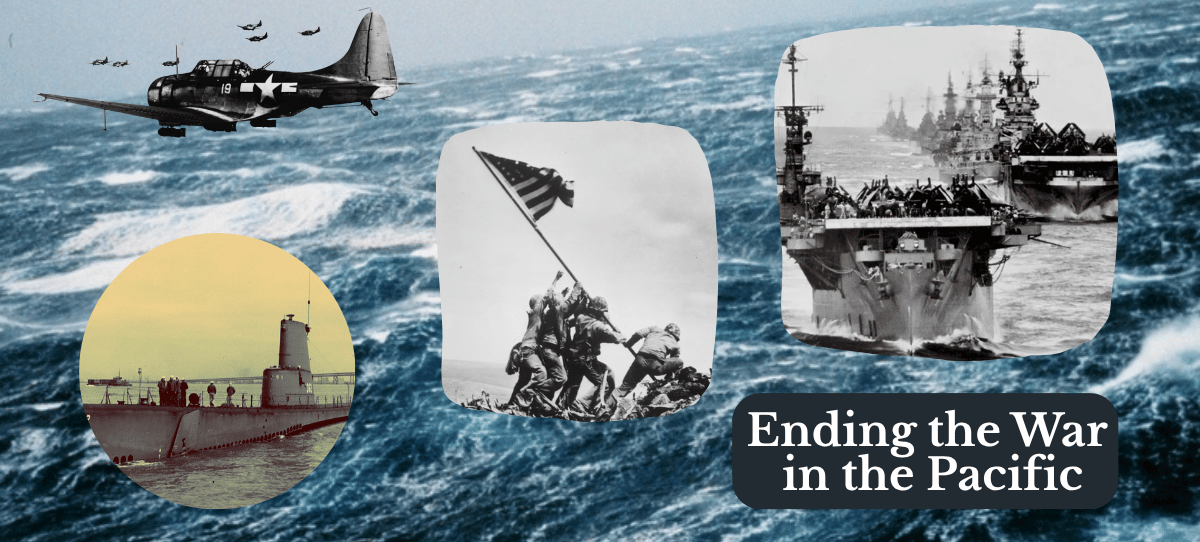
Image credit: various photographs from Naval Aviation Museum, National World War II Museum, and US Navy Archives.
Discover more from friarmusings
Subscribe to get the latest posts sent to your email.
 friarmusings
Another great muse!