We know from St. Paul’s First Letter to Timothy that God desires that all be saved (1 Tim 2:4). It is Paul’s way of telling that the call to salvation is offered to everyone; it echoes the message of today’s first reading from the Prophet Isaiah. We already know that is God’s desire, and yet we sometimes have the same question asked in the Gospel: “Lord, will only a few people be saved?” Jesus’ response does nothing to comfort the questioner: “Strive to enter through the narrow gate, for many, I tell you, will attempt to enter but will not be strong enough.”
Scripture doesn’t tell us what is in the background of the one who asked the question. But what about us? Why are we asking? Maybe we have the same worries as they did more than 2,000 years ago. Perhaps we are worried about family members and friends gone astray. Folks who are no longer active in their faith; folks holding views on issues such as birth control, divorce and remarriage and others at the intersection of the Church and the modern world. People who have works of mercy but are without faith, will they be saved?
We may not want to admit it, but maybe the question is whether only a few people “like us” will be saved. We, the minority who still come to church. We all come here every Sunday – well most Sundays – OK, OK we get here when we can.
We think of ourselves as “good Catholics.” We receive communion, listen to the Word of God, listen to the homily. OK, OK, …mostly listen to the homily.
We volunteer. We try to be good. We pray. We go to confession. We are certainly “striving.” But is it enough?” Lingering at the root of the question is we sometimes wonder if we believe enough, do enough and are enough. It is the shadow fear, lurking in the corner of our thoughts, that we will get to the gate, knock and hear “I do not know where you are from.”
What we want to ask is “will I be saved?” Be more specific about what has to be done. Let us know we are on the right track and doing the right things. We’d love to have the “You are saved checklist” Why can’t we just accept Jesus as Lord and Savior, make an altar call and then rest assured that once saved, always saved. Short answer, the Bible doesn’t say that. We are with St. Paul working out our salvation by striving and coming to terms with the choices in the narrow and wide doors of life.
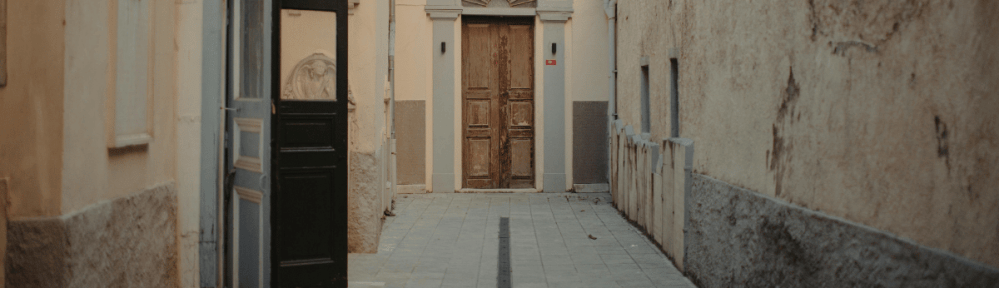
Makes you wonder about the difference. I mean if God desires that all be saved and if everyone responds in a righteous manner, then you’re gonna’ need a wide gate to let everyone in. The gates aren’t just the pearly gates of Heaven. The wide and narrow gates are here in the ordinary and every day.
Maybe it’s like this. The “wide gate” lets you come to Mass or prayer – kinda’ slipping in with the crowd, anonymous, no one asking you questions about who you are, why you’re here and what you hope for. You attend Mass – fully actively participating – or not. You receive the Eucharist and whisper your “Amen.” You leave after Mass and try to live good lives. We are good people, right? We keep the commandments..mostly. This life on broad avenues with wide gates. How will this story end as we arrive at the eternal banquet and knock on the door crying out “Lord open the door… we ate and drank in your company.” No doubt we expect the gate to open wide for us. Comes the reply from the other side of the locked door be “I do not know where you are from…” What happened? We were good and faithful Catholics, weren’t we? “What more does God want?”
“Lord, will only a few people be saved?”
But what if the Church had one small door manned day and night by a porter. What if you had to knock to enter and after knocking the porter began to ask you, “How was your week? How did you serve the Lord in love? How did you love the people that God loves?” – or other similar questions. What if you had to give an account of your week as you entered? There would be no anonymity; there would only be your thoughts, words, and deeds – a chance for you to examine your own heart for your response to love’s demands. It would be a chance to see how love has changed us, challenged us, called us ever onward to be whole, to be complete, to love even more fully. In the examination we ask ourselves, “what does God want of me?” and realizing He wants it all –your whole soul, mind, and body turned to God.
I think this is what is meant by “striving”? I think it also includes working past our own doubts. I am not strong enough, not virtuous enough; I am not worthy. In our examination of the week at the porter’s gate we can realize we are flawed, incomplete – and yet the porter opens the gate and tells us we are loved – flaws and all.
To strive via the narrow gate is to be humble enough to engage a review of the hours of our day, our week, the passing, fleeting moments of our lives. The wide gate is the generic confession: “I lied.” The narrow gate is “I lied to this person about this thing because I was hoping to get this or avoid that.”
To strive via the narrow gate is to be humble enough to approach that person and ask for reconciliation. And when you get there you again choose your gate – the wide gate of “I’m sorry” (that’s about you and you alone – what about the other person?). Or the narrow gate of “please forgive me” and then be willing to wait in the moment of silence before the reply – an answer which might be “I forgive you” or might be “No, I’m not ready to forgive you.”
There are many more examples of the wide and narrow gates we face in each and every day of our journey to God. Moments when we choose, willing to be accountable, humble, strong enough to enter the narrow gates of what Love asks of us.
“I come to gather nations of every language…brothers and sisters from all the nations.” People who strive to live the common language of love – in their thoughts, in their deeds, and in their words. Flawed people who miss the mark, sometimes get it wrong, but are always willing to attempt the narrow gate. People who are saved in love, for love and because of love, by Love itself.
This is the people God calls. These are the people who will be saved. Those who knock on heaven’s door, to whom God replies – “I know you.”
Image credit: Pexels | Farouk Tokluoglu | CC-BY
Discover more from friarmusings
Subscribe to get the latest posts sent to your email.
 friarmusings