
As noted in the previous post, “War in the Pacific to this Point”, the series has focused on the strategic plans and tactical experience that has shaped the war on land and sea, and in the air. 1944 ended with the Philippine island of Leyte under Allied control. An invasion of Luzon was next with the hope that Japan would declare Manila an “open city” as MacAruthur had done in 1942.
After Luzon, the “road to Tokyo” was clear: Iwo Jima, Okinawa, and then (most likely) the southern Japanese home island of Kyushu.
This is a good point in the series to look at Japan and consider its governance, national identity, and their plans to defend the home islands. From the Allied perspective it is clear that the Imperial Japanese Army has effective control of future war plans and actions, but as allied intelligence operations reveal (via diplomatic code MAGIC) there are some misgivings about the military dominated governance. What remains a point of uncertainty is the role of Emperor Hirohito.
The next several posts will focus on Japanese leadership at the beginning of 1945 as well as some fundamental ideas and principles that were intrinsic to Japanese national self identity among the leadership. Were they ideas and principles that were specific to the ruling elite? To what degree were they shared by and within the military, especially the Imperial Army? The same questions can be asked of the ordinary citizen whose information about the war was limited to information provided by the government which continued to broadcast stories of glorious victories, heroic losses, and righteous nature of this war endeavor. It is important to remember that the nation of Japan has been on a war footing since 1937 and the Sino-Japanese War.
The Allies had privileged access to most diplomatic and military traffic via its radio intelligence efforts via MAGIC and ULTRA codebreaking. Militarily, ULTRA gave us the ability to see strategic decisions being played out, but not the ability to see the decision taking shape within the ruling elites. MAGIC allowed us to listen in to the conversation within diplomatic channels. What became clear is that the diplomatic arm of Japan had a cadre of posted diplomats that were rather free in initiating “feelers” that were not authorized by the Foreign Minister – sometimes different embassy staff serving in the same foreign embassy giving different and somewhat contradictory indications. Yet, we did not have access to the inner discussions among the key decision makers.
Yet the massive amount of radio intelligence allowed, coupled with our pre-war knowledge of many key figures, allowed us to surmise how the puzzle palace was operating.
During the post-war occupation of Japan, interviews with leadership and aids, war documents, testimonies, and review of massive amounts of meeting minutes, notes, staff reports, and the usual output of bureaucracies confirmed what had been surmised as 1944 turned into the new year. What is also important is to remember a point I made in the very first post of the series. Almost none of this was available to the historians that wrote in the 1960s creating a narrative that became frozen in amber for a quarter of a century until declassification of these documents began in 1995.
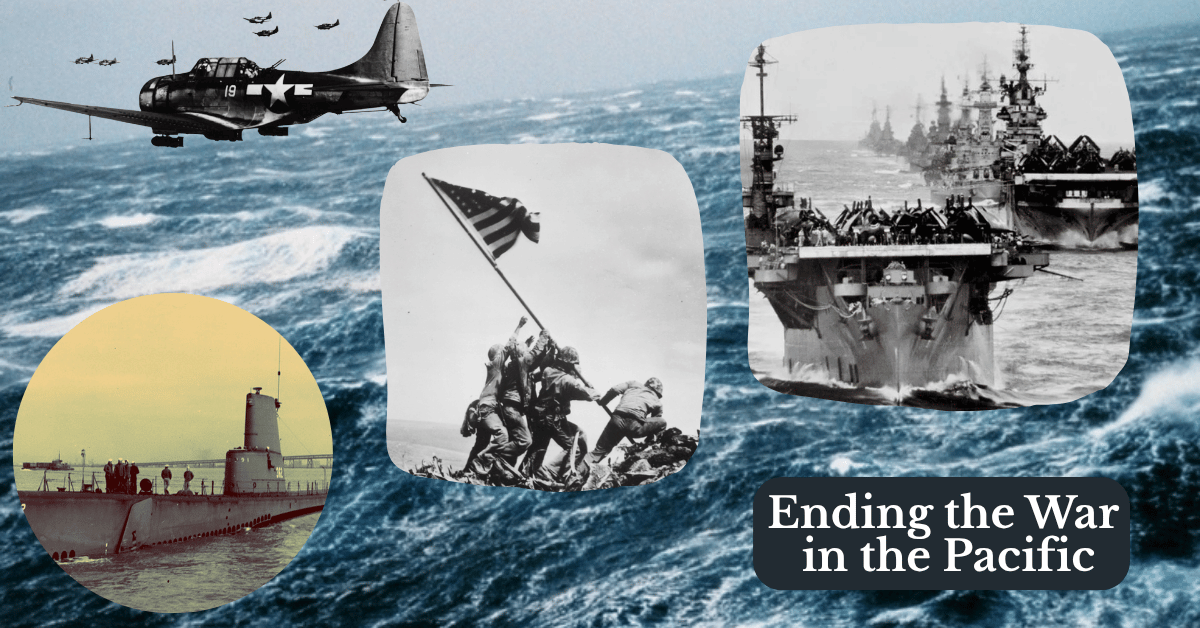
Image credit: various photographs from Naval Aviation Museum, National World War II Museum, and US Navy Archives.
Discover more from friarmusings
Subscribe to get the latest posts sent to your email.
 friarmusings