
In the previous post we reviewed the legacy of battle as 1944 came to a close and noted the lethal legacy of Japanese military choices and led to one loss after another. The once powerful Combined Fleet of the Imperial Navy was but a memory. They had once roamed the western Pacific at will; now they were limited to coastal water and home island ports. The Imperial Army fared no better losing garrison after garrison, sacrificing their most experienced battlefield leaders and soldiers to death. There was no surrender. Japan wanted a “decisive victory” conclusion to conflict. What they started was a war of attrition they had no hope of winning. All the while war draws closer to the home islands. At this point one has to ask about civil and military leadership at the start of 1945.
Here is an overview of leadership dynamics and structures in January 1945 (as it had been through out the war):
- Real decision-making power rested with the military, particularly the Army, as it had since the 1930s
- The civilian government had limited independence, often subordinate to military interests.
- The Emperor held ultimate constitutional authority, but his actual role in daily governance and war policy remained ambiguous. Many war decisions were “approved” by his silence. That strikes us as strange, but that was the operative culture of governance.
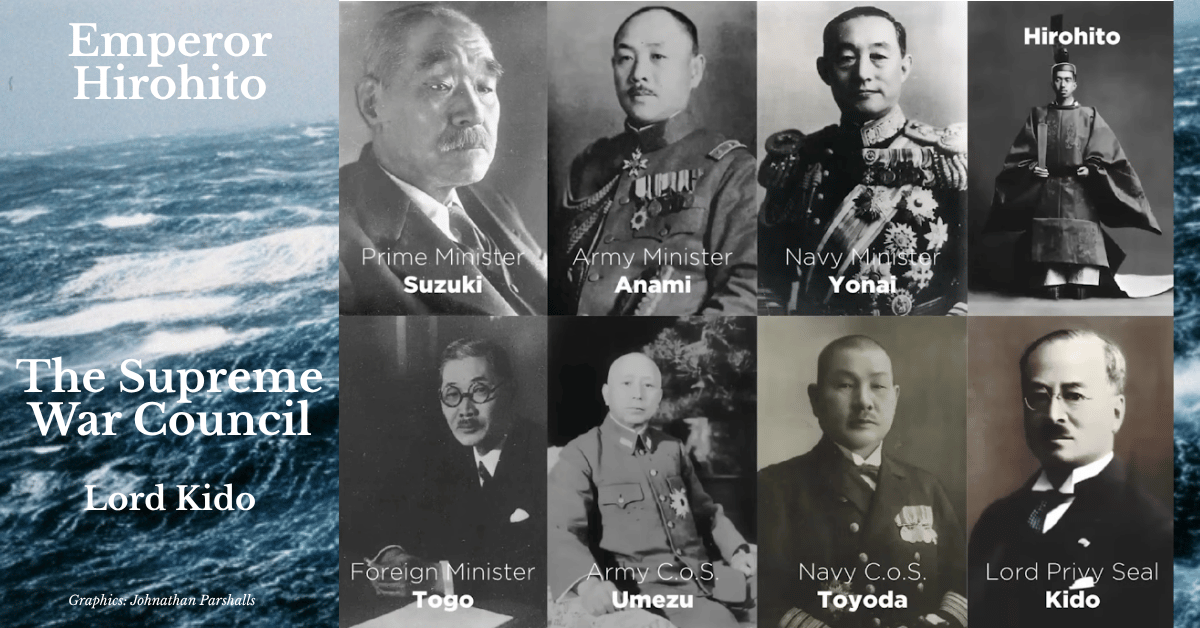
Emperor Hirohito (reigned 1926–1989) was the sovereign and divine head of state. Under the 1889 Meiji Constitution, he held supreme command of the army and navy and could exercise executive power through military ministers. In practice, the war decisions were made by a group known as the Supreme War Council (Go-Sō-Roku, often simply called the “Big Six”). The Emperor received frequent briefings on the progress of the war, however, but there is little or no evidence that he exercised his constitutional authority (i.e., commanded with direct orders) until he accepted the Allied terms for unconditional surrender overcoming a deadlock within the Supreme War Council (“Big Six”) as key members wanted to continue fighting under the Ketsu-Go plan approved by the Emperor in January 1945. More on this in later posts.
The council members were: Prime Minister, Foreign Minister, War Minister, Navy Minister, Army Chief of Staff, and Navy Chief of Staff. Two things are of key importance. Four of the six members were not civilians but were active duty military. In addition the Council did not recommend action to the Emperor by majority. The recommendations were always unanimous. The result was that well reasoned objections might be silenced or held back in order to achieve unanimity. Or, needed decisions languished.
The civil government – headed by the Emperor – consisted of a Prime Minister and Cabinet. The Prime Minister presided over the Cabinet, but the Cabinet was weak and subject to the influence of the military and the Imperial General Headquarters. Cabinet members were: Foreign Affairs, War (Army), Navy, and Home Affairs. The War and Navy Ministers were required by law to be active-duty officers, giving the military veto power over the formation of civilian governments. It is noteworthy that in April 1945 the role of Prime Minister was filled by Admiral Kantarō Suzuki (from April 7 onward).
The Emperor had other advisory councils, none more important than the Privy Council, an advisory body with no executive power. However, Koici Kido, Lord Keeper of the Privy Seal was a close advisor and would play an important role as events unfolded especially in the later months of 1945.
Historians are all in agreement that it was Emperor Hirohito’s issuance of the Saidan (The Sacred Decision) on August 14th (broadcast to the nation on August 15th) that ended the war. Historians do not agree on the mysterious path within the governmental institutions to reach that point. Neither does a 1946 document, prepared by the Emperor, help researchers to an agreed-upon conclusion. The issuance of the Saidan does raise the question, if the Emperor could stop the war then, why did he not stop it sooner? Or all together?
A path to understanding those questions requires an understanding of how the Emperor viewed the situation of the war in early January 1945 and what was the extent of his actual (vs. constitutional) power?
But equally as important was how the civilian and military leadership of the Allies viewed and understood the levers of power within the nation of Japan. Was the Emperor seen as a symbol/figurehead whose role was to give formal acknowledgment of what had already been decided by the Big Six? Did the United States have diplomatic access to the Emperor even if they considered him the decision maker?
What seemed evident from “outside” was that the military, especially the Army, was in charge.
Image credit: various photographs from Naval Aviation Museum, National World War II Museum, and US Navy Archives.
Discover more from friarmusings
Subscribe to get the latest posts sent to your email.
 friarmusings