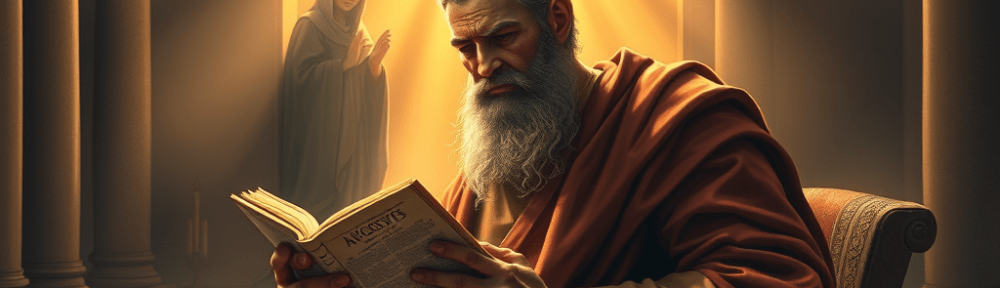
Today is the Feast Day of St. Augustine of Hippo and perhaps it is good for a quick refresher of this person that so influenced Christianity. He was born in Thagaste, in Roman North Africa (present-day Algeria), growing up with his mother, Monica, was a devout Christian, while his father remained a pagan until late in life. His early life did not follow in his mother’s faith tradition, rather he pursued studies in rhetoric and philosophy, eventually teaching in Carthage, Rome, and Milan. His was the pursuit of truth which he sought in various philosophies and religious movements – none of which seemed to address his greater questions. In the interim, as was the tradition of the day, he was – shall we say – morally unsettled. Meanwhile his mother prayed for his conversion.
At the age of 31 he was moved by the preaching of St. Ambrose in Milan and by an experience of divine prompting while reading Scripture. It was in this period that he remarked: “Lord make me chaste, but not just yet” – a good indication of the on-going internal struggle. Soon enough Augustine was baptized and soon returned to North Africa founding a monastic community. He was later ordained a priest, becoming bishop of Hippo (North Africa) four years later, a position he held for 35 years.
Here are five pivotal moments in Augustine’s life and the impact of these moments that resonant even up to today:
His Conversion to Christianity (386 AD) – After years of spiritual searching and moral struggle, Augustine experienced a dramatic conversion in Milan, prompted by the prayers of his mother, St. Monica, the influence of St. Ambrose, and a mysterious child’s voice saying, “Take and read.” Opening Scripture to Romans 13:13–14, he encountered the call to abandon his old life. Augustine’s conversion illustrates the Church’s teaching on grace, free will, and the transformative power of Scripture. His Confessions, the first spiritual autobiography in the West, has inspired countless believers to see God’s hand in their own journey of faith.
His Baptism by St. Ambrose (387 AD) – Following his conversion, Augustine was baptized by Bishop Ambrose at the Easter Vigil, alongside his son Adeodatus. This sacramental moment marked the beginning of his public Christian life. His baptism highlighted the role of the Church and its sacraments in the life of the believer. Augustine’s later theological writings would deeply shape Catholic sacramental theology, particularly on baptism, grace, and original sin.
His Ordination and Consecration as Bishop of Hippo (391–395 AD) – Despite his reluctance, Augustine was ordained a priest and later became bishop of Hippo, a North African port city. He served faithfully for over 30 years, preaching regularly and writing extensively. Augustine’s pastoral ministry produced profound theological works such as On the Trinity, The City of God, and numerous biblical commentaries. His vision of the Church as both a visible institution and a pilgrim people continues to inform Catholic ecclesiology.
His Response to the Donatist Controversy – Augustine confronted the Donatist schism, which claimed that the validity of the sacraments depended on the holiness of the minister. He defended the Church’s unity and the principle that sacraments are effective ex opere operato—by the work being done, not the worthiness of the minister. Augustine’s defense of sacramental efficacy and Church unity remains central to Catholic theology and ecumenism. His insights laid foundations for later teachings at the Council of Trent and Vatican II.
His Writings During the Fall of Rome (410–430 AD) – As the Western Roman Empire crumbled, many blamed Christianity. Augustine responded with The City of God, distinguishing the temporal city from the eternal one. This work provided a Christian philosophy of history that remains vital in navigating the relationship between Church and state. It reassures believers that the Church transcends earthly powers and is ultimately oriented toward the eternal kingdom.
Image credit: WordPress AI
Discover more from friarmusings
Subscribe to get the latest posts sent to your email.
 friarmusings