
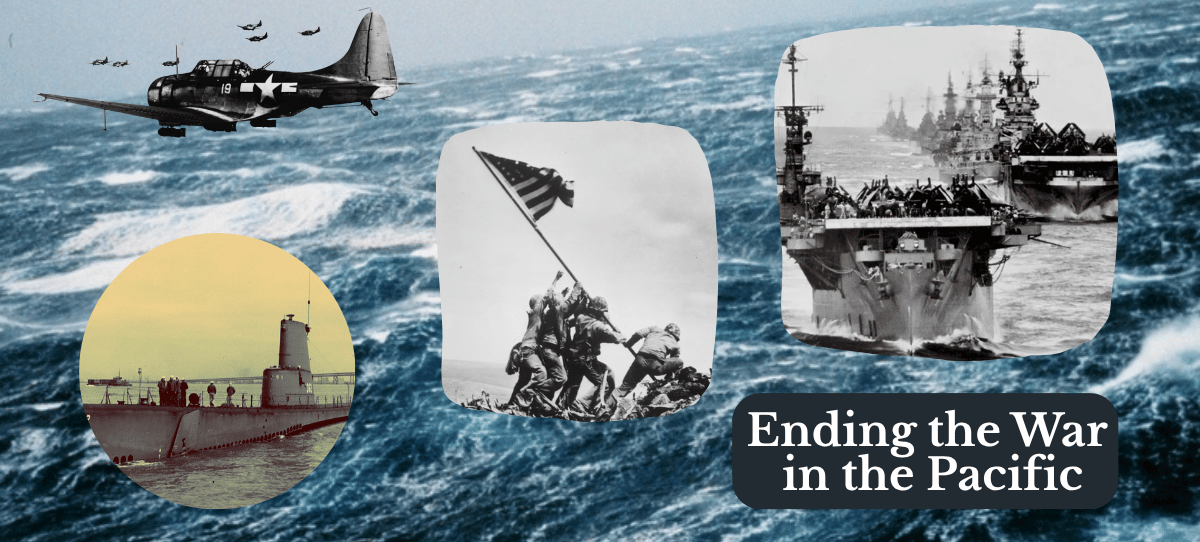
As the war in the Pacific moved into the summer of 1945 combatant casualties continued to mount as discussed in the previous post – so too did civilian deaths. On Saipan the Imperial Japanese Army (IJA) incorporated civilians into combat roles – it was the first but not the last time allied forces would encounter this blurring of military and civilian roles: Guam, Tinian, Iwo Jima, Okinawa and Manilla in the Philippines. By any measure, these were war crimes, but the effect was to implant in allied war planners the seeds of what they might expect if and when it came time to invade the main Japanese home islands of Kyushu and Honshu where the civilian populations were in the tens of millions
Historian Richard Frank (in Downfall: The End of the Imperial Japanese Empire) and John Dower (in War Without Mercy) detail this evolution. Both historians see evidence of a “total-war” mindset that developed as the war in the Pacific progressed when it was clear to Japanese military leadership that they were fighting a war of attrition. Twin allied advances in the Southwest and Central Pacific campaigns were inexorably driving towards the Japanese home islands leading into the brutal logic of late-war defense. By mid-1944, Japanese commanders had recognized that defeating U.S. forces in head-to-head combat was unrealistic. Their goal became to:
- Inflict maximum casualties to slow the allied advance toward Japan.
- Buy time for homeland defense preparations.
- Strengthen Japanese domestic resolve by showing heroic resistance of the Army (IJA)
- Weaken U.S. domestic resolve by increasing the numbers of Allied casualties
During 1944 and 1945, the Japanese government and military conducted an intense propaganda campaign on the home islands to prepare the civilian population for total war and the possibility of a direct invasion by Allied forces. This campaign aimed to instill a mindset of self-sacrifice, resistance to surrender, and fanatical defense of the homeland.
Government-controlled media (newsprint, radio, film) reported fabricated stories of amazing Japanese victories – for example, after the air Battle of Formosa the media reported that virtually the entire U.S. aircraft carrier fleet had been sunk – in fact none has been sunk or damaged. But the news of heroic victory was part of the plan to bolster home island civilian resolve. At the same time, the media reported atrocities committed by Allied troops, particularly Americans. Radio broadcasts included patriotic songs, imperial edicts, and updates on “heroic last stands” by Japanese soldiers in places like Saipan and Iwo Jima. Films and illustrations depicted women and children fighting with bamboo spears, heroic kamikaze pilots and last-stand fighters, and civilians preparing for urban combat.
Locally, the Imperial Rule Assistance Association was established to form local government bodies to spread messages that death was preferable to surrender; civilians had a duty to fight, regardless of age or gender; and that the Emperor expected total devotion, even to the point of suicide.
Indoctrination was active within the elementary education system. Schoolchildren were taught to worship the Emperor, fear enemy occupation, and prepare to defend their homes. By 1945, children as young as 12 years old were being trained in rudimentary combat skills and emergency medical response.
At the same time a broader indoctrination was inculcated by religious and cultural messaging. Shinto ideology was employed to present death in battle or suicide for the Emperor as spiritually purifying and heroic. The concept of “gyokusai” (honorable death, often by mass suicide) was promoted as the ultimate form of loyalty.
The home islands also developed civil defense and citizen militia mobilization. The Volunteer Fighting Corps (Kokumin Giyūtai) was established in 1945 for men aged 15–60 and women aged 17–40. These were civilian militias whose weapons were most often bamboo spears, farm tools, or grenades. Their mission was to combat an invasion through guerrilla tactics and mass resistance. In this way the government promoted the idea that every citizen should be prepared to die rather than allow the nation to fall.
To that end the government promoted the slogan: Ichioku Gyokusai — “One Hundred Million [Japanese] Will Die Gloriously.” Literally the expression means “100 million shattered jewels.”
These changing battlefield tactics and home island preparations/indoctrination is what faced the Allied planner charged with designing the invasion of the home islands.
Note: this is not to say that propaganda was not employed in Allied countries in order to foster support for the war effort, but it was not done so that “one hundred million will die gloriously.”Image credit: various photographs from Naval Aviation Museum, National World War II Museum, and US Navy Archives.
Discover more from friarmusings
Subscribe to get the latest posts sent to your email.
 friarmusings