
In popular understanding, we think of intelligence operations as “code breaking.” But those were always later developments. The first step was listening in on enemy transmissions. Intercepts were collected by ground stations, ship-based stations, aircraft with radio monitoring gear, and even submarines. Once the encrypted communications were intercepted, even when messages couldn’t be decrypted, analysts studied call signs, frequencies, message traffic volume, transmission times, and transmission locations. Early in the war these “signal intelligence” (SIGNIT) operations were sophisticated enough to reveal patterns such as unit locations, movements, and order of battle. The early June 1942 Japanese attack on Midway was “known” through traffic analysis without the benefit of code breaking. This was done by the Hawaii based Station Hypo.
Hypo, although based on the island of Oahu near Admiral Nimitz’s Pacific Fleet headquarters, it technically reported to OP-2–G in Naval Headquarters Washington DC. Early in the war the two groups were offering different analyses using the same information. There are epic stories about disagreements, but in time those differences were greatly reduced, especially when the JN-25 Japanese Navy Code was broken. The JN-25 system was used for the rest of the war changing the underlying code book and additive tables – the cipher key. By way of analogy, the software remained the same while periodically changing the password. The change slowed Allied codebreakers temporarily, but within days or weeks, analysts could reconstruct enough of the system to resume reading significant portions of the traffic. Japan’s failure to recognize the depth of Allied codebreaking was a major intelligence failure—and one that contributed significantly to their defeat.
Meanwhile in early 1944 at the Battle of Sio on New Guinea, Australian troops recovered a complete set of Imperial Japanese Army (IJA) code books and ciphers – called the AN Code. This allowed the Australia based Central Bureau and FRUMEL (Australia/U.S.) units to decipher IJA plans. But there was a “hitch.” General MacArthur (Southwest Pacific area commander) preferred his own council. His experience with his own Intel Chief was that they never got it right, grossly overestimated or underestimated Japanese resistance or the suitability of the next step in the campaign to provide a locale for constructing a suitable airfield. MacArthur’s attitude towards his own Intelligence Operation will come to the fore during discussions of the 1945 amphibious landings on the home Japanese islands.
By the autumn of 1944 the Allied forces in the Pacific were able to “read” the Army’s AN Code, the Navy JN-25 code and MAGIC. The latter was the codename of the project that broke the Japanese diplomatic code (Purple). That project was run by the U.S. Army’s Signal Intelligence Service (SIS). MAGIC supported war planning in the Pacific, though less tactically valuable than the U.S. Navy codebreaking of JN-25. (Note: given the volume of SIGNIT the problem was always which messages to “read.” Traffic analysis helped prioritize which messages to break first. But there was always a backlog, especially when the “cipher keys” were changed.) Although “ULTRA” technically referred to British code breaking of the German ciphers, ULTRA came to stand as a general term of any military intelligence – including the AN Code and JN-25 codes. For convenience, this and later posts will use the generic “ULTRA” to refer to military intelligence.
By 1944 the Joint Chiefs of Staff (JSC) had its own intelligence unit, the Joint Intelligence Committee (JIC) which functioned as the primary intelligence advisory body to the JCS, providing strategic assessments and coordinating intelligence from all services. The JIC synthesized information from Army, Navy, diplomatic, and signals intelligence sources.
Why is all this important? Because there are multiple streams of intelligence that were only assembled at the JSC level. For example, Adm. Nimitz had access to ULTRA but none at all to MAGIC. However, Nimitz was not always given JIC analysis. In late 1944 the JSC would tell both Southwest and Central Pacific Commands to begin to plan for Operation Olympic, the invasion of the southern home island of Kyushu which would rely on the best intelligence available. There would be a “wrinkle” in the planning process.
Historians Richard Frank and John Drea note that “MacArthur consistently dismissed ULTRA evidence that failed to accord with his own preconceived vision.” (Frank, 275) This tendency was noted by General Marshall, Army Chief of Staff and MacArthur’s “boss”. He noted that MacArthur was “so prone to exaggerate and so influenced by his own desires that it was difficult to trust his judgment.” The “wrinkle” would be whether MacArthur was willing to accept intelligence about defense forces and capability on the home island of Kyushu or would he be more interested in commanding the largest amphibious invasion force in history.
Intelligence provided different estimates of Japan force strengths in terms of soldiers, naval assets, aviation assets, special attack unit (kamikaze) capabilities and size, logistic supply chains within Japan – and the list goes on. In addition, from the Spring of 1945 until the beginning of July, the intelligence briefings began to rapidly show an evolving capability to resist any invasion of Kyushu.
The planning had to keep up with the landscape of “what do you know,” “how do you know it,” and “what credibility do you give it?” It was likened to a game of multi-dimensional chess with moves across boards, elevations and across “time.” By comparison the initial invasion of Guadalcanal, however brutal and key, was more akin to checkers in complexity.
That’s why it is important, but why am I writing about it? What was a virtual certainty in January 1945 (invasion of Kyushu) was far less certain by August 1, 1945. The adeptness and skill of the allied intelligence operations would become the critical factor on whether to invade or seek other means to end the war in the Pacific. Especially the intelligence about the build up of Special Attack Units – kamikaze.
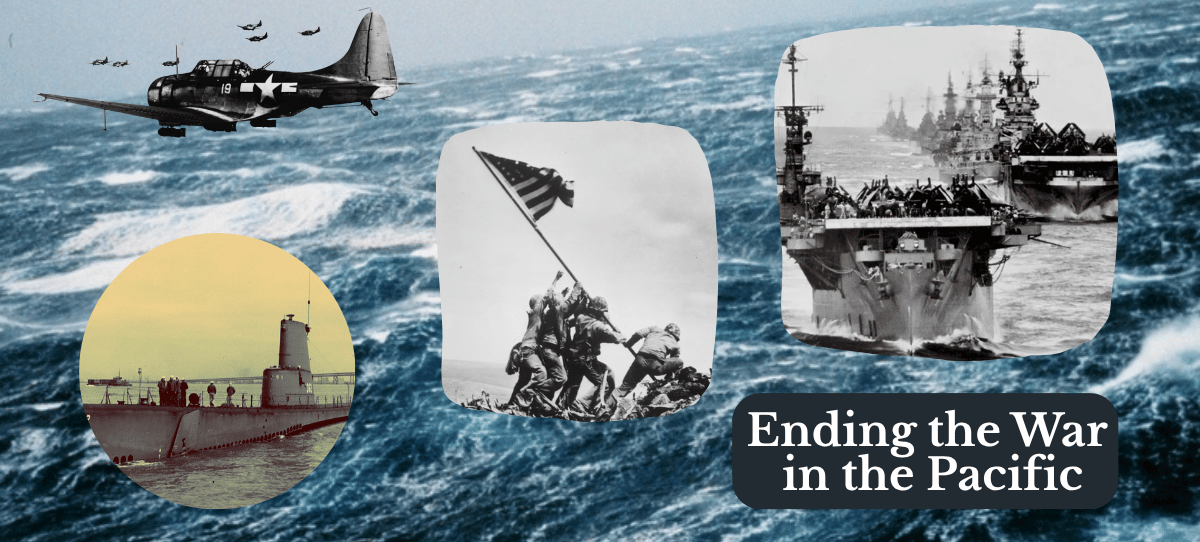
Image credit: various photographs from Naval Aviation Museum, National World War II Museum, and US Navy Archives.
Discover more from friarmusings
Subscribe to get the latest posts sent to your email.
 friarmusings