
Sometimes the task at hand is like trying to rewire the house while keeping the lights on. Such was the 12 months preceding the planned November 1, 1945 Operation Olympic’s landings on the southern Japanese home island of Kyushu. That was the “rewiring” part. The “lights” that needed to be kept burning brightly were spread far and wide. Here is a brief summary of the major Pacific engagement from October 1944 until the end of the war.
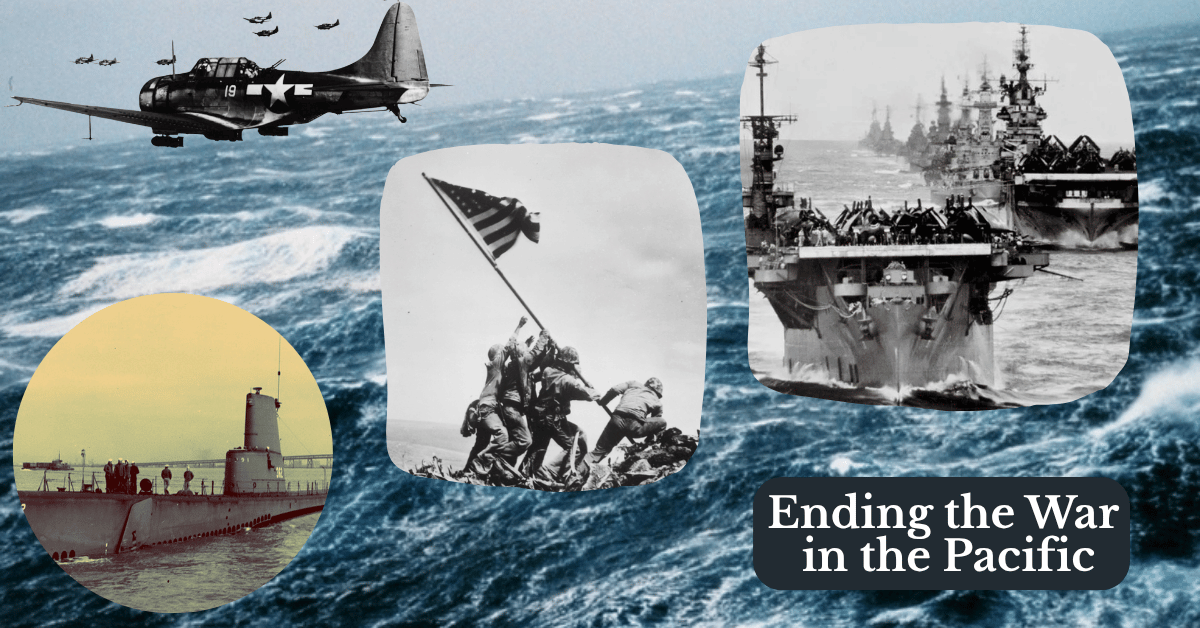
- Repatriation of the Philippines (Leyte, Luzon, Palawan, Visayas, Mindanao) (Oct 1944 until the end of the war)
- Formosa Air Raid by the Fast Carrier Task Force (Oct 1944)
- Strategic Bombing of Japan (Nov 1944 until the end of the war)
- Burma: Battle of Meiktila and Mandalay (Jan – Mar 1945)
- Iwo Jima Campaign (Feb 19 – Mar 26, 1945)
- Dutch East Indies (Indonesia) operations to retake key islands (May 1 – Jun 21)
- Burma: Battle of Rangoon (Apr 30 – May 3)
- Okinawa (Apr – Jun 1945)
- Unrestricted submarine operations (until the end of the war)
- US 5th Fleet Fast Carrier Raids from the Sea of Japan to Singapore (Feb-May 1945)
- Mining of Japanese coastal waters (Feb-May 1945)
These operations engaged the entirety of Central Pacific Command (Nimitz) and Southwest Pacific Command (McArthur) – and yet at the same time the Allied forces were asked to begin preliminary planning for Operation Olympic which would be an amphibious invasion far more complex that Normandy.

Logistics
The Normandy landings were not the first amphibious assaults for the European Theater of Operations (ETO). The allies had successfully landed in North Africa, Sicily, the boot of Italy, and Anzio. With the exception of North Africa (unopposed) the logistics and supply chains were massive, complex, but did not require long distances. The D-Day Invasion of Normandy in June 1944 secured a beachhead on mainland France. Logistics in support of the Normandy invasion was massive, but only needed to cross 20-100 miles of the English Channel in a region where the Allies controlled sea lanes and the air.
Logistics support for Operation Olympic depended on the ability to provide logistics support from the west coast of the United States to Guam to Kyushu – 5,650 miles. Pacific logistics operations involved establishing advanced island bases and a sophisticated, albeit sometimes inefficient, chain of supply across vast distances to support the “island hopping” campaign. Key challenges included the immense distances, competition for scarce shipping, integration issues between different military services’ logistical systems, and the need to deal with primitive conditions at forward bases. The US Navy and Army, along with the Merchant Marine, were responsible for the movement of troops, fuel, ammunition, and supplies, utilizing standardized ships and mobile support facilities. Over the course of the war the US Navy transitioned from shore-based to fleet-based logistics which meant that “gas station” and the “store” came to the fleet – refueling and receiving supplies while underway. The Navy also established floating/anchored facilities for fuel and supplies at advanced bases like Majuro and Ulithi; Guam became a major stores/supply depot with facilities at Apra Harbor. At the same time the Navy developed mobile dry docks and repair ships to carry out repairs at forward locations, reducing the need to return to the US.
The Battle Space
Normandy targeted 5 closely connected landing beaches (Utah, Omaha, Gold, Juno, Sword) landing 156,00 troops ashore the first day. They expected to face 50,000 Germans in the coastal defense zone, with limited armor and air support – with no civilian support of German operations. Especially at Omaha Beach the resistance was fierce; far less so at other beaches. The Olympic landings would be very different.
Olympic would land in 3 main areas (Kushima, Miyazaki, Ariake Bay) landing some 400,000 soldiers and marines in the initial wave facing Japanese troops that were combat-ready and well dug-in. How many troops? The answer to that was one that kept evolving as plans were developed. In addition Japanese civilian militias and prepared home defense forces would be activated.
While it could be said that the Pacific allies controlled the sea lanes and air space against traditional opposition, the same could not be said regarding Japanese Special Attack Units (suicide planes, boats, submersibles, etc.) There were as many as 10,000 kamikaze aircraft available to oppose the landing.
Where the Normandy troops landed on broad beaches with relatively flat inland areas, Kyushu offered narrow beaches, rugged mountains, limited road networks, and a network of dense fortifications beyond the landing zone (as at Biak, Peleliu, and Okinawa). It was a terrain that favored the Japanese and mitigated the use of superior allied armor (tanks, etc.).
It was a complex battle space that faced the planners.
The Series Going Forward
The war has come to Japanese “home waters.” The series has tried to describe a number of actions jumping around the Pacific as well as moving around the timeline. All of it to bring us into a different “battle space” – the political and military decision/policy stakeholders on the Japanese and the Allies sides of the war.
By the mid-summer of 1945 the war of attrition that the nation of Japan brought upon themselves by their own miscalculation of allied response to their hyper-aggressive expansion across the East Asia sphere had come to their doorsteps. Virtually every conquest made in the Pacific and East Asia by March 1942 had been lost. While they still had armies in Burma, Indonesia, French Indochina (Vietnam), China and Manchuria – and these were under increasing threat by opposing forces and lack of supplies – the army garrisons of the Pacific Islands were isolated, left to wither, or had been decimated.
The Combined Fleet, the once mighty force that attacked Pearl Harbor, had been sunk. The U.S. submarine blockade of the Japanese home islands was devastating the nation of Japan. With the loss of Iwo Jima and Okinawa, the homeland had already been invaded and those places conquered. The main islands were being bombed at will by B-29 bombers operating from Tinian, Guam and Saipan; new airfields were being prepared on Iwo Jima and Okinawa, even further diminishing the distance to every Japanese city. And yet there were no meaningful initiatives from Japan to end the war.
Historian Jonathan Parshalls offers a sad comparison between those circumstances and a scene in the 1975 movie, Monty Python and the Holy Grail – specifically the Black Knight scene. In the scene King Arthur comes upon the Black Knight who is guarding a small bridge, allowing no one to pass. The Black Knight has just killed a knight dressed in green, showing no mercy. King Arthur requests (later demands) that the Black Knight let him pass. The same response is given, “None shall pass.”
At this point a duel with swords begins. King Arthur cuts off the Black Knight’s limbs one by one. Each time, the Black Knight insists, “It’s only a scratch,” “It’s just a flesh wound” and “I’ve had worse.” Finally, the limbless knight “stands” on the ground refusing to acknowledge he has been defeated. King Arthur now simply bypasses him but even then The Black Knight’s taunts “Come back here, I’ll bite your legs off!”
The Black Knight loses his limbs; Japan has lost its navy, air force, is unable to defend its citizens from bombing, and is on the edge of famine. Yet the military insisted they were still in the fight. In each case there was a fundamental refusal to acknowledge reality. For the Black Knight, yielding would shatter his self-image. For Japan, surrender challenged the cultural ideals of bushidō, loyalty to the Emperor, and the nation’s perceived divine mission.
The Black Knight scene ends as an impotent torso still shouts defiance. July 1945 ends with Japan’s “black knight” played by the Supreme War Council (“the big six”) insisting that an allied invasion of Kyushu will result in Japan’s “decisive victory.” It is the impotent assertion: “None shall pass.”
This sad comparison of real life to the dark humor of comedy offers a fundamental and troubling question: is there a pathway to peace when the opposing force is intrinsically incapable of acknowledging defeat and surrendering?
And that is the most fundamental question the series will attempt to address moving ahead. As we moved ahead, be aware that “Defeat” is a military assessment that can be “calculated” with a degree of certainty. “Surrender” is a political decision which is not necessarily connected to the assessment of defeat.
What is the political pathway to the end of the Asia-Pacific War?
Stay tuned.
Image credit: various photographs from Naval Aviation Museum, National World War II Museum, and US Navy Archives.
Discover more from friarmusings
Subscribe to get the latest posts sent to your email.
 friarmusings