
To understand in the inner workings of the wartime governance of Japan there are three keys to keep in mind:
- Cabinet and Supreme War Council recommendations to the Emperor must be unanimous and if unanimity can not be reached, the government collapses and a new cabinet and council must be promoted.
- In accord with the Meiji Constitution, certain cabinet members must be filled by active duty members of the military. In the context of #1 above, this means that the military holds a de facto veto on anything with which it does not agree. A single military member can either “filabuster” or simply resign – either achieve the same thing: collapse of the government.
- In accord with the Meiji Constitution, the Emperor is a Constitutional Monarch, but at the same time is “Supreme Commander” of the Military (daigensui).
Does #3 mean that the “buck stops” with the Emperor? Hardly. As described in earlier posts, the received tradition was that the Emperor was not an absolute monarch – and that is consistent with the Meiji Constitution. Then again, the Emperor was not a symbolic monarch like the King of England. In practice, the Emperor’s role lived somewhere between the two on a spectrum of direct influence, passive influence, and removed from decision making. Emperor Hirohito’s father was quite removed from decision making or shaping the future of Japan. Hirohito was… well, that has been the subject of debate by historians for the last 80 years and more.
The post-war tribunals placed the blame and responsibility for the war on the military, ultranationalists, and the zaibatsu (financial clique). But Emperor Hirohito escaped post-war tribunals because Gen. MacArthur (SCAP – Supreme Commander for Allied Powers) excluded him from the tribunals for reasons associated with SCAP’s vision for post-war Japan. This provided a post-war orthodoxy that Emperor Hirohito was a peace loving constitutional monarch who could not prevent the military from their desire for war. That view could not withstand the passage of time and the declassification of wartime documents.
Using primary sources that became available in the 1990s there has been a trend among historians to examine his role, not just as constitutional monarch, but also his role as daigensui – supreme military commander. The records show that he was active as military commander at the strategic level, more active than the immediate post-war narrative portrayed. But active as supreme commander in a tactical sense? Active as a voice of questions and inquiry? Was the role of monarch really separate from that of supreme commander? Historians such as Butrow, Titus, Large and Wetzler view the pre-war decision making as a pluralistic and consensus-oriented participation of ruling elites and accept Maruyama’s argument that such a system resulted in ambiguous individual responsibility baked into a process of negotiation and compromise – this included the Emperor.
After surrender, Japanese wartime cabinet and council members took responsibility for their part in the start and operation of the war. The Emperor remained silent.
Other historians grant Hirohito’s reluctance to authorize the war, but note that his preference was not for peace but for a diplomatic solution. There is a huge difference. While there was peace (calm before the storm) with the United States, Britain, and the Netherlands, there was active war and occupation in Manchuria, Korea, parts of China, French Indochina (Vietnam) with the near occasion of war threatening British Malaya and Dutch East Indies—key sources of oil and rubber. (See Achieving Colonial Ambitions)
Hirohito had already authorized war. He wanted diplomacy to provide him with a replay of the September 1938 Munich Agreement which allowed Nazi Germany to annex part of Czechoslovakia in an effort to prevent war. The then English Prime Minister, Neville Chamberlain, heralded the diplomatic deal as “peace for our time,” the appeasement policy ultimately failed when Hitler continued his territorial aggression, culminating in the invasion of Poland and the start of World War II. The allies had already shown Hirohito the model that would allow Japan to retain their Empire as it stood in 1941.
Hirohito preferred diplomacy as his concern with military action was the uncertainty of outcome. The downside to pulling the United States into armed conflict was that losing meant the loss of the Empire, his removal from governance in the remaining nation of Japan and the possible dissolution of the Imperial House as an institution in Japan. This is the view of noted WW II historian Herbert Bix. A review of source documents pertaining to the June-August 1945 period strongly supports that conclusion. In August 1945 when the Emperor “stepped in” with his Saidan (sacred decision) to end the war, saving the Imperial House was a major concern. Perhaps his primary concern.
At this point, one needs to pause and remember the three keys at the beginning of this article and the “Black Knight” analogy in the previous post. In January 1945 there is no scenario in which Japan is not defeated; unconditional surrender has been the formal allied policy since the January 1943 Casablanca Conference. There is no scenario in which the Supreme War Council will unanimously agree that defeat has happened and now it is time to surrender. Only the Emperor will be able to intervene and he continues to search for a “decisive battle” (Ketsu-Go) that will reach a negotiated peace with the goal of… of what? In Bix’s view, only when he has assurance of continuity of the Imperial Household and thus the kokutai of the nation.
This means that “surrender” was significantly delayed after “defeat” was beyond question. Millions of Asian lives were lost in the interim with the vast majority of them being in Japanese-occupied lands. One need only review the post Civilian Deaths. Historians Richard Frank and Jonathan Parshalls estimate that in occupied Asia countries, in the last months of the war, there were 70,000 deaths per week among non-combat civilian populations.
Historian Masumi Junnosuke argues that at any point the Emperor could draw on his own great authority , knowledge, and experience to influence the decisions by asking questions (gokamon) or by conveying his personal wishes during his imperial audiences and conferences with governmental and military leaders. Historians such as Noriko Kawamura adopt Junnosuke’s position but believe it is necessary to acknowledge Japan had a history of political assassinations and that Hirohito “occupied a precarious and ambiguous position that existed above the highly complicated relations of a powerful political triangle: court advisors and senior statesmen (jushin); government ministers and bureaucrats; and military leaders… The triangular power struggle was further complicated by divisions with each group between moderates and hardline ultranationalists and militarists…[with a further complication of] interservice rivalry between the army and the navy and another division between moderate senior officers and younger militant groups within the branches of the military.” Hirohito was the sole point of convergence of all these streams of power.
80 years later historians still debate his role. If he decisively ended that war could he just as decisively prevented its start? Or was the “triangular power struggle” different enough to enable his “sacred decision?”
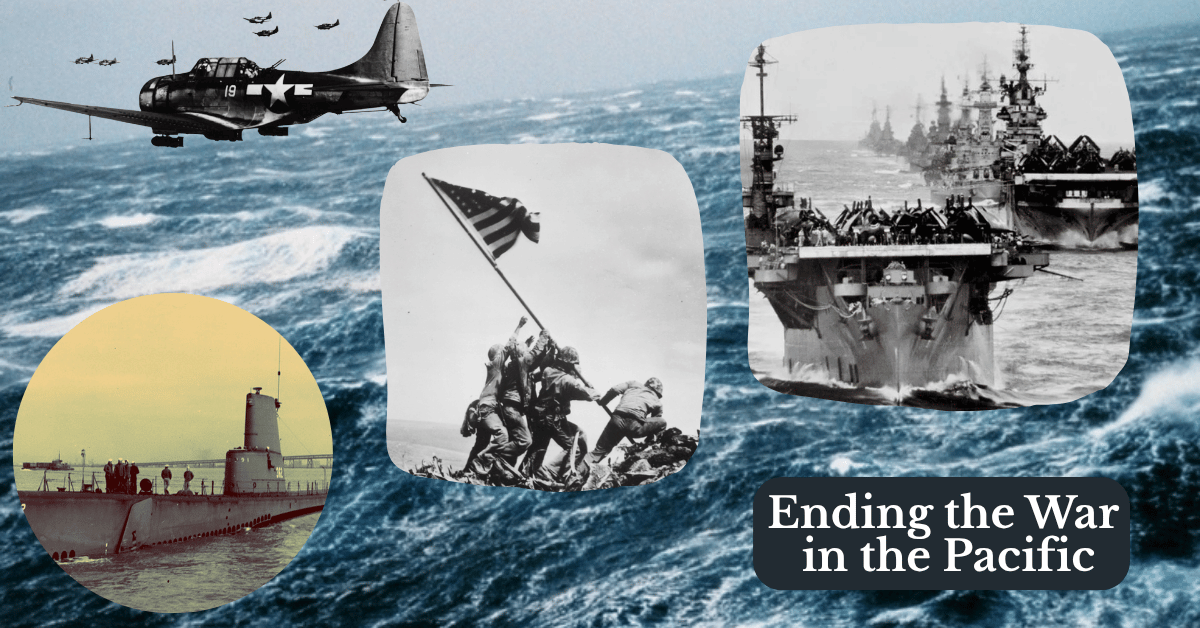
Image credit: various photographs from Naval Aviation Museum, National World War II Museum, and US Navy Archives.
Discover more from friarmusings
Subscribe to get the latest posts sent to your email.
 friarmusings