
In the summer of 1942, as outlined in the post “Before the War”, Japan pursued parallel paths: diplomacy and war preparations. The military (members of the cabinet, IJA Headquarters, and influential flag officers) flush with success in Manchuria, China and French Indo-China (Vietnam) wanted to unleash the Army against the entire Asia-Pacific region in order to establish the Empire of Japan under the guise of the Greater East Asia Co-Prosperity Sphere. The Navy was circumspect with part of its leadership desirous of some means to achieve “glory for the Emperor” as the Army had already done. But another part of its leadership understood that meant taking on the US and British Pacific Fleets. The United States was particularly worrisome given three factors: (1) the fleet at Pearl Harbor, (2) that US shipyards were already building a new generation of aircraft carriers, battleships, cruisers and fleet tankers that would be commissioned in 1942, and (3) that was without the full engagement of the industrial base of the nation. That meant the war plan “decisive battle” would not be engaged in Philippine Island waters, but needed to be a “knockout blow” at Pearl Harbor to take out battleships and aircraft carriers.
In the autumn of 1941 there were a series of Imperial Conferences (Gozen Kaigi) where Emperor Hirohito, his cabinet, and senior military leaders debated the U.S. demands for a diplomatic settlement and Japan’s course of action. The first of these conferences was held September 6, 1941 – “Imperial Conference on the Empire’s Future Policy.” The cabinet and military presented Hirohito with two paths: (a) continue negotiations with the U.S. and Britain and (b) preparation for war if negotiations failed. Hirohito approved a resolution: negotiations would continue, but war preparations must be ready by late October if talks broke down. The Emperor made it clear that diplomacy was the priority (for reasons outlined in the previous post) and so he accepted the parallel path, but also set a firm deadline for agreement or war.
The Second Imperial Conference was held November 5, 1941 after weeks of inconclusive Army-Navy-Cabinet debates it was agreed that the military would strike Pearl Harbor while also moving into Malaya, the Dutch East Indies, and the Philippines. At a final Imperial Conference on December 1, 1941. The cabinet reported to Hirohito that diplomatic negotiations had failed. The Army and Navy both argued that war was now unavoidable. Hirohito approved the resolution that war with the United States, Britain, and the Netherlands would begin in early December. Diaries record Hirohito as somber, but he gave no objection. His silence ratified the decision. Hirohito performed the ritual reading of the imperial rescript that authorized hostilities. The debate was closed. The Combined Fleet had already set sail for Pearl Harbor on November 26th. Army troops were already being deployed throughout the Asia Pacific region.
While most of this post was previously covered, it is interesting to consider Hirohito’s role in the start of the war. As noted in the series of posts about his early years as Regent and then Emperor, he was “feeling his way.” He did not have the wisdom of the genrō (elder statesmen) who had guided his father, assasination threats were real. He inherited a “Sacred Duty” to guide the nation to rule the “eight corners of the world” but the implementation of the plan was being led by rogue members of the Army in Manchuria and China. The rivalry between Army and Navy was palpable; Hirohito was aware it only took one disgruntled military cabinet member to collapse the government.
The 1930s events in Manchuria and China had led to Hirohito’s first steps into what historian Stephen Large calls “self-induced neutrality.” It seems evident that by December 1941 he was fully in a self-induced neutrality, willing to assent to whatever unanimous decision the cabinet and council presented.
That had changed by the summer of 1945. The June 1942 Battle of Midway was a harbinger of what was to come. But post-war diaries, journals of the Imperial Japanese Army (IJN), and other contemporaneous sources show that Hirohito’s neutrality began to fade – especially during the 1942 Guadalcanal Campaign and the larger Solomons campaign that continued into 1943 (see the post War in the Pacific – the early months). During these campaigns and all that followed into the summer of 1945, Hirohito was not just receiving reports but was actively pressing for a “decisive victory” to bring the Allies to the negotiation table. As time moved forward the Emperor pressed for a “decisive battle” in which allied losses – even in the context of allied victory – would bring the Allies to the negotiation table.
In daily briefings and meetings, discussions with advisors – especially Lord Kicho and Prince Konoe – Hirohito complained about complete lack of cooperation between the Army and Navy, the track record of over promising and under delivering, and acknowledged the clear evidence that there was no front on which the war was going in Japan’s favor. Every indication was that the allies increasingly had a stranglehold on Japan. His comments, questions and suggestions to his military leaders seemed to be politely acknowledged and routinely ignored at some point in the chain of command. One has to question his role as daigensui – supreme military commander.
When US forces landed on Luzon in January 1945, the Emperor pressed for a vigorous and offensively oriented fight on the northern Philippine island. The local army commander ignored the Emperor and chose to play the “long game” of a protracted defensive campaign of attrition. The Army Chief of Staff Umezu refused to intervene. There were limits to the Emperor’s control, seen in 1945, and seen throughout the 1930s in events like the “Manchuria Incident” in which junior officers invaded Manchuria against the expressed wishes of the Emperor and direct orders of the military chain of command.
The Emperor’s needed-decisive battle would not be Luzon. This was not the first, nor the last time, the military ignored Hirohito even though by the Constitution he was the supreme commander-in-chief of all armed forces. If they would not heed his command to attack, would they obey his decision to surrender? This was of special concern with IJA forces in the Asia-occupied territories.
When reading the histories, it seems a fair conclusion that Hirohito’s desire was to shed his self-induced neutrality (his motivations are debated) but he was not able to navigate the milieu of power and interests that drove the key players. In addition, the culture of bushido and sacred duty were elements that made the beginning of the war successful but were a powerful energy that was not easily extinguished to end the war with honor.
The fundamental and troubling question facing the Allies is whether there is a pathway to peace when the enemy is intrinsically incapable of acknowledging defeat much less mustering the political will to surrender? Especially when the terms of peace are at odds with each side’s goals for the post-war era. One wants to retain some part of its ill-gotten gains. The other demands unconditional surrender.
For two weeks, the posts in the series moved forward in time to describe the amphibious invasions and victories (Leyte, Luzon, Iwo Jima, and Okinawa) that brought us to the doorstep of the Japanese home islands by July 1945. These victories meant advanced airfields for fighter aircraft, battlefield attack planes, tactical bombing by shorter range B-24 and B-25 bombers, reconnaissance aircraft, scout planes, and all manner of airframes to control the skies over Japan. All this as B-29s continued to strategically and firebomb Japan cities and manufacturing and place sea mines in every sea channel in the home islands.
In that same time period the increasing brutality of war among soldiers was described, but also intentional brutality against civilian populations. The psychic and psychological damage of war is building among the war fighters and civilians alike.
At this juncture, the series will venture “behind the curtain” of governance and war planning from January 1945 until the formal surrender of Japan with the signing of the surrender documents on the deck of the USS Missouri on September 2, 1945. The series will attempt to describe a “history” of events that is still being uncovered even these 80 years later. Here in 2025, the war diary of the Naval Minister of War, was just made available to historians. It provides insights that, in ways, changes the landscape of the path to surrender.
“Pay no attention to the man behind the curtain!” is a famous line from the 1939 film The Wizard of Oz, where the Wizard shouts it as his true identity as a regular person controlling effects with machines is exposed. In the ongoing posts of this series, we will pay special attention to the men behind the US and Japanese curtains.
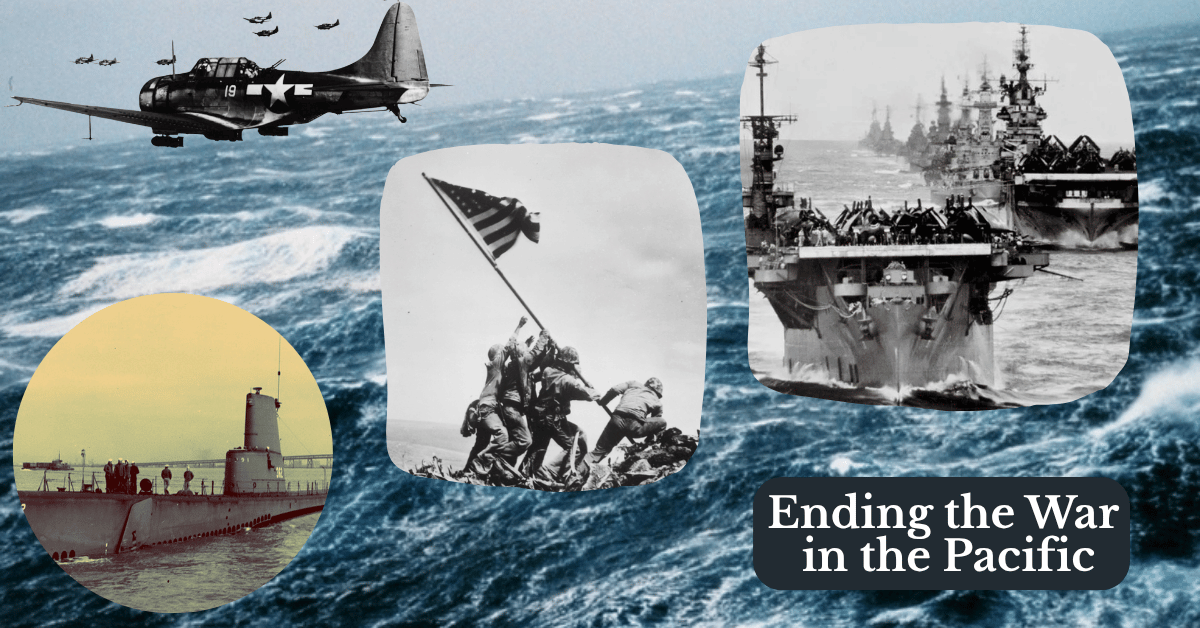
Image credit: various photographs from Naval Aviation Museum, National World War II Museum, and US Navy Archives.
Discover more from friarmusings
Subscribe to get the latest posts sent to your email.
 friarmusings