
The two previous posts were meant to give the reader a sense of the Emperor’s role in war-time governance in Japan. To be sure, I have not done the topic justice as just like “Washington insider” machinations (then and now) Japan had its own “system” to navigate to achieve decisions. Some of this was already covered. A review of two posts would be helpful: Ketsu-Go and Governance and Ketsu Go. The former describes Japanese plans for the “decisive battle” that would bring the Allies to a negotiation table and away from their demands for unconditional surrender. The latter describes the sequence of events that took Ketsu-Go from a strategic idea (January 45) to a formally approved plan of action (March 45) – and gave some sense of the internal factions within the government along with their agendas. In this post we look “behind the curtain.”
The previous posts have tried to show that Hirohito, as Emperor, moved from “self-induced neutrality” in decisions to a more animated Emperor in decisions about the war. He was briefed and was aware of war progress and failures. He asked critical questions. He knew of cases where the military subverted his expressed views. And he deftly navigated the reach and influence of his power while remaining the Emperor in a constitutional monarchy where the power lay with the military.
What is uncertain was the quality of information the Emperor was receiving. While there were cases in which military leaders hedged reports, these same leaders were at the mercy of field commander reports which often were greatly exaggerated. This was especially true among Imperial Army (IJA) ranks; less so from the Imperial Navy (IJN). It was hard to obfuscate the loss of aircraft carriers, battleships, cruisers and more. A subtext of much of the reports, as the historian Edward Drea notes, was a dismissive view that “Americans [were] products of liberalism and individualism and incapable of fighting a protracted war.” This is what drove the Japanese to find the “Decisive Battle” to bring the Allies to a negotiation to end the war. Midway, Guadalcanal and especially Saipan were to be those battles. And yet the allies pressed forward with the war. The Emperor supported the drive to bring about the decisive battle – but as a necessary precursor to his end-game: a negotiated peace. Or perhaps a negotiated continuity of the Imperial Household.
In 1941, Hirohito felt that the “final demand” from the U.S. Government (the November Hull Note) was essentially a demand for unconditional surrender for a war that had not been fought. It meant surrendering all the Imperial gains acquired since 1941. It would have been a surrender with no honor. Now, more than 4 years later, the war has been fought “with honor.” The “Decisive Battle” is the last attempt to bring the U.S. to the negotiation table to find peace, but with honor. Unconditional surrender was an anathema.
According to Showa Tenno Dokuhakuroku (the personal reflections of the Emperor and his role in the governance of Japan, written in 1946 but not released until after his death in 1989) and the diary/testimony of Lord Kido, the Emperor called a February 1945 meeting of the jushin, the former prime ministers. To avoid rousing concerns among the military leaderships, he met privately and one-on-one with members of the jushin. Apart from Prince Konoe, there was no support for or sense that prompt peace was needed. In private, Konoe advocated urgently pursuing peace in order to preserve the throne and avoid civil unrest, specifically a communist revolution in which the throne would not survive. The Emperor responded it was premature to seek peace unless there was one more military gain. This was a view that was, in March 1945, shared by Lord Kido and his close circle of confidants. It should be noted these were the members of the so-called “peace faction.”
What about the views of the Supreme War Council? As Iwo Jima was falling into Allied control, on March 20th a formal Gozen Kaigi (Imperial Conference) was held with the Emperor and Supreme War Council (“Big 6”) were present.
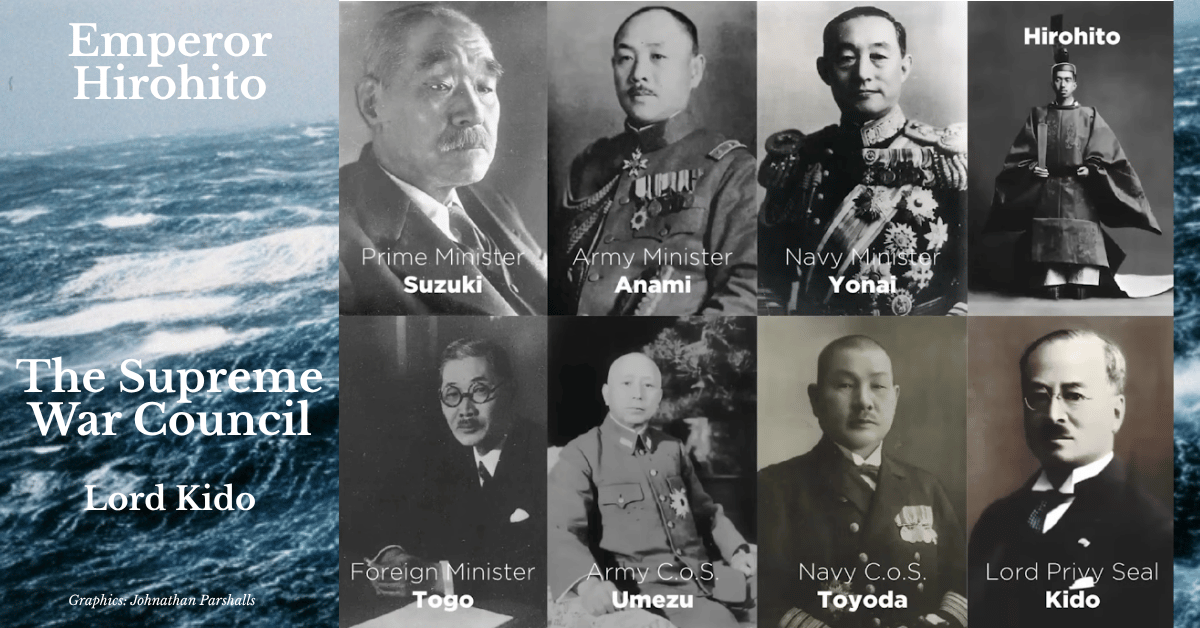
Here are key players in what unfolds with the government of Japan and the Imperial Household (from April 1945 until the end of the war):
- Prime Minister – Suzuki (former Admiral)
- Foreign Minister – Tōgō (professional diplomat)
- Minister of War (Army) – General Anami
- Minister of the Navy – Admiral Yonai
- Chief of the Army General Staff – General Umezu
- Chief of the Navy General Staff – Admiral Toyoda
- Lord Privy Seal Kido, and
- Emperor Hirohito.
The Army presentation was unchanged from the January meeting: concentrate the bulk of remaining forces, land and air units, for a decisive battle in Kyushu – not on the beaches – but with an in-depth defense took advantage of prepared defensive positions, inland terrain and avenues of advance that lent themselves to inflict massive casualties on the allies. It was a repeat of the “playbook” from Biak, Peleliu, Leyte and Iwo Jima – as well as the preparations being finalized on Okinawa. Two additional features were planned: kamikaze attacks from Army air units, integrated with Naval air units, and on land a mobilized civilian Volunteer Fight Corps. This corps, Kokumin Giyūtai, was formally established by Imperial Edict No. 519 on March 23, 1945.
The Navy presentation was largely centered on Special Attack Unit (kamikaze) operation and coastal defense. At this point all parties knew that the once proud and powerful Combined Fleet was effectively gone as a fighting force.
The strategic and tactical goal was to inflict massive casualties on the U.S. to force a negotiated settlement preserving the kokutai of the nation. War Minister Anami strongly promoted the plan, framing it as the “last chance to preserve the nation’s honor and independence.” Prime Minister Suzuki later told post-war Allied interviewers that he had serious reservations but knew that opposing the Army was futile – and so did not oppose the plan. Foreign Minister Tōgō raised concerns about Japan’s isolation and the danger of total destruction, but did not openly challenge Ketsu-Go. According to postwar accounts, testimony and memoirs, the general mood in the room was committed to a “decisive battle” strategy as the best means to a negotiated peace that would preserve the nation – and possibly some war gains in Southeast Asia.
While there was unanimity in March 1945, as the war progressed, divisions within the Council led to indecision and lost time in making any “course changes” other than the approved Kastu-Go. There was no precedent for Emperor Hirohito to step in and take charge. It simply wasn’t done.
As we move farther into 1945 the Army faction (Anami and Umezu) will remain firmly entrenched in their commitment to Ketus-Go as the only honorable course of action. There will never be unanimity in any offered proposal that would direct the War Council to other than Ketsu-Go.
Image credit: various photographs from Naval Aviation Museum, National World War II Museum, and US Navy Archives. Big 6 image from presentation by Jonathan Parshalls
Discover more from friarmusings
Subscribe to get the latest posts sent to your email.
 friarmusings