
Who were the allied leaders whose decisions would be the most impactful on the Asia- Pacific War? And equally important what were key inter-allied conversations and decisions that would shape the manner and outcome of the war? Unlike Japan that had no effective dialog or connection to its Axis partners, the Allied met quite regularly in high level conferences with its partners. Quite early in the war, the allies agreed that both the war in Europe and the Asia-Pacific would end in unconditional surrender.
At the January 1943 Casablanca Conference the Allies (U.S., Britain, USSR*) demanded, as pertains to Japan, that Japan surrender without preconditions, meaning:
- total disarmament,
- Allied occupation of the home islands,
- war crimes trials, and
- Reshaping of Japan’s government along democratic lines.
At no point did the policy mention the future of the Emperor, a central figure in Japan’s political and spiritual life.
This policy did not emerge from a vacuum but was rooted in and shaped by the experience of World War I, current knowledge of WWII axis war crimes, and concerns over postwar stability.
From the viewpoint of the WWII Leaders, the First World War armistice was a failure. An armistice is not a surrender; this allowed many Germans to believe they had not been truly defeated militarily. Coupled with other factors (hyper inflation, war reparations, and more) this became a national sentiment that undermined the Weimar Republic and paved the way for the rise of Nazism. The Allies wanted to avoid a repeat of this scenario by ensuring that WWII ended with total and undeniable defeat.
By the time of the January 1943 Casablanca Conference the war crimes of Nazi Germany (the holocaust) were already publicly acknowledged by the Allies. In December 1942 they condemned “the systematic extermination of the Jews in Europe.” The war crimes of the Japanese army in China, Korea, and other Asian countries were already well known and had been extensively covered in the Western Press. It was believed that the violent nature of the Axis was deeply rooted in its leaders and adherents. And thus the conclusion of Allied leaders was that German Nazism and Japanese militarism must be eradicated to prevent future global wars. Further, the leaders of the atrocities must be held accountable in war crime tribunals.
At a Casablanca press conference (January 24, 1943), President Roosevelt said: “Peace can come to the world only by the total elimination of German and Japanese war power… The elimination of German, Japanese, and Italian war power means the unconditional surrender by Germany, Italy, and Japan.” As a result, the policy of unconditional surrender was established at Casablanca for the reasons outlined above as well as to prevent the WWI experience of an individual allied country making a separate peace with an Axis power such as happened when Russia made a separate peace with Germany (Treaty of Brest-Litovsk), weakening the overall Allied position.
The policy also had the effect of signaling to the people at home and deployed war fighters that the governments were committed to justice and total victory. It was a signal to reassure the citizenry that their sacrifices were necessary and would be honored. The policy also looked to the postwar world when unconditional surrender would give the Allies maximum control over reconstruction, occupation, and denazification or demilitarization. The war crimes tribunal also laid the groundwork for democratic governments.
The policy of unconditional surrender never wavered but remained a known demand of the Allies. But was that knowledge an aid or hindrance to ending the war? Historians are divided on the answer. From Casablanca to the end of the war, “unconditional surrender” never addressed the role of the Emperor who was inseparable from the kokutai of the nation. Would he be tried as a war criminal? Would the Imperial House be disestablished? Would he be reduced to a figure head without any power? After the war, several Japanese leaders testified or wrote that the lack of clarity about the Emperor’s status was the main sticking point to Japan’s surrender, e.g. Foreign Minister Tōgō. The historical record shows that it was his sticking point, but not one shared by the other members of the Supreme Council.
In the first half of 1945, the already established policy (Ketsu-Go) of the Council and Cabinet, approved by Emperor Hirohito, was that no peace offers could be entertained until after the Allied forces had landed on Kyushu and suffered severe and extensive casualties. Only then would the Allies, wearied by war, worried about home front support, be open to a negotiated peace acceptable to Japan – and their idea of an acceptable peace in no way resembled unconditional surrender. Their idea not only left Japan independent and unconquered, but also left them in control of some of their 1942 territorial gains until such time as the occupied people were ready for self-government. It is key to remember that the Supreme War Council did not rule by majority, but by unanimity. Ketsu-Go was unanimously recommended and would remain the approved policy until a new recommendation was made (or the government fell and a new government formed – still under the veto-control of the military.)
Using post-1995 materials historians such as Richard Frank (Downfall, 1999) and Tsuyoshi Hasegawa (Racing the Enemy, 2005) emphasize that internal divisions about every element of unconditional surrender remained the principle barrier. As latter posts will show Minister of War Anami, Chief of the Army General Staff Umezu, and Chief of the Navy General Staff Toyoda remained staunchly in opposition to any negotiated surrender until after the Ketus-Go operation even after Hiroshima, Nagasaki, and Russia’s declaration of war against Japan. The role of the Emperor was not “the sticking point” for them.
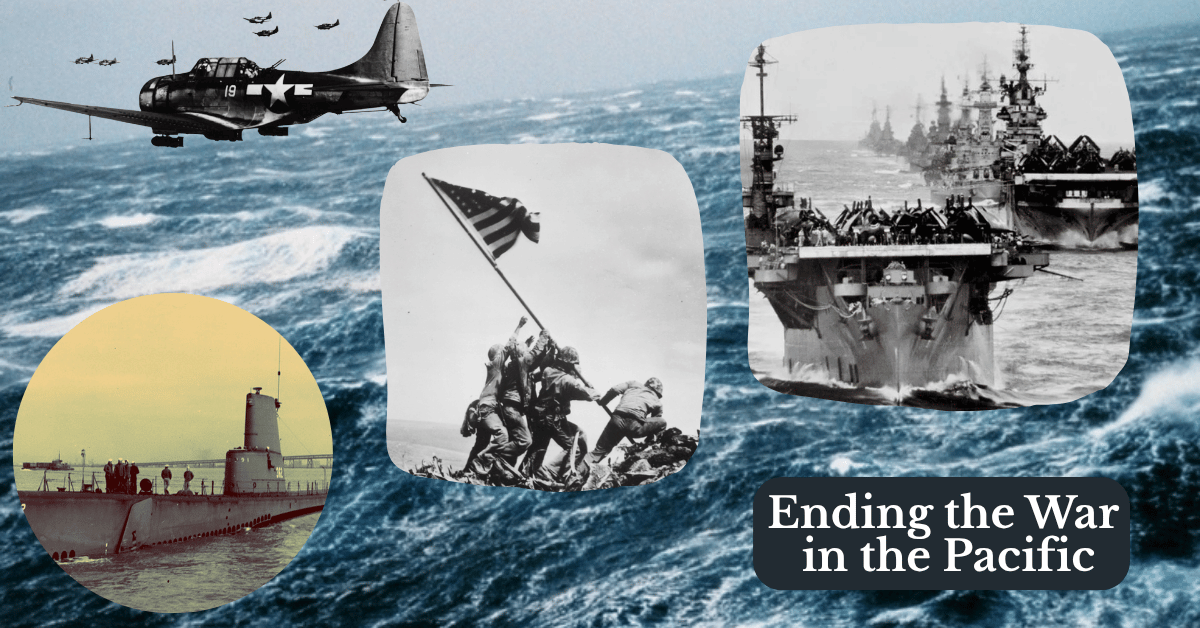
Image credit: various photographs from Naval Aviation Museum, National World War II Museum, and US Navy Archives.
(*Stalin was not present but later agreed in principle)
Discover more from friarmusings
Subscribe to get the latest posts sent to your email.
 friarmusings
Unconditional Surrender was announced by Roosevelt without consultation with allies. Churchill was blindsided and not in favor, but agreed to keep the alliance intact.
There are varying accounts, all of which agree that Churchill was not in favor of it – as to “blindsided” that is where accounts vary ranging from “no warning” to “his staff and key advisors were briefed” well before Casablanca. Such is history