
We jump ahead on the timeline for a moment to complete the Allied thought that began at the Jan 1943 Casablanca Conference: terms of surrender for Germany and Japan. 2.5 years after Casablanca, after Nazi Germany had unconditionally surrendered, the Allies prosecuting the war in the Pacific met. On July 26, 1945, US President Harry S. Truman, UK Prime Minister Winston Churchill, and President of China Chiang Kai-shek issued a document, which outlined the terms of surrender for the Empire of Japan. The Potsdam Declaration (Proclamation Defining Terms for Japanese Surrender) was a statement that called for the surrender of all Japanese armed forces. The ultimatum (and it was worded as an ultimatum) warned: “We will not deviate from them. There are no alternatives. We shall brook no delay.” The ultimatum was clear: if Japan did not unconditionally surrender, it would face “prompt and utter destruction.” By this time in the war Japan was already devastated by bombing and only possessed defensive capability. The war was all but lost by any conventional standard. The Potsdam statement was released only 11 days before the atomic bombing of Hiroshima.
Details of the Potsdam Declaration were:
- The elimination “for all time of the authority and influence of those who have deceived and misled the people of Japan into embarking on world conquest”
- The occupation of “points in Japanese territory to be designated by the Allies”
- “Japanese sovereignty shall be limited to the islands of Honshu, Hokkaido, Kyushu, Shikoku, and such minor islands as we determine,” as had been announced in the Cairo Declaration in 1943
- “the Japanese military forces, after being completely disarmed, shall be permitted to return to their homes with the opportunity to lead peaceful and productive lives”
- “we do not intend that the Japanese shall be enslaved as a race or destroyed as a nation, but stern justice shall be meted out to all war criminals, including those who have visited cruelties upon our prisoners”
- At declaration’s end: “We call upon the government of Japan to proclaim now the unconditional surrender of all Japanese armed forces, and to provide proper and adequate assurances of their good faith in such action. The alternative for Japan is prompt and utter destruction.”
But the declaration omitted mention of the Emperor, and this was interpreted by some Japanese leaders as a sign that surrender would mean an unacceptable humiliation with the dismantling of Japanese identity and even possibly mean execution of the Emperor. On July 28, 1945, Japanese Prime Minister Kantarō Suzuki gave a press statement in response to the Potsdam Declaration. He said Japan would “mokusatsu” the declaration: “[We] mokusatsu it and will press on with the war.”
The Japanese government’s response was ambiguous – and perhaps necessarily so. Suzuki could only speak authoritatively once the “Big 6” reached a unanimous decision, submitted to the Emperor for his assent The word mokusatsu can mean “to ignore,” “to treat with silent contempt,” or simply “to withhold comment.” In Japanese nuance, Suzuki may have intended a noncommittal or delaying stance as internal debates continued – which were extensive among the war and government cabinet members, especially the military, obstinate in their views. In the interim, the Allies moved closer to use of the atomic weapon.
Allied intelligence, having long broken the diplomatic code MAGIC, interpreted Suzuki’s statement as a total rejection as it was paired with the declaration that Japan would “fight on.” As noted already, this is 11 days before the dropping of the bomb.
But this is getting a bit ahead of ourselves. We will need to return to early 1945 and follow the workings behind the scenes in Tokyo’s halls of power. But first a look behind the “American curtain.”
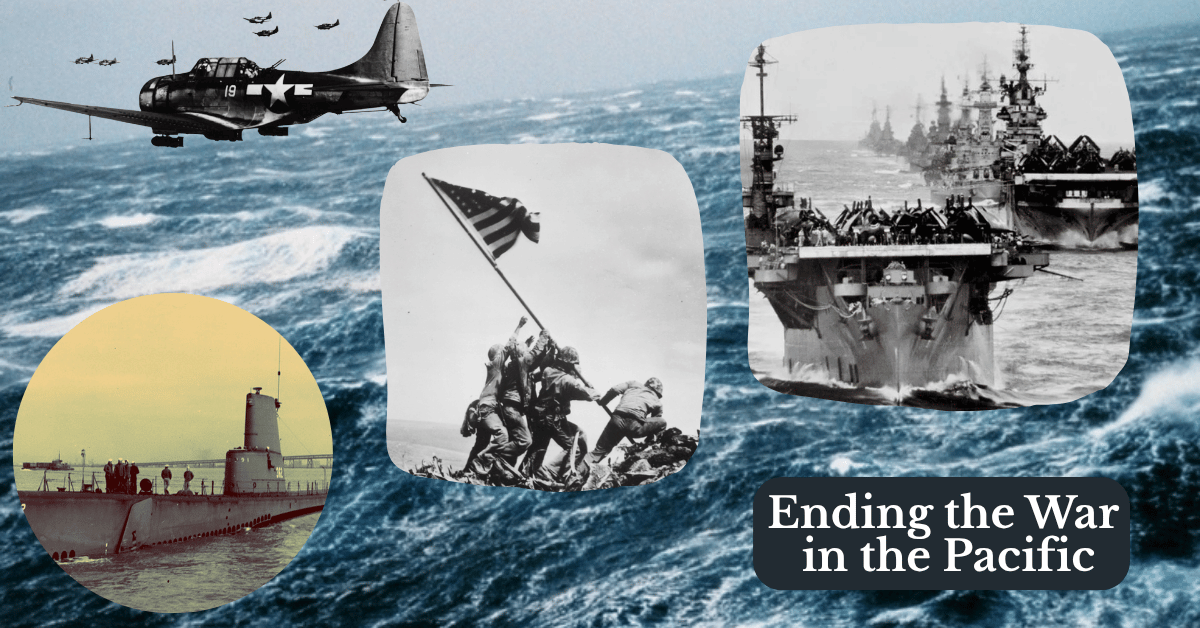
Image credit: various photographs from Naval Aviation Museum, National World War II Museum, and US Navy Archives.
Discover more from friarmusings
Subscribe to get the latest posts sent to your email.
 friarmusings