
The title may have caught your eye and caused you to wonder about the dates. Shouldn’t the War in the Pacific be dated from December 7, 1941, the attack on Pearl Harbor, until September 2, 1945 and the surrender of Japan aboard the USS Missouri? Certainly those are the dates which involved the United States and her allies. But war in the Asia-Pacific region had already started with the Sino-Chinese war, long simmering, but breaking out into open warfare in 1937. Japan had occupied Manchuria since 1931, but then invaded much of China from 1937 onward, including Beijing, Shanghai, Nanjing, and the coastal regions). French Indochina (Vietnam) was invaded next: the North in 1940 followed by the South in 1941. Well before Pearl Harbor troops were already in position to launch attacks against Cambodia, Laos, Thailand, Burma, Indonesia (Dutch East Indies), Malaysia and Singapore, Brunei and Borneo, Hong Kong, parts of New Guinea, the Marshall Islands, Truk, Palau, the Marshalls, and other Micronesian islands. It should also be remembered that Japan ruled the Korean people during the 20th century.
The United States was drawn into a war already underway for more than 4 years.
In the 1960s historians and moralists began to criticize the decision to drop the atom bombs on Hiroshima and then Nagasaki. As noted in the post Genesis of the Series,, the two primary objections and points of critique offered were on moral grounds and on military necessity. The moral objection was that the atomic bomb deployment killed tens of thousands of civilian non-combatants and thus violated just war principles and humanitarian norms. The military objection was that Japan was already militarily defeated and seeking ways to surrender.
The historians of the 1960s did not have access to the diplomatic and military intelligence that was highly classified in their time, but it was intelligence that was available (and used) by the decision makers of 1945. That intelligence was unclassified in 1995 and made available to a later generation of historians and has been incorporated into this series. If you’ve read the series to date (available here) the point has been made that there is a difference between defeat (a military assessment) and surrender (a political decision). Via any measure, by the end of July 1945 Japan was defeated – at least it had no pathway to victory. They also had no political means to surrender as evidenced and described in the posting between Oct 3rd and Oct 10th (2025). But they weren’t seeking surrender – at least not unconditional as demanded by the Potsdam Declaration – they wanted a negotiated settlement that would allow them to retain their holding throughout Asia and essentially keep the elements in government that had brought about the Asia-Pacific war in the first place. Japan was not seeking surrender at the end of July 1945.
The moral objection raised the issue of “just war.” In the 1960s it was raised in the context of the atomic bombs, but in this series – still ongoing at this writing – is that the atomic bomb was not available for deployment. Nonetheless, the question remains: was the Asia Pacific a just war?
My plan (hope) is to write a parallel series to publish at 7:10 am each weekday that begins to offer some insight on the question of just war. And for that we need to dig a little bit into the foundations of “just war” and its roots in largely Catholic moral theology. I will offer a “30,000 foot” view of the origins, development and how the theory of “just war” came to be. I hope to make it accessible as possible and leave references for those who want a deep dive into the subject.
For this series, militarily, the Allies still face the decision of how to end the war with available conventional weapons and is it possible to do so within the theory of just war. Stay tuned.
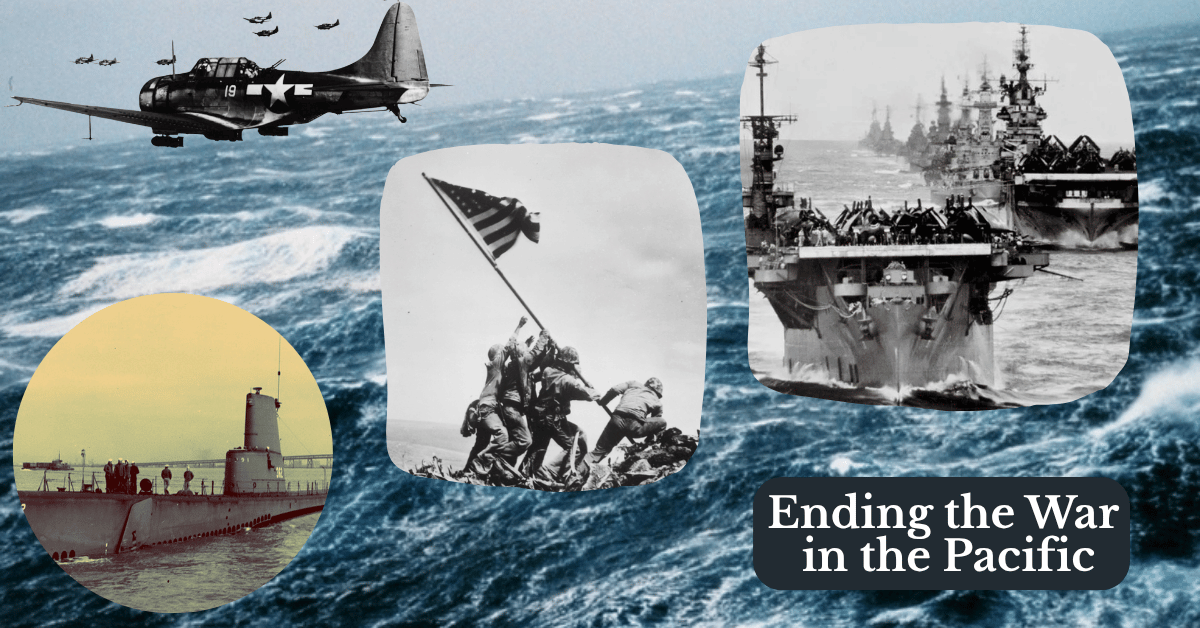
Image credit: various photographs from Naval Aviation Museum, National World War II Museum, and US Navy Archives.
Discover more from friarmusings
Subscribe to get the latest posts sent to your email.
 friarmusings