
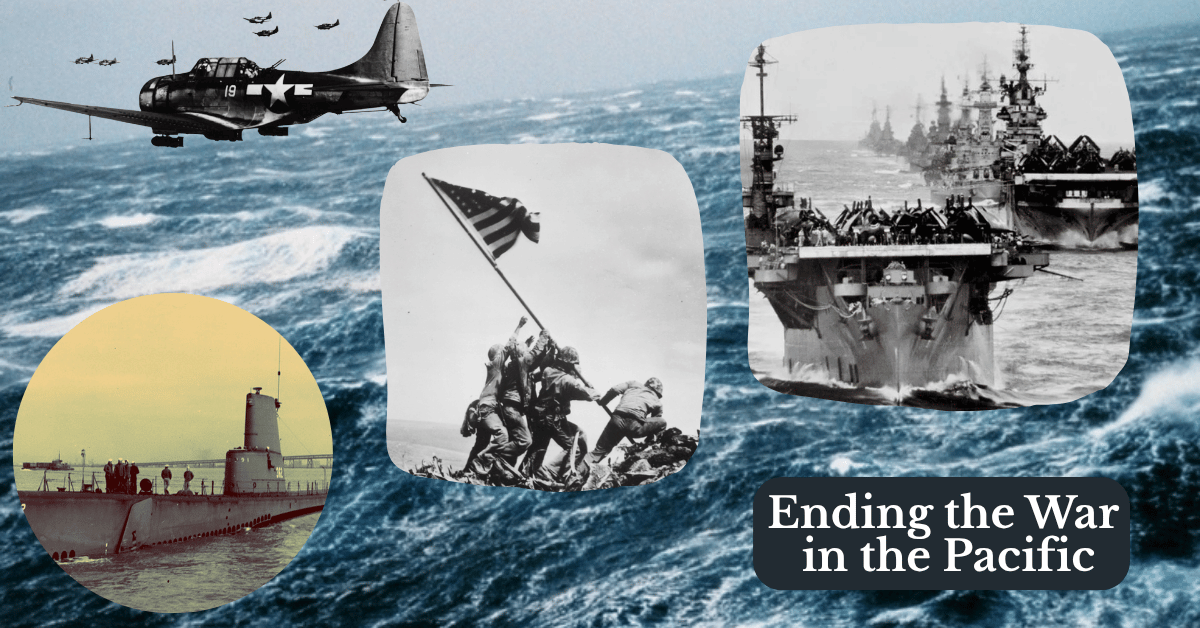
It was a busy month. Mounting military losses and the inability of Prime Minister Koiso to garner consensus within the War Council led to the collapse of the government and the appointment of Admiral Suzuki as Prime Minister. It takes time to form a government – and meanwhile there is a lot going on. Iwo Jima is reaching its bloody end just as Okinawa begins to unfold. The losses among land forces, naval personnel (viz. kamikaze) and especially among civilians will be horrific and impactful.
Some argue that April 1945 was a lost opportunity. Suzuki was the new prime minister and there are those historians who assert that he was an advocate for peace. That is probably wishful thinking. He was an absolute opponent of unconditional surrender but at the same time was a proponent of Ketsu-Go. He was not a hardliner like Army Chief of Staff Umezu and War Minister Anami, but one of his first acts was to sign a pledge presented by a delegation of generals from IJA/HQ that committed Suzuki to prosecute the war to its fullest as outlined in Ketsu-Go, the plan to defend the home islands to the bitter end – no surrender. Hardly a peace advocate.
There were some shuffles and changes in the War Council, but overall there was no real change of views at the table. Anami, Umezu, and to some extent Suzuki, were hardliners that were committed to Ketsu-Go. The other three (Navy Minister Yonai, Foreign Minister Togo and Navy Chief of Staff Toyoda) were committed to Ketus-Go as well at that point in time. It is also important to know that the “Big 6” operated within the imperial headquarters (HQ) environment. The Navy was reasonably orderly, by the Army HQ was a hive of the militarist and ultranationalist wing of the armed forces – and made their influence felt in government. Umezu and Anami were the leaders of that hive, but unlike some of their junior officers, they understood their role at a strategic level and how they were called to serve the Emperor. The immediate staff in the War and Army department was made up of militarists committed to the final battle at the tactical level. For some of the junior officers, loyalty to the Emperor was secondary to their vision of Japan’s destiny and living out the bushido code.
Even if Suzuki was an advocate for “peace” in some form, he “inherited” a War Council that was united around the March decision for Ketsu-Go. Remember, he could only present a unanimous decision to the Emperor.
It is easy to imagine that on the day Suzuki took office he wondered about the difficulty of the task that lay ahead of him. His day was about to get worse. On the same day Suzuki took office, April 5th, the Soviet Union informed the Japanese government that they would not renew their neutrality pact, in which they promised not to enter the war in the Pacific. The Japanese-Soviet Neutrality pact had its roots in serious armed conflict in 1938-1939 along the Manchurian–Mongolian/Siberian border as Japan tried to expand its Manchurian territories to the North and West. This was just the latest conflict present since the Japanese-Soviet War in the early 1900s.
The 1939 German–Soviet Non-Aggression Pact surprised Japan. Berlin, its nominal Axis partner, had essentially made peace with Moscow just as Japan had been fighting the Soviets. This left Tokyo diplomatically exposed. With tensions high, both Japan and the USSR had reasons to avoid a two-front war. The Soviets feared German aggression. By securing peace with Japan in the east, he could concentrate forces in the west. A neutrality pact would allow Japan to focus on expansion southward (toward Indochina, the Dutch East Indies, the Philippines) without worrying about Siberia. The pact was signed on April 13, 1941. Both sides pledged to respect each other’s territorial integrity and neutrality if either was attacked by a third power.
From Tokyo’s perspective (wishful thinking), the Soviets did not abrogate the Soviet–Japanese Neutrality Pact outright but rather gave notice that they would not renew it after its expiration in 1946. That was certainly the diplomatic and legal conclusion. Soviet Foreign Minister Molotov told Japanese Ambassador Naotake Satō that the Neutrality Pact of 1941 had “lost its meaning” and “the prolongation of that pact has become impossible.” Therefore, the Soviet Government “does not intend to renew the pact at the expiration of the five-year term, that is, on April 13, 1946.” Allied diplomatic intelligence (MAGIC) had already been tracking diplomatic tension between Japan and the Soviets. But there is more to the story.
At the December 1943 Conference in Tehran, Stalin told Roosevelt and Churchill that once Germany was defeated, the USSR would enter the war against Japan. Though no date was fixed, this already suggested Moscow did not view the neutrality pact as binding for the long term. U.S. records of the conference confirm Roosevelt and his advisers left convinced that Soviet entry against Japan was a matter of when, not if.
By mid-1944, the allied intelligence had reached the conclusion that Moscow would abandon neutrality at the earliest convenient time. This was confirmed at the Yalta Conference in Feb 1945. Stalin gave Roosevelt and Churchill concrete promises: the USSR would enter the war against Japan three months after Germany’s surrender. In exchange, Stalin secured territorial concessions (Kuril Islands, southern Sakhalin, influence in Manchuria). This effectively confirmed to U.S. leaders that the neutrality pact would not be renewed and that Soviet action against Japan was planned. The Soviets had already begun to move troops east to the Manchurian border.
Given the trajectory of the war in Europe, the U.S. believed that for the Soviets to attack in summer 1945, they would have to legally denounce the pact in spring 1945 (the April deadline). MAGIC intercepts of Japanese diplomatic traffic showed Tokyo was anxious about the possibility of Soviet betrayal and actively probing for Soviet assurances, sensing the pact’s fragility. They were right to be worried.
There are articles and commentaries by historians that argue part of Truman’s decision to use atomic weapons was out of concern that Russia would enter the war in the Pacific. That view makes no sense. We knew that the Soviets had already started to move troops to the Mongolian and Siberian borders. The Soviets had already agreed to enter the war within 3 months of Germany’s surrender – which appeared extremely likely to end in late April or early May 1945. That means, the Soviets would be ready by early August 1945.
Even more strange is the argument that Japan was trying to enlist the Soviets as brokers to start negotiations with the Allies – and they indeed were – but that somehow those making the argument thought the Soviets would be honest brokers. The Soviet intent was clear. They intended to achieve in 1945 what they had failed to achieve in 1905 – warm water ports in the Pacific. The shortest route to that goal was the promised war on Japan.
On April 12th, President Franklin D. Roosevelt passed away in Warm Springs, GA. Harry Truman was sworn into the office of President. He had largely not been “in the loop” and faced a steep learning curve. Where Roosevelt had a long connection with the military and especially the Navy, Truman had none beyond his service in the First World War. A lot had changed in those 25 intervening years.
Image credit: various photographs from Naval Aviation Museum, National World War II Museum, and US Navy Archives.
Discover more from friarmusings
Subscribe to get the latest posts sent to your email.
 friarmusings