
In May 1945, Germany surrendered unconditionally. Many commentators offer that this would have been the optimal time to organize discussions with the Allies about a negotiated peace, preempt Russian involvement in the Pacific War, and end the war on terms acceptable to Japan. No attempts were made – nor were they likely to have gotten “off the ground.” The mindset of the Council was devotion to the Ketsu-Go plan. Suzuki had zero possibility of reaching a unanimous Council position in order to present such an option to the Emperor.
Meanwhile, during this time period, Leyte has fallen, Luzon is all-but-defeated, Iwo Jima has been taken, and Okinawa is in progress. Allied bombing and firebombing continues. The submarine blockade is tightening its hold. The last oil tanker reached Japan in March 1945. Japan had their oil, gas and aviation fuel reserves and no hope to replenish their stock – which was more than 1 million barrels. At the same time B-29 sealane mining is grinding coastal sea traffic to a halt, naval shore bombardment continues and there is no decisive battle left save Okinawa (doubtful) or Ketsu-Go, the defense of the home islands.
In this time period Emperor Hirohito had asked for two reports: (a) Estimate of the World Situation (prepared by the Army staff) and (b) Sōri Daijin Hōkoku – “Report to the Prime Minister” (prepared by Admiral Sakomizu). Sakomizu was asked to produce an objective, comprehensive assessment of Japan’s military, economic, and social condition to guide decisions about continuing or ending the war. The report painted a grim and realistic picture.
The Sakomizu Report
Sakomizu represented a nation on the verge of economic collapse. US air raids had virtually destroyed the industrial base. Fuel, steel, and other critical resources were exhausted or cut off by blockade. Merchant shipping had been reduced to a fraction of prewar capacity, making resupply from the colonies (e.g., rice from Southeast Asia) impossible. This last part was accompanied by the troubling report of a growing food crisis. Domestic agricultural production had fallen sharply due to lack of fertilizer, tools, and manpower. The 1945-46 rice harvest was forecast to be near 50% of the normal harvest. All this while food imports had collapsed with the loss of shipping. Sakomizu warned of mass starvation if the war continued into 1946.
As regards the military, Sakomizu reported that the Imperial Army and Navy no longer had the means to launch significant offensive operations. Weapons production was declining steeply; shortages of aircraft, ships, and ammunition were critical. And that cities would continue to be burned down as there was no effective air defense against the relentless waves of B-29s. The only deterrent was the weather.
The continuing, unrelenting bombings and shortages were eroding public confidence. Sakomizu opined that the people’s endurance was near its limit. People had departed the cities in droves, placing increased pressure on the smaller towns, cities, and farming communities. Their departure further reduced the industrial base in terms of factory labor and the supply chain of smaller companies that provided component parts to the larger factories. Among those remaining in the larger cities, absenteeism was rising as laborers spent increased time searching for the basics of life: food, fuel, and such.
Sakomizu concluded that Japan could not sustain the war beyond the end of 1945. He warned the government and the emperor that prolonging the conflict would mean national collapse, famine, and ruin. It was one of the first high-level acknowledgments within Japan’s leadership that the war was unwinnable and provided the emperor with a stark, data-driven picture of Japan’s inability to continue the war.
Some historians believe that the themes of the report began to arise in May and June’s imperial conferences as the Emperor began to reference the worsening economic and food situation. At the same time in Supreme Council and Cabinet gatherings, Foreign Minister Tōgō and Lord Keeper of the Privy Seal Kido used parts of Sakomizu’s analysis in arguing that Japan must at least seek Soviet mediation for options of a negotiated end to the war. The hardliners did not object but made clear, all remained subject to Ketsu-Go. The same historians see evidence of Sakomizu’s report in the Emperor’s August surrender “sacred decision” and subsequent report to the nation: Japan’s defenses were broken, the people could not endure more suffering, and continuing the war would bring “the total extinction of the nation.”
The World Situation Report
About the same time as the Sikomizu report, the Emperor asked the Army General Staff’s Operations Bureau to prepare a survey of the global strategic environment. (Sekai Jōsei Bunseki). It was less blunt than Sakomizu’s assessment but still sobering. Key sections of the report focused on Germany, the Soviets, the United States and Britain, and China.
The report acknowledged that Germany’s defeat was inevitable and near. Japan could no longer count on Germany to divert Allied forces. And as a point of fact, Japan should expect massive transfer of troops, equipment and supplies from the European theater to the Asia-Pacific Region. This would place pressure not only on the home islands, but also Malay, Burma, Java and the whole of the occupied territories.
The report noted that the Soviet Union was clearly preparing to shift against Japan once Germany fell. This was evidenced by the Soviet military buildup on the Manchurian and Mongol borders. At the same time, the Chinese Nationalists were regaining ground on the mainland as allied supply lines from Burma were providing the difference.
The report regarding the United States and Britain noted that U.S. industrial power was overwhelming and the ability to produce war goods, logistically support all their amphibious landing simultaneously and at a distance across the entire Pacific, was simply too much. This report was possibly the first formal acknowledgement to the Emperor that it was a war of attrition that Japan could not hope to win. The final assessment was that the invasion of Kyushu/Honshu seemed unavoidable.
The report’s conclusion suggested that Japan’s options were shrinking: either fight a defensive war to the bitter end or seek some kind of negotiated settlement before the Soviet Union entered the war. The authors of the report, members of the Army staff, delivered the report as commanded by the Emperor and were immediately transferred to Manchuria and what would soon be the “Russian Front.”
The Fundamental Policy
The two reports were also delivered to the Supreme War Council and the full cabinet. The response to the two sober assessments is telling in that it will show the state of Japan’s leadership’s thinking just two months before surrender. On June 8, 1945, the Supreme War Council approved a document formally titled: “Fundamental Policy to be Followed Henceforth in the Conduct of the War” (Kongo Sensō Suikō ni Kansuru Kihon Hōshin).
The key point of the document was that Japan would prosecute the war with all available resources, even if it meant the nation’s destruction. The leadership accepted the possibility of “100 million dying together” (ichioku gyokusai, “honorable suicide of the whole people”). Reaffirming their commitment to Ketsu-Go, Japan would mobilize all civilians and military forces to inflict such heavy casualties on invading U.S. forces that the Allies would offer more favorable peace terms.
The Allies’ demand for unconditional surrender (from the Yalta and Casablanca declarations) was rejected – and this was 6 weeks before the Potsdam Declaration. The associated goal was preservation of kokutai, the national polity centered on the emperor. But one new pathway appeared. While continuing the fight, Japan would seek Soviet mediation (before the USSR entered the war) as a way to end the war short of unconditional surrender.
At the Imperial Conference of June 8, 1945, the Supreme War Council formally presented the draft of the “Fundamental Policy” to the Emperor for approval. Normally, Hirohito would listen, nod, and approve without comment. But this time, he spoke up. According to the official minutes (Sugiyama Memo and postwar testimony), he said: “I desire that you give careful thought to the ways and means of ending the war, in order to relieve the suffering of my people.” This was not a veto of the policy, but it was a pointed reminder: even while approving a fight-to-the-end stance, Hirohito was giving evidence that there was an acceptable alternative to Ketsu-Go.
Some would note that Hirohito had moved to the “peace faction” but was constrained by his understanding of the role of the Emperor under the Meiji Constitution. I think that is true and his concern for the people was sincere. But at least equally of concern was postwar continuity of the Imperial Household. For personal benefit? For national polity? They don’t have to be separate issues. He could have
It is significant in that Emperor Hirohito seemed to be moving beyond his usual role as a passive approver and was starting to “nudge” policy.
Yet, on June 9 Hirohito issued an Imperial Rescript endorsing the Fundamental Policy to give moral and symbolic backing to that decision. It read, in part: “The war situation has become exceedingly severe, and the trials which the nation must bear will grow heavier. It is Our wish that all Our subjects will overcome these trials, secure in their faith in the eternal nature of the Empire. All officers and men of the Army and Navy, together with all Our subjects, must unite their total strength, and by enduring the unendurable, be resolute in carrying on the war to the end.”
The Rescript gave the Fundamental Policy the Emperor’s public voice and legitimacy. It was essentially a rallying cry for total resistance, even if the nation faced destruction, serving to strengthen national resolve for the defense of the homeland..
The Secret Memo
After the Fundamental Policy was approved, Lord Kido Kōichi (the Lord Keeper of the Privy Seal, and one of Emperor Hirohito’s closest advisers) delivered a secret memo to the Emperor on June 9: Jikyoku Shūshū no Shori Hōan, “The Draft Plan for Controlling the Crisis Situation.” Kido’s draft plan was a candid alternative to the Fundamental Policy. Whereas that policy was essentially “fight on while probing for Soviet mediation,” Kido argued the opposite: that Japan needed to move quickly toward ending the war.
In many ways, his memo carried on the conclusion of the Sakomizu Report. Kido viewed Japan’s situation as without hope, emphasizing that Japan could not continue fighting much longer: the economy, food supply, and military power were collapsing. He warned of famine and the complete destruction of the kokutai if the war was prolonged. Kido strongly urged that Japan should take the initiative in seeking peace, rather than waiting until total collapse. He was also clear that the Soviet Union was not to be trusted and that Japan should directly approach the Allies. He recommended approaching the United States and Britain directly, perhaps through neutral intermediaries such as Switzerland, Sweden, the Vatican.
Kido was the first to suggest and commit to what would become known as the “one condition surrender”: preservation of the imperial institution (kokutai). Kido suggested Japan should be prepared to give up everything else—including disarmament, loss of overseas territories, even occupation—if necessary, to secure the survival of the throne.
Historians wonder about Kido and the “one condition surrender.” Was he incredibly insightful in essentially outlining what would be the form and shape of the surrender two months later? Was he speaking to what he knew as the deepest concern of the Emperor? Was he committed to the Imperial Household as the embodiment of the kokutai?
When Hirohito intervened in July–August to press for surrender (even before the atomic bombs and Soviet entry), he was drawing on the arguments Kido had laid out in June. In that sense, Kido’s memorandum was one of the intellectual and moral foundations of the Emperor’s eventual choice.
On the other side of the world, June was an equally important month for the US Allies.
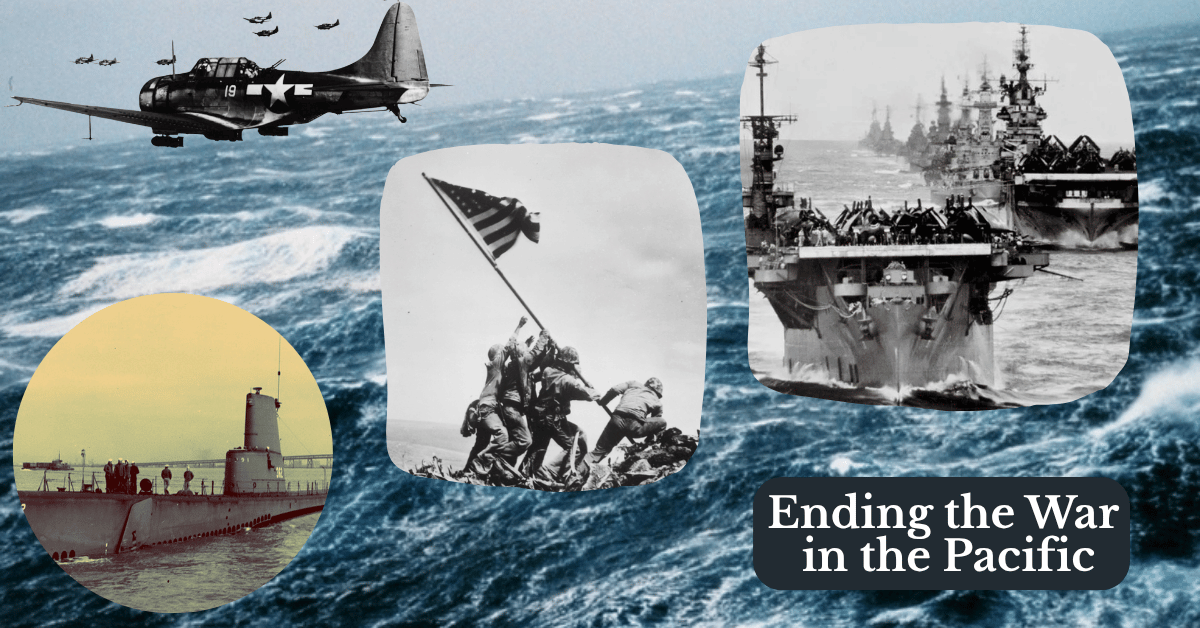
Image credit: various photographs from Naval Aviation Museum, National World War II Museum, and US Navy Archives.
Discover more from friarmusings
Subscribe to get the latest posts sent to your email.
 friarmusings