
In the previous post we considered the basis of modern just war theory in the writings and reflections of St. Thomas Aquinas. His thoughts became the basis for reflection on wars prior to the 20th century. For example, in the 16th century the Dominican Francisco de Vitoria applied just war thinking to Spain’s wars of conquest in the Americas. While he rejected armed conflict against indigenous people for the cause of conversion, he argued that the Spanish explorers had freedom to be in the foreign lands and their defense was just. Thomas’ thoughts were applied to conflicts between Christian monarchs, regional disputes, and the such. It was not until the 17th century that Hugo Grotius, De Jure Belli ac Pacis, used the theory and applied just war reasoning to the Thirty Years’ War and European state conflicts. His work was foundational in international law and guided legal-political thinking for centuries. It also reflected the changing nature of war in the western European world.
In a very different setting, during the Crusades of the 11th–13th centuries, medieval theologians and canonists defended the Crusades as just wars under Aquinas’ principles. Their understanding was that the wars met the criteria: legitimate authority in the Pope; a just cause in defense of pilgrims and recovery of holy places; and the right intention, namely service to God. It was not until the late 16th century in the work of Francisco Suárez that “proportionality” was considered.
During the First World War, unsurprisingly, theologians – both Roman Catholic and Protestant – saw their own nation as the just cause. Under Pope Benedict XV, the Catholic Church’s stance was formally neutral. In his 1917 letter Dès le début and the peace proposal of 1917, Benedict lamented the war as a “useless slaughter” and urged peace. But theologians often defended their own nation. German Catholic thinkers argued Germany’s war was defensive against Russian aggression, hence “just cause.” French Catholic clergy pointed to the German invasion of neutral Belgium as proof that France’s cause was just, defending international law and innocents. Anglican leaders argued Britain had a moral duty to defend Belgium’s neutrality and oppose German militarism, stressing right intention—not conquest, but restoration of peace.
All combatants claimed their governments had properly declared war. Each side said it was defending. Each side claimed to seek peace, but on its own terms. Proportionality and discrimination were largely absent from the discussion
The Swiss theologian, Karl Barth, condemned the manner in which theologians in every nation simply “baptized” their government’s war policy. In his later Commentary on the Book of Romans, he wrote: “Theologians and pastors from every side had allowed their faith to be put in the service of the war.” Ecclesial historians see the First World War as a case when the just war tradition was co-opted by nationalism.
In the years before the United States’ declaration of war upon Japan, the atrocities of the Japanese army against Chinese civilians was well known. British and American Catholic and Protestant missionaries and local church clergy had made known to Church leadership the details of Japan’s aggression. They called on U.S. Christians and the U.S. government to weigh ethical responsibility. While they might not always have used the formal categories of just war theory in theological terms, their arguments often invoked analogous moral criteria: aggression, innocence of civilians, complicity, and the duty to protest or act.
In the Episcopal Church’s publication “The Witness” (November 1939), an open letter from an American missionary in China addressed to the Presiding Bishop decried U.S. complicity by way of supplying war-related materials (steel, oil) to Japan:
“We in the American Church Mission are given a unique opportunity … But … as Americans we must hang our heads in shame because of the fact that it is our country that is aiding and abetting Japan in this cruel war. What is the little we can do in the way of good as against the far faster evil which is also made possible by American aid with steel and oil? … If America would absolutely refuse to supply Japan with war materials, this war could be brought to a much speedier end.”
In the U.S. Roman Catholic circles, the Maryknoll Missionaries were witnesses to the atrocities, especially Nanking, and were vocal advocates of a call to action. The priests, sisters and brothers sent reports to the home Maryknoll Office, as well as U.S. and foreign embassies. In their writings for publications and during mission appeals to church audiences in the U.S. they were descriptive of the massacres, rape, and looting – calling on the faithful to appeal to their Representative, Senators and to the President. The same messaging became consistent in the national Catholic press and media.
After the war, though the atomic bomb has understandably dominated Catholic just war reflection, a number of Catholic theologians reflected more broadly on World War II through the lens of just war. Figures such as Jacques Maritain, Romano Guardini, Johannes Baptist Metz, John Courtney Murray, and Yves Simon uniformly agreed that the war against Nazi Germany and Japan met the just war criteria jus ad bellum – but each also questioned the known effects of strategic bombings, intentional fire bombing, and failure to discriminate actions against civilians as failures, jus in bello.
In his 1944 Christmas address, Pope Pius XII insisted that true peace must be based on justice, not merely victory. He implicitly judged the Axis war of aggression as unjust, while warning Allies not to perpetuate injustices in victory. As regards the Nuremberg and Tokyo/Manilla War Crimes Trials, Pope Pius XII issued no official documents, but commented indirectly in speeches and addresses. He affirmed that crimes committed during the war were morally grave, and that there had to be accountability. At the same time, he voiced concern about victor’s justice. In a 1946 address to the College of Cardinals, he warned against “arbitrary justice” that might be applied unequally, stressing that law must remain impartial and not become an instrument of vengeance. He was concerned that opportunities for clemency in individual cases might be overlooked in the effort to ensure such militarism did not arise again.
Such is the very short course of the history of just war theory leading up to and through the end of the Second World War. Apart from committed pacifists, at least in the western tradition, the consensus is that the allied nations had just cause to declare war against the Axis powers of Germany, Italy and Japan. That addresses the question jus ad bellum, leaving the questions jus bello and jus post bellum. As to the latter, given the history of the two nations, while perhaps not perfect, the two principal Axis powers, Japan and Germany, were rebuilt with massive western aid, democratic nations arose, economies thrived, and each took their place among the nations. Jus post bello would not seem to be a question that is raised.
The question of interest is jus bello, especially as it concerns the ways and means to end the Asia Pacific War. In the language of Just War Theory – were the ways and means “proportional” and was adequate care given to the question of non-combatant injury and death.
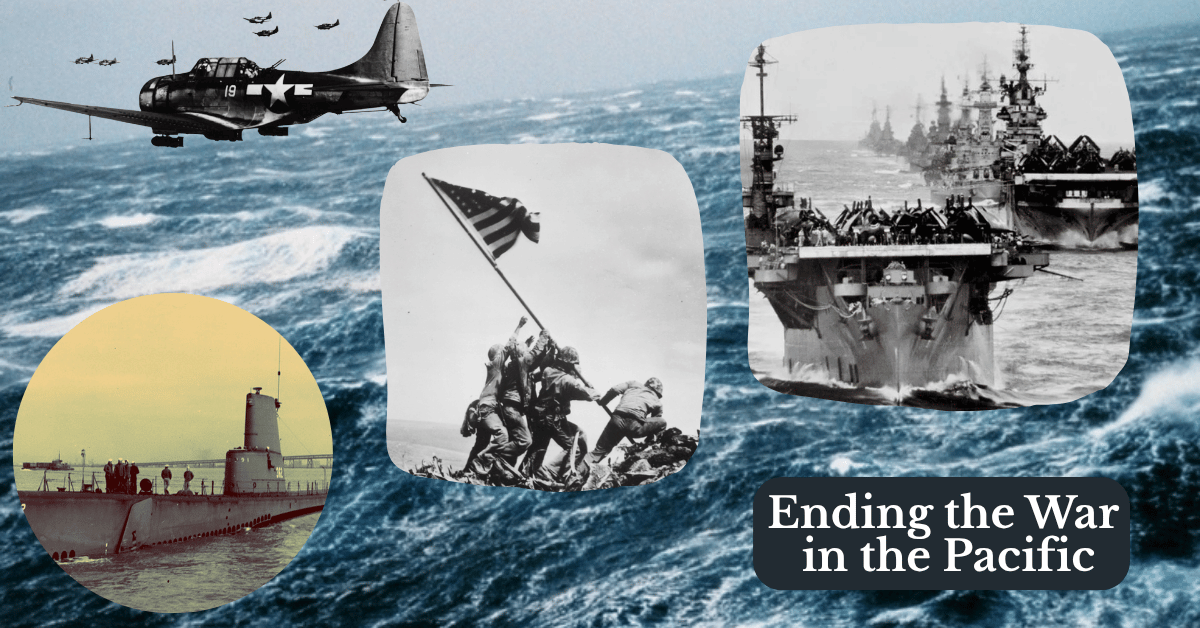
Image credit: various photographs from Naval Aviation Museum, National World War II Museum, and US Navy Archives.
Discover more from friarmusings
Subscribe to get the latest posts sent to your email.
 friarmusings