
After the May 1945 German surrender, arrangements were made for the Allies to meet in Potsdam, Germany. The topics were to settle the postwar arrangements for Europe and to reach agreement on coordinated Allied military operations against Japan. A month before the mid-July Potsdam Conference, President Truman met with his senior advisers to go over plans for ending the war with Japan and to prepare himself for Potsdam. In a 14 June memorandum to the service chiefs setting up this meeting, his Chief of Staff, Admiral Leahy, said the President wanted to:
“. . . discuss details of our campaign against Japan. He expects at this meeting to be thoroughly informed of our intentions and prospects in preparation for his discussions with Churchill and Stalin. He wants an estimate of the time required and an estimate of the losses in killed and wounded that will result from an invasion of Japan proper. He wants an estimate of the time and the losses that will result from an effort to defeat Japan by isolation, blockade, and bombardment by sea and air forces. It is his intention to make his decision on the campaign with the purpose of economizing to the maximum extent possible in the loss of American lives. Economy in the use of time and money cost is comparatively unimportant. I suggest that a memorandum discussion of the above noted points be prepared in advance for delivery to the President at the time of the meeting. . . .”
Leahy’s memorandum was forwarded immediately to the Joint Planning Staff and the Joint War Plans Committee who had the task of preparing the initial draft of the paper. This was not a task they were expected to accomplish in just a few days. It was a task to compile a cogent summary of the planning work that had been done, in stages, since late 1944.
It did catch some senior planners off guard. Gen. George A. Lincoln, the senior Army representative on the Joint Planning Staff, remarked on the phrase: “his intention to make a decision on the campaign.” He found the comment “a little disturbing . . . it is late in the day to be making decisions” The reference was to the May 25th formal directive from the Joint Chiefs of Staff (JCS) to General Douglas MacArthur, Admiral Chester Nimitz, and General Henry “Hap” Arnold, instructing them to begin detailed and final planning for Operation Olympic. The target date had already been set for a November 1, 1945 landing.
As Leahy’s memo made clear, the one singular question to be answered for the President was what were estimates of allied casualties for Operation Olympic. Interestingly, discussions among various planners focused not only on what the proper casualty estimate would be, but also on whether an estimate should even be offered.
On 15 June 1945, the Joint War Plans Committee submitted its draft of the requested paper to the Joint Planning Staff. The paper presented essentially the same case for an invasion of Kyushu that had been made in the earlier debates preceding the operational directive of 25 May. It also incorporated the same forecast of Japanese forces (six combat divisions, two depot divisions, 350,000 men) that had been presented in intelligence estimates going back to mid-1944. Estimates that were increasingly incorrect and alarmingly low as June moved into July. The casualty estimates were 106,000 (killed, wounded, MIA).
A revised version of the 15 June report was circulated the following day to the Joint Chiefs through the Joint Planning Staff, which had made a few changes to the language. Although most of these were little more than minor modifications to the wording, there were two important exceptions: the Joint Planning Staff version deleted both the entire casualty estimate table and the figure that showed total US personnel (766,700) who would be involved in the Kyushu operation. The JCS draft offered no descriptive language or numbers to replace these deletions. Historians have researched the reasons for this decision, but apart from personal recollections offered years later, there are no working notes indicating why.
In an apparent effort to close or narrow the gap between presenting no casualty figures at all and presenting numbers that the Joint Planning Staff was unwilling to use with the President, the Army’s Director of Operations, Maj. Gen. J. E. Hull asked his staff for casualty figures for recent Pacific operations (Leyte, Luzon, Iwo Jima, and Okinawa – the last of which was still underway). What was presented was a table of ratios: Japanese to American casualties (killed, wounded, MIA). Campaigns pre-1945 showed a 5:1 ratio. The Iwo Jima and Okinawa campaigns revealed a 1.25:1 ratio indicating Japan had well learned the lessons of Biak and Peliliu.
In parallel to this, the Army Chief of Staff, Gen. George Marshall inquired of MacArthur – the designated Allied Overall Commander of Olympic – for his staff’s estimates. He provided a number of 105,000 but at the same time remarked that he thought the estimate to be high.
The Navy did not provide updated estimates from May, as both CNO Admiral King and Admiral Nimitz had already withdrawn their support for Operation Olympic because of the high and increasing casualty estimates. It was their command that was affected by Okinawa and Iwo Jima. It is noteworthy that Nimitz’s staff projected the loss of 25 aircraft carriers, 10 battleships, and 40 cruisers and destroyers due to Japanese Special Action Units (kamikaze air, surface and subsurface units as well as coastal defenses/mines.) Hundreds of other ships were expected to be damaged, many heavily.
Presenting the Case
The 18 June meeting with the President was attended by Marshall, Leahy, King, Secretary of War Stimson, Secretary of the Navy Forrestal and others. Marshall presented the summary report that General Hull had prepared, including the casualty figures from various operations in the Pacific and the ratios. The report also included the judgment that “There is reason to believe that the first 30 days in Kyushu should not exceed the price we have paid for Luzon.” Admiral Leahy challenged the Luzon comparison; he contended that the casualty rate from an invasion of Kyushu would be more likely to resemble the experience on Okinawa. Noting that the rate on Okinawa had been 35 percent, Leahy suggested that applying that percentage to the number of US personnel to be committed to the Kyushu operation would produce a more realistic casualty estimate.
The meeting minutes do not show Marshall or any of the other participants taking the logical next step–calculating what a 35-percent share of this total would be. Had someone done that math, the answer would have been 268,450 US casualties – 2.5 times higher than the estimates of JWP or MacArthur.
A lot of the remaining discussion focused on the ability to reinforce the Japanese garrison once the battle had begun. It would turn out to be a pointless discussion. When the President asked about the size of the Japanese forces expected to be encountered in an invasion of Kyushu, Gen. Marshall cited the longstanding estimate that by November the Japanese would have a total of 350,000 military personnel on Kyushu – and no ability to reinforce.
By late July, the Japanese had a total of 990,000 military personnel on Kyushu and an unknown number of Civilian Defense Force fighters. In a worse case scenario, if the “ratios” of Iwo Jima and Okinawa held (1.25:1) that implied 792,000 Allied casualties.
The one question that President Truman wanted answered on June 18th was the casualty estimate: “It is his intention to make his decision on the campaign with the purpose of economizing to the maximum extent possible in the loss of American lives.”
There is no record in the meeting minutes of his receiving a direct answer.
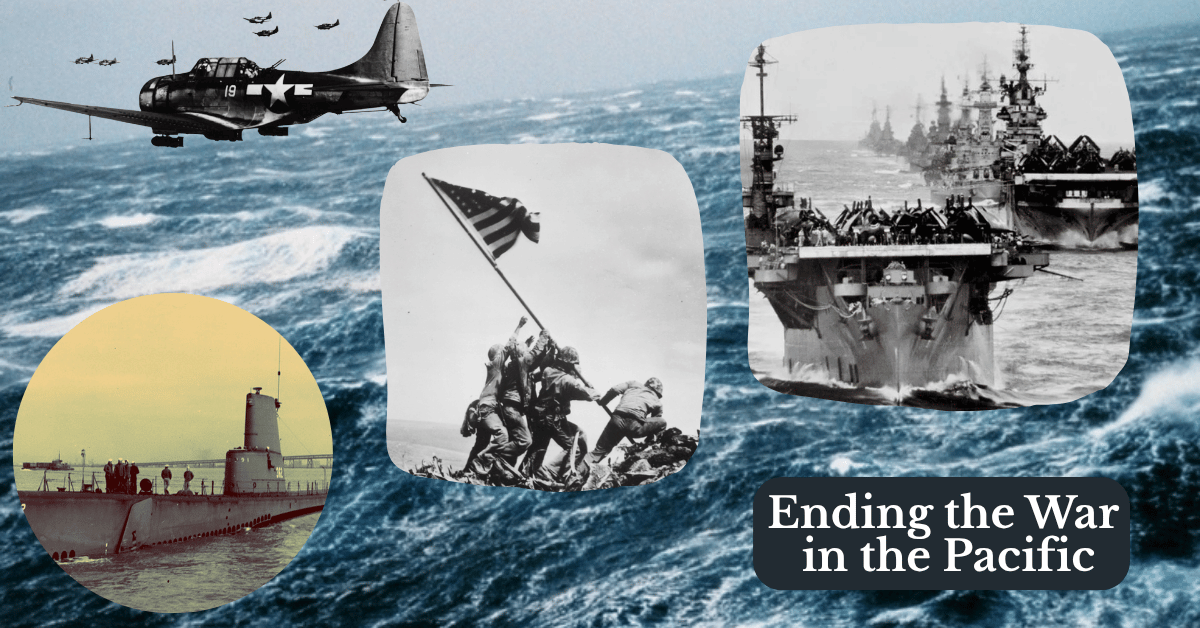
Image credit: various photographs from Naval Aviation Museum, National World War II Museum, and US Navy Archives.
Discover more from friarmusings
Subscribe to get the latest posts sent to your email.
 friarmusings