
The previous post ended with this: “The question of interest is jus bello (in war), especially as it concerns the ways and means to end the Asia Pacific War. In the language of Just War Theory – were the ways and means “proportional” and was adequate care given to the question of non-combatant injury and death.? In preparing to write on this topic I am not sure how to best describe the reading and research. The following expressions come to mind: “down the rabbit hole,” “swamp,” and “forget the forest, I am still looking for trees.” Whereas the conditions for establishing jus ad bellum are consistent and have been clearly expressed, not so much for jus bello. It is an understatement to say there are “different schools of thought.” The debate centers on two concepts: proportionality and necessity – that are intertwined.
One of the schools of thought are the “consequentialists.” Although I did not see a delineation of “schools with a school,” the literature certainly seemed to indicate a wide division in views of writers that would be counted as consequentialists. For the sake of brevity, I would label them the “wide” and “narrow” schools of thought and would provide an example of each (with apologies to just war theorists and their work.)
One theorist of what I am calling the narrow school described the following as their understanding of proportionality and necessity. An innocent person on the street is being attacked by an unjust aggressor. The innocent person has just reasons for self-defence but now their response needs to be necessary (in this case, a given) and proportional. If the self-defence results in the death of the unjust aggressor, then the response is proportional. If the only means for the innocent person to defend themselves will result in the death of a bystander then the innocent person may not defend themselves because their action causes the loss of “an even more innocent life.” The example went on to speculate that were two innocent people being unjustly attacked and their defense took only one bystander’s life, then the action is jus bello because then the response is proportional. As you can imagine, any attempt to apply that thinking to an actual armed conflict is meaningless from the beginning. And even less connected to the real world, the narrow school places the moral burden on the individual warfighter.
The wide school seemed to say that it was really only after the cessation of conflict would one be able to tell if the jus bello was proportional. Which might be more realistic, but leaves little guidance to the war planners and in the end leaves the moral and spiritual burden with the warfighter. What is lost in between is the death of “bystanders” – and even that is murky. What about the non-combatant working in the factory that is producing the means by which the unjust aggressor is able to pursue their unjust war. In other words, the theorist world is divided into combatants and civilians. The real world is not so orderly. Consider the experience of the allies on Tarawa, Saipan, and Okinawa (to name a few) when some of the civilians were essentially indentured workers (i.e. slaves for all practical purposes) from Korea and China that were forced to take up arms. Consider the experience of the warfighters on Okinawa when the civilians, technically Japanese, were incorporated into “Iron and Blood” units to serve as attack troops, but were not necessarily uniformed. The real world of combat is chaos where survival is a core human response. Yet when the battle is over the memories remain. What was proportional and necessary gains no clarity.
During World War II there was no Convention or Treaty that addressed civilian casualties. It took 32 years after the end of the war until such language appeared in widely accepted principles. The clearest statement of jus bello proportionality in law is in Article 51(5) of Additional Protocol I of the 1977 Geneva Conventions, which prohibits any ‘attack which may be expected to cause incidental loss of civilian life, injury to civilians, damage to civilian objects, or a combination thereof, which would be excessive in relation to the concrete and direct military advantage anticipated’ (emphasis added). The absolute prohibition against civilian deaths does not exist in law or convention. The incidental loss of civilian life is held “in the balance” against “direct military advantage anticipated.” The intended targeting of civilians for no other reason than to target them is prohibited.
Just war theorists (some) and international lawyers have settled on military advantage as the one effect of military action against which harms caused to civilians are to be measured in the assessment of jus bello proportionality. What is assumed is that the immediate aim of military action that harms civilians was as a side effect and not the principle aim of the action. As a matter of morality, jus bello proportionality has to weigh the harms that an act of war inflicts on people against the act’s impartially good effects, that is, the contribution the act makes to the achievement of a just cause.
Note: the above is by no means a complete treatment but if offered a first look for the readers of this post.
How do just war theorists apply the above to the Asia Pacific War? To be fair, most modern theorists try to apply their principles to the war in Bosnia, Iraq, Afghanistan, and Gaza where urban combat is a primary feature of the conflict and the combatants are often regular combatants vs. irregular combatants (insurgents, revolutionaries, etc.). The several treatments I read do not seem to understand the battleground of the Asia Pacific War. Their view seems to be that the unjust aggressors are the Japanese military, the just defenders are the Allied military, and the innocents/civilians are the Japanese citizens. That is the limit of what they address. There was no mention of Koreans, Chinese, Burmese, Vietnamese, Malayans, Javans, Filipinos, and the civilians of numerous other Asian, Indonesian, and Microneasan countries. As historians Richard Franks and Jonathan Parshalls have pointed out, in the last months of the Asia Pacific War, some 70,000 non-Japanese civilians were dying each week. In the last 12 months of the war 1 million Vietnamese died, mainly of starvation because of Japan actions to misappropriate food supplies for the home islands at the expense of the Vietnamese.
In this Pan-Pacific scale, jus bello proportionality, necessity, military advantage, good effects, are variables in what must appear as an unsolvable jus bello determination. Militarily, the Allies still face the decision of how to end this just war with available conventional weapons and is it possible to do so within the theory of just war.
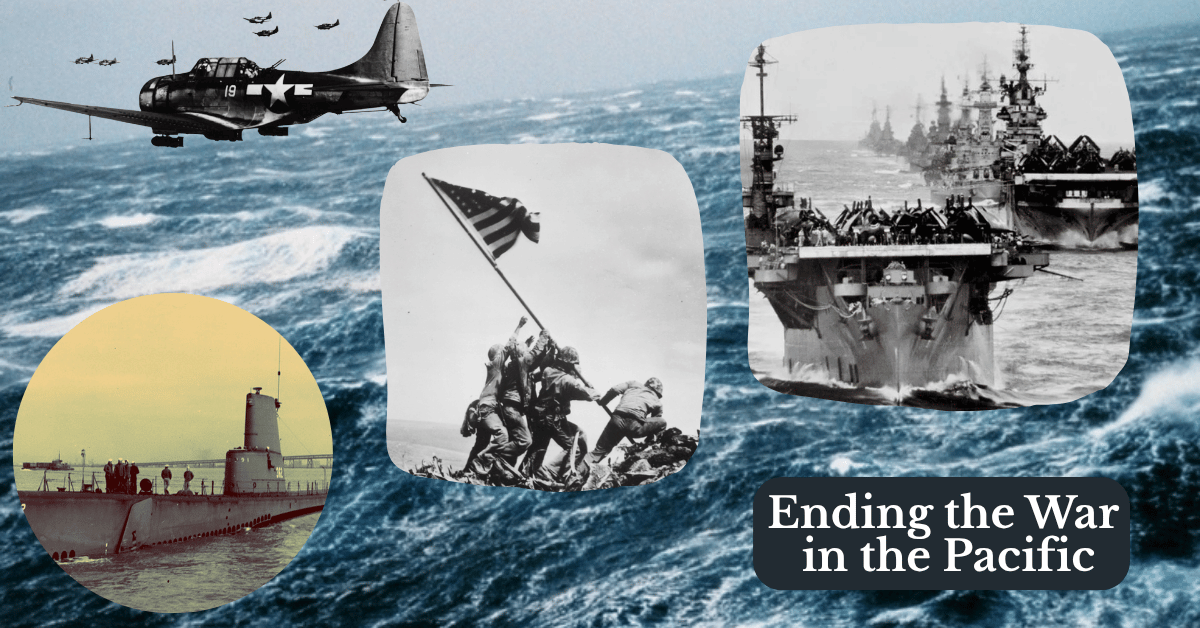
Image credit: various photographs from Naval Aviation Museum, National World War II Museum, and US Navy Archives.
Discover more from friarmusings
Subscribe to get the latest posts sent to your email.
 friarmusings