
This is an addendum to the “Olympic Decision” post. It continues the thread of thought that suggests President Truman left the June 18, 1945 without a firm answer to expected losses – not to say he wasn’t briefed later. But it also addresses the historians who offer that post-war Truman inflated the estimated US losses associated with an invasion to “more than a million.”
In the earlier article it was posited that based on Japanese troop strength on Kyushu by the end of July and a casualty rate similar to Okinawa, there would be an estimated 792,000 allied casualties. By and large those are ground force casualties and do not account for shipboard naval losses. In Admiral Nimitz’s early May estimate, his planning staff projected massive losses due to kamikaze attacks: 25 aircraft carriers, 10 battleships, and 40 cruisers and destroyers. Japanese documents and testimony of naval leadership indicated that the Kyushu kamikaze efforts would be primarily aimed at troop transports and supply ships. The troop ships (Attack Transport-AP) varied in size but this will give you an idea of the capacity.
| Campaign | Number of APs | Total Troops | Average per AP |
| Marianas | 70 | 80,000 | 1,150 |
| Leyte | 200+ | 170,000 | 850 |
| Iwo Jima | 66 | 70,000 | 850 |
| Okinawa | 300+ | 180,000 | 600-1,000 |
| Kyushu (est.) | ~975 | ~780,000 | ~800 |
This would be at three different beachheads.
In the post Special Attack Forces – Kamikaze, the experience of kamikaze gave the naval planners great concern – and that was when the assumed target would be the warships which by 1945 were floating anti-aircraft (AA) gun platforms. The troop ships did not carry substantive AA capability.
At Okinawa, transports had been relatively well protected by picket destroyers, but still several APs were hit (e.g., USS Henrico, USS Hinsdale, USS Achernar). For Operation Olympic, because of the scale (1,000+ ships off Kyushu), planners knew the Japanese could not be prevented from reaching the transport anchorages in massed waves. These anchorages would only be a couple of miles offshore.
The experience at Okinawa revealed that it was not enough to shoot and hit the kamikaze. The 20mm and 40mm guns were plentiful but even blowing the wing off a suicide was not enough to ensure that the kinetic energy of the plane did not continue ahead and plow into the ship. And it was not just the airplane. Most kamikaze planes carried at least one 500 lb bomb. The 5-in/38 caliber naval gun had the range and projectile to disintegrate the plane.
At Okinawa the Japanese sorties flew ~300 miles to reach the US fleet, but to do that they fly into a defense at depth that began with combat air patrols (CAPs) covering the fleet with the “big blue blanket,” a screen of radar picket ships relaying information to Combat Information Centers (CIC), and then through the screens of destroyers, destroyer escorts, LCV gun ships, light cruisers, cruisers, and battleships.
That defense in depth would not be possible for the Kyushu amphibious landings. The campaign would rely on pre-invasion CAP missions to suppress airfields as well as shore bombardment to accomplish the same.
The U.S. Navy’s Joint Staff Planners estimated 30-40% of transports in the assault waves could be sunk or heavily damaged. It was estimated that 30,000 to 50,000 U.S. troops would be killed or drowned at sea before even landing. And that was the cost among soldiers and marines.
The Joint Staff Planners estimated that between 50,000 and 100,000 U.S. Navy officers and sailors would be casualties depending on how heavily kamikazes penetrated defenses. In addition carrier air groups were expected to take 20–25% losses in the first month, or about 4,000–5,000 naval aviators killed or missing. These would not be air borne casualties but would be associated with the loss of aircraft carriers.
There is little wonder that Admiral Nimitz and King did not support Operation Olympic.
The June 18th briefing may not have reported the loss projections to the President, but I think that the “more than a million” estimate was well warranted.
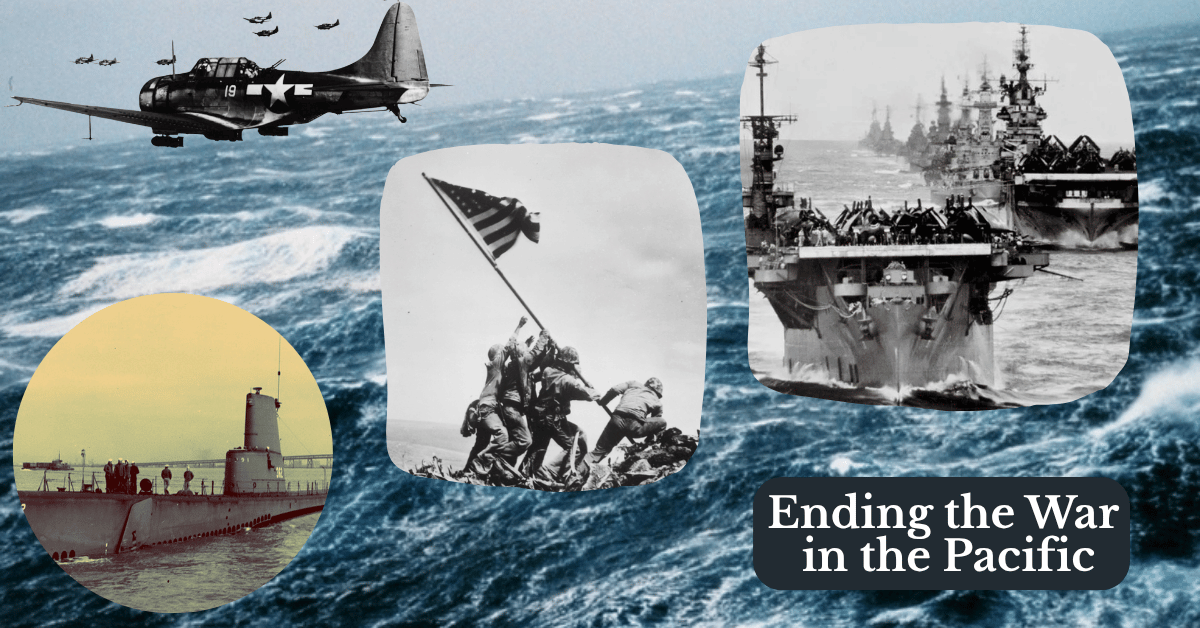
Image credit: various photographs from Naval Aviation Museum, National World War II Museum, and US Navy Archives.
Discover more from friarmusings
Subscribe to get the latest posts sent to your email.
 friarmusings