
One of the things that surprised me about publishing (news, magazine articles, books, etc.) is how little control the author has over the title. That is the domain of the publisher and editors. The title is meant to hook you, to raise your curiosity and interest in the created content by the author. Several years ago I ran across a book with the following title “An Economist Walks Into a Brothel.” The publisher accomplished their mission; I bought the book. It is a book about risk – the ways we assess it and manage it. The first chapter was very interesting … and then it becomes less so. I probably need a publisher’s touch for the title of this post. I wonder how many times I will have changed it before I finally post it.
There is a lot of good information, scholarly articles, theological reflections, and more on just war theory. Some of it focuses on historical development. Some attempts to reinterpret the theory to fit modern context. Since the end of WW II that nature of war has changed whether we were paying attention or not. While always a threat, the likelihood of a “world war” is not (hopefully) on the horizon. Since the end of World War II the conflicts have been geographically limited – the interested parties might well be many – but the breadth of the conflict is limited to a region or even a single country. Theorists speak in terms of warfare as
- Intranational
- Cross border
- Revolutionary overthrow energized by political systems
- Etc.
The war in Vietnam in the 60s and 70s was intranational (North v. South Vietnam), was also cross border and revolutionary (Viet Cong), but was not international in scope. The same or similar can be said of other conflicts in the last 80 years. But in the first quarter of this century, conflicts are increasingly urban warfare where proportionality and necessity vs. military advantage are increasingly difficult despite a focus on “rules of engagement” (ROE) for combat missions. The recent experiences of Iraq and Afghanistan are replete with examples.
Consider how different the Asia Pacific War is compared to the conflicts in Korea, Vietnam, Serbia-Croatia, Kuwait, Iraq, Afghanistan, and Syria. These were just the wars involving the United States and don’t address the series of Pakistan-India wars (both of whom possess nuclear weapons) or the varied Israeli-Arab wars. The insurgencies are too many to list here.
In addition, armed combat increasingly involves people who do not have a view of Western just war theory. While some might point to the Geneva Convention as the international law equivalent thereof, such things can simply be ignored and withdrawn from. Japan withdrew from the League of Nations and the Washington Naval Treaty when it suited their needs. Cross border and internal revolutionary forces are not signatories to any convention and have often demonstrated a pattern (e.g. people traditionally seen as non-combatants acting as suicide bombers, lookouts, scouts, being used as shields, etc.) whose immediate effect is to place the moral burden squarely on the shoulders of the warfighter.
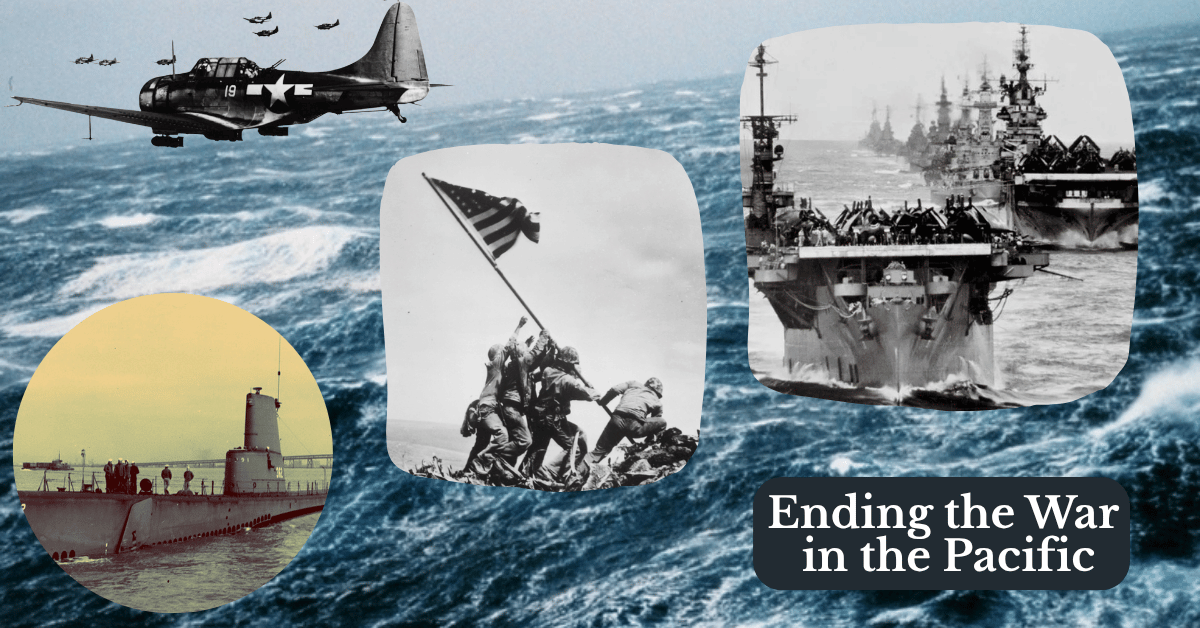
Image credit: various photographs from Naval Aviation Museum, National World War II Museum, and US Navy Archives.
Discover more from friarmusings
Subscribe to get the latest posts sent to your email.
 friarmusings