
When one talks about Japan’s efforts to end the war, there are those who claim there were numerous attempts, all of which were ignored by the Allies. There were indeed several and they were, for the most part, simply “noted.” The Allies then waited to see what might become of the Japanese inquiry.
What one must keep in mind is that diplomats, intermediaries, and private citizens can all be in conversation with important, well-placed individuals of other governments. Those individuals might informally pass along information, but there will be no substantive conversations that have a hope of going anywhere unless the government knows the inquiry was authorized by the Japanese government – not just the Foreign Minister, but the Supreme Council and Emperor – and there is some kind of “term sheet” outlining “this is what we want to talk about” and here is “the opening position.” Otherwise, it is just talk.
Unauthorized Inquiries
From April through August 1945 there were numerous unauthorized “peace feelers” carried out by diplomats, intermediaries, and private citizens. These were often uncoordinated, sometimes directly at odds with official policy, and usually reflected desperation on the part of individuals who thought Japan was headed toward destruction. Here are just a few of the more notable unauthorized inquiries at the diplomatic level. There were other private citizen contacts as well.
April 1945 – Portugal: initiated by the Japanese ambassador in Portugal speaking to the U.S. minister in Lisbon. The informational conversation was testing whether the U.S. might soften the demand for unconditional surrender. The conversation lacked substance. It was unauthorized and without a term sheet.
May–June 1945 – Switzerland. The Japanese minister in Bern used Swiss intermediaries to reach out to the U.S. and British representatives in Bern. The Japanese minister, Shun’ichi Matsumoto, wanted to explore ceasefire terms, especially around preservation of the Emperor. Allied intelligence of the MAGIC traffic revealed that the approach was unauthorized and that Matsumoto was in danger of being recalled for his efforts. Washington and London simply noted the inquiry and the Japanese government’s reaction.
Spring–Summer 1945 – Sweden: The Japanese envoy in Stockholm., Kumaichi Yamamoto began conversations with Swedish officials, who then relayed hints to U.S. and British diplomats about an openness to negotiated peace. The Allies regarded it as exploratory but again lacking authorization or substance.
May–June 1945 – The Vatican: Members of the Japanese Foreign Ministry and individuals like Prince Konoe Fumimaro (a former prime minister, working outside official channels) made appeals to the Vatican to mediate with the U.S. to see if the Papacy could soften Allied terms or protect the imperial institution. The Vatican did not pass on the inquiry, but the Allies were aware of the offer via MAGIC.
These unauthorized feelers reveal the fragmented state of Japan’s diplomacy in 1945. With no coherent policy until very late, scattered diplomats tried to improvise their own backchannels. The Allies were, at the same time, able to read official government message traffic that reiterated unconditional surrender was not an option. The unofficial efforts were dismissed. In total it simply reinforced Washington’s insistence on unconditional surrender.
Diplomacy with the Soviets
In mid-1945 there were several attempts to see whether the (then still-neutral) Soviet Union would be willing to serve as a mediator for a negotiated peace between the US and Japan. There are lots of twists, turns, subplots, and misdirects in the story of these attempts. Perhaps the best available/accessible source for all the details is Tsuyoshi Hasegawa’s “Racing the Enemy: Stalin, Truman, and the Surrender of Japan” (2005). He describes in great detail the different attempts that occurred in Japan with the Soviet ambassador as well as the attempts that occurred in Moscow with the Japanese ambassador. Hasegawa is not making the argument that Japan was ready or seeking a way to surrender. As he shows in his narrative, at no point did Japan offer a “term sheet.” Hasegawa’s point is to show there was a singular focus on the Soviet Union and no other nation. It begs the question, “why not multiple channels?”
The Supreme Council became aware of the unauthorized inquiries, effectively removing those countries from consideration. But even more important, the Army and Navy both distrusted second tier intermediaries who held no position of world power. The fear was that this would be seen as weakness.
In addition, officially pursuing multiple and parallel channels was thought to project desperation. Focusing on one great-power intermediary (the Soviets) gave the appearance of a serious, unified effort—at least diplomatically.
There was perhaps a strategic logic to their insistence on the Soviet Union. The Allies had declared at Casablanca (1943) and reaffirmed at Yalta (Feb 1945) that “unconditional surrender” was the policy. The Foreign Ministry believed that trying to negotiate directly with the U.S. or Britain would almost certainly bring the same rigid response. In addition there was no “term sheet” that the Foreign Ministry was authorized to offer as a starting point for discussions – or even discussions about having discussions. In early 1945 the Soviet were still officially neutral towards Japan. This made them the only major power not yet openly at war with Japan.
They led to a thinking that perhaps the Soviets could offer some leverage, acting as a mediator, to open a conversation about terms other than strict unconditional surrender. In June 1945 the Supreme War Council authorized Foreign Minister Tōgō to seek Soviet mediation through Ambassador Naotake Satō stationed in Moscow.
Of course, unbeknownst to Japan, Stalin had already promised at Yalta (Feb 1945) to enter the war against Japan within 3 months of Germany’s surrender (likely by August 1945). Thus, the Japanese strategy of relying exclusively on Soviet mediation was doomed from the start—Moscow never intended to help Tokyo except to buy time for its own preparations in the Far East.
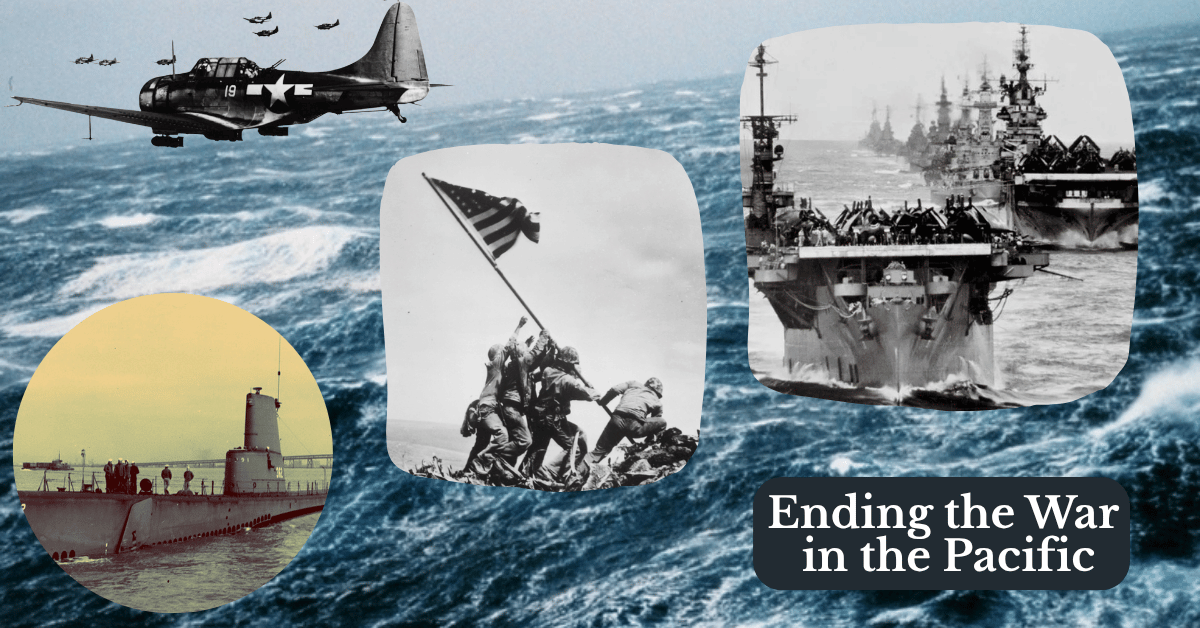
Image credit: various photographs from Naval Aviation Museum, National World War II Museum, and US Navy Archives.
Discover more from friarmusings
Subscribe to get the latest posts sent to your email.
 friarmusings