
Much of the Just War Theory conversations (apart from what I have called narrow consequentialism) centers on the deaths of civilian populations. Broadly reading the available literature there seems to be a rating of moral importance in which the moral weight is given to civilians over drafted military over volunteer military. In part, it is the theorist’s way to nuance out the factors involved in thinking through jus bello decisions. For example, if the only way to save 100,000 of our civilians’ lives from terrorist attacks is by bombing another country’s cities and intentionally killing 10,000 of its citizens – would it be an action jus bello? Or, what if some enemy civilians place themselves as voluntary shields around a military target, hoping to deter attacks on it. Have they become combatants? What if they are not voluntary but are being forced into that role as happened in the Battle of Manila? What if citizens, dressed as citizens, are part of a military charge against defended positions such as happened on Saipan? What if citizens have workshops, critical to war production, adjacent to their house as was common in Tokyo and other major industrial cities of Japan? What if only 20% of the homes in a neighborhood have such workshops but the majority of other residents work in the larger factory where home workshop items are assembled into war materials and weapons?
And if the larger goal is to end the Asia Pacific war to stop the mass deaths of non-Japanese citizens in Japanese-occupied territories, is it proportional and necessary to not intend, but to know that it is inevitable that Japanese civilians will die because of allied military actions that are scaled up to a national level? What if the action is not direct attack by armed forces and weapons, but simply the blockade of the aggressor nation that will result in increasing civilian deaths by starvation until the nations, already militarily defeated, finally politically surrenders?
Does a campaign of dropping millions of leaflets to warn civilians that their city is being scheduled to be bombed in the next five days mitigate the responsibility for civilian deaths? (Note: because of the unpredictability of Japanese weather more precise warnings were not deemed feasible) Was such action even necessary?
Some of the above or all of the above – assuming the war is just – still becomes wrapped up with battlefield tactics employed by the unjust aggressor. If the unjust aggressor places combatants among the local civilian populations, knowing that an attack is inevitable – and the intention was a military one, that is to preclude the attack – who is responsible for the inevitable civilian deaths. I would say that many of the theorists would place the responsibility upon the combatants who attack even though their intent and goal was not civilian deaths and their action was part of a large campaign to stop a far more serious case of civilian deaths. Most military commanders, after having exhausted other alternatives, would hold the unjust combatants responsible.
The Battle of Manila is almost a case study in this problem. The Japanese forces in the city were actively murdering civilians in intentional and sadistic ways. There were more than 27 different instances of major massacres of civilians in Manila during February 3-19: Dy-Pac Lumberyard, Masonic Temple, La Concordia College, Colegio de Sta. Rosa, St. Paul College in Malate, Fort Santiago in Intramuros, Palacio del Gobernador, and San Agustin Church in Intramuros to name a few. No one was spared, not even children, infants or children in the womb. The allies were receiving reports on the ongoing massacres. For a time, the allies did not use artillery, but ground troops only. Was the decision to begin to use artillery, knowing it would also cause civilian deaths, jus bello? Was it proportional and necessary? Historians such as Alfred W. McCoy, Teodoro Agoncillo and Richard Connaughton estimate that 75,000 – 80,000 of the 100,000 deaths were due to Japanese atrocities in the battle for Manila. When the battle ended there were people to identify and intern, and stories to record. The allies immediately began detailed investigations and recorded testimonies of survivors. These testimonies and the record of more that 250 other massacres that had happened throughout the Philippine islands became part of the War Crimes Trials.
One of Just War Theory’s goals is to protect the humanity of the combatants. There are some theorists that conclude the allied use of artillery on the southern part of the city of Manila was not justified (to be sure they are a minority). It leaves one to wonder if they lost the view of humanity while reaching their conclusions.
The Battle of Manila shocked U.S. planners, who realized that in Japanese cities, with even denser populations, civilian deaths could dwarf Manila’s losses. It reinforced the fear that invading the Home Islands would trigger catastrophic urban destruction and mass civilian casualties. Operation Downfall planners wondered if every major Japanese city could become “another Manila” — with garrisons refusing surrender and deliberately fighting from civilian areas. This meant that American troops could not expect rapid occupation of cities but house-to-house, block-to-block combat with massive losses.
Would Operation Downfall, the invasion of the home Japanese islands, be necessary? Would it be just?
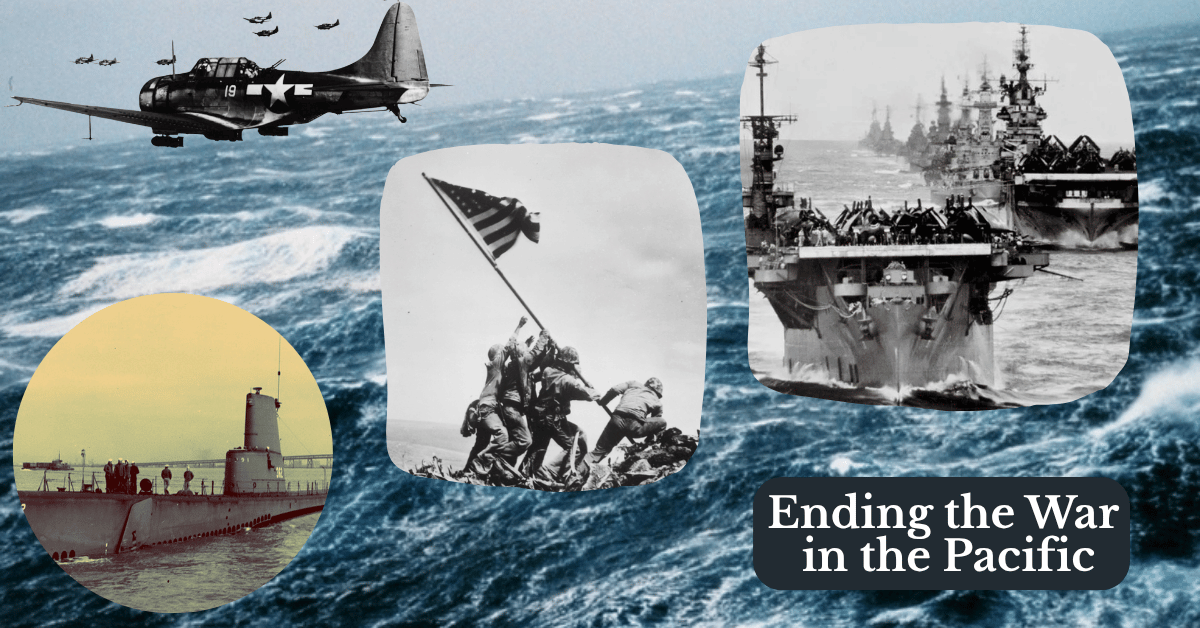
Image credit: various photographs from Naval Aviation Museum, National World War II Museum, and US Navy Archives.
Discover more from friarmusings
Subscribe to get the latest posts sent to your email.
 friarmusings