
As the summer progressed, the emperor and other key members of the inner leadership grew concerned and anxious that the civil order of Japan was threatened. In the breakdown of civil order, there was fear that the Japanese people would be ripe for a revolutionary moment. The root cause of growing dissatisfaction was the slow realization that the reports of Japanese victories were simply wrong. They had daily evidence that allied bombers controlled the skies and were unhindered in their devastating fire-bombing attacks on cities. The vaunted Japanese military could not protect them.
Food Crisis and the “domestic situation”
At the same time it was clear that the food situation was becoming increasingly dire. For too long Japan had relied on food from Korea, Taiwan, Manchuria, and occupied territories. U.S. naval blockade had cut off imports, and domestic stockpiles were being depleted. Japan did not have a developed roadway system and so internal distribution of food and supplies were dependent upon rail and coastal transport. US bombers targeted train tunnels in the mountainous and hilly regions. At the same time, B-29 continued the mining of the coastal waterways, dramatically reducing the capacity of that transportation system.
Prior to 1941, 40% of Japan’s rice was imported, primarily from Korea and China. By the summer of 1945 those imports fell to virtually zero. The Japanese government instituted food stuffs to replace rice: soybean, sweet potatoes, wheat, barley, millet and a variety of greens. The problem was that these substitutes did not provide the caloric intake needed. But even more, rice was not just a staple but a cultural cornerstone. Its scarcity created a deep psychological blow as it “whisphered” wartime defeat. The food problems led to malnutrition, absenteeism from work, and other social problems. “The domestic situation” became the euphemism describing the building dynamic. They projected the real crisis would come in the fall, particularly when the rice crop was due. The 1945 rice harvest was expected to be only 50% of the normal harvest.
If Japan had not surrendered and the war continued into the Spring of 1946, internal U.S. War Department estimated that between 5 to 10 million Japanese civilians were at risk of death. The Japanese Home Ministry, in mid-1945, projected that up to 10% of the population could die from starvation in 1946 if imports did not resume. That meant 7–8 million people.
Fear of Revolution
During the spring and summer of 1945, Prince Konoe and Lord Privy Seal Kido had concerns about possible communist or left-wing revolt taking advantage of the “domestic situation”. While they had concerns that unconditional surrender might not allow the Imperial House to continue, they knew from history that a communist revolution would certainly do away with the Imperial House. As the “domestic situation” continued, morale was collapsing. Kido and others feared that this could give space for radical political movements, especially communists, to mobilize urban workers and students. This was not simply paranoia: in the 1920s and 1930s, Japan had a small but persistent underground communist movement, which the police had harshly repressed. Kido worried that with defeat imminent, the state’s ability to repress unrest was evaporating.
Kido and Konoe were very conscious of how military defeat had triggered revolutions in other nations. In his diary Kido explicitly feared a “Russian-style collapse, ” referring to the 1917 Bolshevik Revolution or a “German-style collapse” following the end of WWI, where disillusioned soldiers and civilians turned against their governments. Konoe and Kido raised these concerns and fears in discussion with the Emperor and within elements of the Imperial Court. They argued that ending the war quickly was essential to prevent a domestic revolution from erupting.
They looked into Japanese society and saw what they considered precursors to revolution. There was labor unrest seen in factory absenteeism and strikes due to exhaustion or food shortages. There were scattered reports of reluctance among student labor battalions and conscripts resisting the draft into military service. At the same time the feared Tokkō (Special Higher Police, Japan’s “thought police”) was providing intelligence on radical talk among workers and students, noting that the idea of “revolution after defeat” was circulating. It should be noted that this had been an ongoing concern as since the 1920s, Japan enforced the Peace Preservation Law, which criminalized communist ideology and established the feared Tokkō. Under this law known Communist leaders had been imprisoned or were in exile. Kido feared that if defeat came and prisoners were freed with exiles returning, the Japanese Communist Party (JCP) could quickly reorganize, especially if the Soviet Union provided support.
Tsuyoshi Hasegawa (Racing the Enemy, 2005) and John Dower (Embracing Defeat, 1999) both note Kido’s fear of communism as genuine and served as a way to argue for surrender that resonated with Hirohito, who dreaded social revolution even more than military defeat. Otherwise there is little evidence of a mass revolutionary movement ready to seize power in 1945 Japan. The JCP was too weak and fragmented. But the fear of it was real among the ruling class and the Imperial Court.
Post War Food Crisis
To give you an idea of the extent of the crisis, within 6 months of allied occupation of Japan, the U.S. began large-scale emergency grain shipments, particularly wheat and rice. Between March and July 1946, over 800,000 tons of food were shipped to Japan, mostly by the U.S. government under emergency provisions as Japan was not eligible for United Nations relief as a former member of the Axis powers. Even still, malnutrition-related illnesses and deaths rose significantly through 1946. High rates of nutritional edema, low birth weights, and wasting diseases were experienced. Infant and child mortality spiked in 1946 due to malnutrition-related diseases.
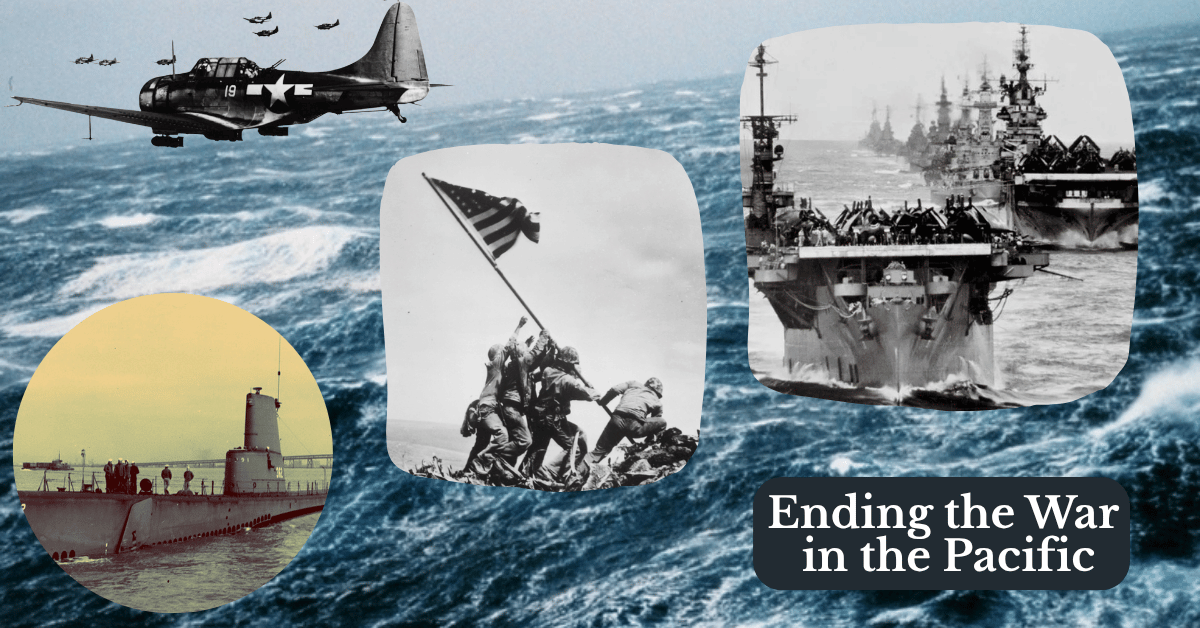
Image credit: various photographs from Naval Aviation Museum, National World War II Museum, and US Navy Archives.
Discover more from friarmusings
Subscribe to get the latest posts sent to your email.
 friarmusings