
“The sooner the Americans come, the better… One hundred million die proudly”
Such was the Japanese wartime propaganda campaign in 1945 as part of the Ketsu-Go defense plan against the inevitable invasion of the home islands by Allied forces. The slogan urged a total commitment, even unto death, to protect Japan. If necessary, Japanese civilians were to fight to the death to defend the homeland. Along with military operations, the goal was to inflict unacceptable casualties on the enemy and force a negotiated peace.
Japan had a standing army of 4 million men, but more than half were spread out across the Asia Pacific region with a large part garrisoned in China and Manchuria but unable to cross the Sea of Japan to reach the home islands because of the naval blockade, submarine operations, and mining of the sea lanes by allied bombers operating from Saipan. Thus the call for the people to come to the aid of their homes and nation.
For more than 2,000 years, Japan had never been successfully invaded. The most serious threat had come from two attempted Mongol invasions in the 13th century, both of which were thwarted by typhoons that caused massive losses of ships, sailors and soldiers. Although the story of the “Divine Wind” (Kamikaze) “grabbed the headlines” in both invasions, the on-shore Japanese resistance was epic. It is estimated that the Mongol losses approached 100,000 with survivors becoming enslaved. The foundational story became the intervention of the divine and total commitment of the people.
For the record, November 1st was the scheduled date of Operations Olympic, the Kyushu invasion part of Downfall. It was chosen in order to be clear of the traditional typhoon season, but on October 9th, Typhoon Louise (Akune) struck Okinawa full on. Okinawa would have served as a staging area for Operation Olympic. As it was there were still hundreds of U.S. ships and vessels in Buckner Bay that didn’t have time to escape to sea. Twelve ships and craft were sunk, 222 were grounded, and another 32 severely damaged beyond repair. Casualties included 36 killed, 47 missing, and over 100 with serious injuries. About 107 amphibious craft were grounded, many of them wrecked beyond salvage, including four of six LSTs that were driven aground. Eighty percent of the buildings on Okinawa were destroyed or severely damaged, many still packed with war supplies. It could have been worse.
Even with the war officially ended on September 2nd the damage was severe, but had Operation Olympic still been scheduled, it would have been far worse. It would have delayed the operation at least 45 days which would have placed the invasion in the maw of winter storm season.
Ketsu-Go Preparation
As massive as allied invasion preparations were forAlthough the U.S. invasion force for Operation, so too were Japanese preparations to counter it. Japanese Intelligence correctly estimated that the main objective for the initial allied landings would be southern Kyushu, specifically the Kagoshima Bay area, in order to establish an anchorage for Navy units and airfields to provide better air cover and close air support for the operation and follow-on operations. Southern Kyushu was just within the maximum range of U.S. fighters flying from Okinawa, one reason the Japanese assessed southern Kyushu would be the initial objective. The Japanese also correctly assessed that the U.S. would not attempt to take the entire island, but at some point would assume a defensive posture (to defend the new airfields) in preparation for the next planned major landings, which the Japanese also correctly believed to be near Tokyo.
One of the goals of the Japanese defense of Okinawa was “delay” to allow home island defence. The allied initial estimate of 30 days was off by almost a factor of three. That delay coupled with the unusual level of typhoon activity revised Japanese estimates of the invasion time table until late October or early November. The extra months were put to good use. There was ample time to reinforce troops on Kyushsu. In April 1945 there was 1 army division stationed on the southern island. By August 1st there were 15 army divisions, seven independent mixed brigades, independent tank brigades, and two coastal defense divisions. Total troop strength was 990,000. The allies planned to land 582,500 soldiers/marines across the three landing beaches with reserve forces bringing the eventual total to 766,700. As noted in earlier posts, amphibious warfare planning considered the minimum troop strength to be 3 times larger than the defense forces (5x was desired). The numbers for Kyushu (Operation Olympic) gave the advantage to the Japanese.
The strategy for Ketsu-Go was simple and was outlined in an Imperial Japanese Army directive of 8 April 1945. The tactical focus was the invasion but the strategic focus was the will of the American people to continue to support the Allied goal of “unconditional surrender” in the face of massive casualties. The Japanese assessed that the critical U.S. weakness was the ability to sustain such extremely high casualties. Thus, the primary objective of Ketsu-Go was not to hold territory or destroy equipment, but to kill as many Americans as possible regardless of the cost to the Japanese. The objective was to break the will of the American people to sustain such high casualties so that the war could be ended with a negotiated settlement that did not lead to foreign occupation of Japan and possibly allow Japan to hold onto some of its territorial gains in the Asia-Pacific region, especially Sumatra and its oil reserves.
The details of Ketsu-Go made clear that the Japanese were “all in.” Even though half of their army was outside Japan, they were committing all air and naval assets into the defense of Kyushu with the intent to kill as many Americans as possible at the beachhead. The aircraft carrier, battleships, and cruisers were not the targets. American troop transports and amphibious ships were the primary targets with the goal of killing as many as possible before they stepped foot on the beach.
The effects of U.S. naval gunfire figured prominently in Japanese defensive planning. The Japanese battle plans envisioned fighting in such close contact with U.S. forces that the battle lines would be so confused that U.S. advantages in close air support and naval gunfire support would at least be partially mitigated.
During the course of the war, the Japanese had learned what was effective and what was not. Derived from previous combat experience, there were three principles:
- Defensive positions should be constructed beyond the effective range of enemy naval bombardment and in locations that made air raids less effective.
- As at Iwo Jima and Okinawan, caves and redoubts connected by tunnels should be constructed for protection against air raids and naval bombardment and troop mobility
- Inaccessible high ground should be selected as protection against flame-throwing tanks.
In his summary review of Japanese plans, Admiral Cox USN (Ret.) noted: “The Japanese ground forces intended to use a layered defensive strategy that combined defenses at the beach with extensively dug-in positions inland and foot mobile reserves for eventual night counterattack. Tarawa, Biak, Iwo Jima and Okinawa were the proving grounds on how to build concealed beach defenses that could withstand all but a direct hit by a heavy caliber shell. The Japanese had even sent a team to Germany in late 1944 to learn from the German experience at Normandy. Behind the beach defenses was the “foreground zone,” much like the Japanese defenses on Iwo Jima and Okinawa, with mortars and artillery sited on the reverse slope of the first ridge (and camouflaged from air attack), close enough to engage the beachhead before U.S. troops could dig in. Further inland was the “main zone of resistance,” outside the range or inaccessible to naval gunfire, deeply dug-in against air attack, with caves and extensive tunnel systems enabling infiltration behind the lines of advancing U.S. forces.”
But all the above was not the first line of defence. That role fell to what remained of the Japanese Imperial Navy (IJN). By the end of July 1945 all first line combatants (aircraft carriers, battleships, heavy and light cruisers, and most destroyers) were sunk or inoperable. The last remnant of the fleet was destroyed in attacks on Kure Naval Base. What remained was:
- 38 fleet submarines equipped with torpedoes carrying 1,000 lb warheads.
- 120 manned suicide torpedoes (Kaiten), but as many as 1,000 would have been available by November.
- 1,200 Koryu and Kairyu midget submarines equipped with torpedoes or explosive charges (these were planned but allied bombing particularly disrupted construction so it is more likely only 350-400 would have been available.)
- All 19 of their surviving operational destroyers for one-way suicide attacks on the amphibious ships.
- 3,300 Shinyo suicide boats (with a 550-pound explosive charge in the bow)
- 4,000 Fukuryu suicide frogmen whose role was to attacked explosive charges to landing craft.
Air operations were to be limited to kamikaze attacks. Since April 1945 Japanese aircraft defense of the home islands had been minimal. It was thought that bombing had severely impacted airplane production as well as the ability to produce aviation fuel. Allied planners and intelligence officers were incorrect. The Japanese were beginning to marshall their planes and fuel for Ketsu-Go. During the month of July, allied reconnaissance airplanes found that most planes “destroyed on the ground” by naval aviation were in fact wooden models. The Japanese airfleet was being sequestered away from traditional airfields. Every attempt by fast carrier Task Force 58 to draw out opposition was unsuccessful.
Unlike at Okinawa, the kamikaze would only be deployed against troop transports and supply ships once they were within close proximity to the beach. The idea was to make maximum use of short flight times and terrain masking to achieve surprise and negate the U.S. radar advantage. Aircraft were to remain dispersed, camouflaged, and hidden until the amphibious ships were close to shore. Once the allied ships had drawn close, the Japanese army air attack plan called for kamikaze to attack in waves of 300-400 aircraft, at a rate of one wave per hour, day and night, until all aircraft and pilots were gone. This level sorties would have resulted in more kamikaze attacks in three hours than in the three months of the Okinawa campaign, and would have had a good prospect of saturating the defenses of transports when they were most vulnerable.
Estimates of how many kamikaze aircraft and pilots is a matter of some post-war speculation, but what all agree, is the Allies severely underestimated the suicide air fleet they would face. Throughout the summer of 1945 the estimates continued to grow. Post war studies revealed that by August 1945 there were approximately 12,700 aircraft (of all types) and 8,000 pilots available – with another 10,000 pilots in training. The phalanx of kamikaze would have overwhelmed the invasion fleet
Lastly, the Japanese intended to mobilize the “Civilian Volunteer Corps” – conscripted civilians with minimal training and no uniforms. Under the slogan, “The glorious death of the 100 million,” all males ages 15-60 and all females ages 17-40 were to be mobilized by Imperial Rescript. The training was mostly focused on the use of hand grenades, swords, knives, bamboo spears, or anything with a sharp point, with special emphasis on night infiltration behind U.S. lines. The Japanese deliberately had no plan to evacuate civilians from the battle area or to declare “open cities.” The civilians were expected to fight and die to the last with the soldiers, and as a result of extensive Japanese propaganda most Japanese civilians by late 1945 were resigned to that fate. The civilian population of Kyushu was 2,400,000. Whether they died fighting, were caught in the crossfire, committed suicide (as on Saipan and Okinawa), or were executed for not fighting, many tens of thousands of them were going to die.
The Japanese also planned that in the event of an invasion of Japan, all Allied prisoners of war were to be executed; that would have been about 15,000 dead Americans (and 100,00 total Allied), not counting any in the invasion force.
By any measure, an invasion of Kyushu would have been a bloodbath of epic proportions.
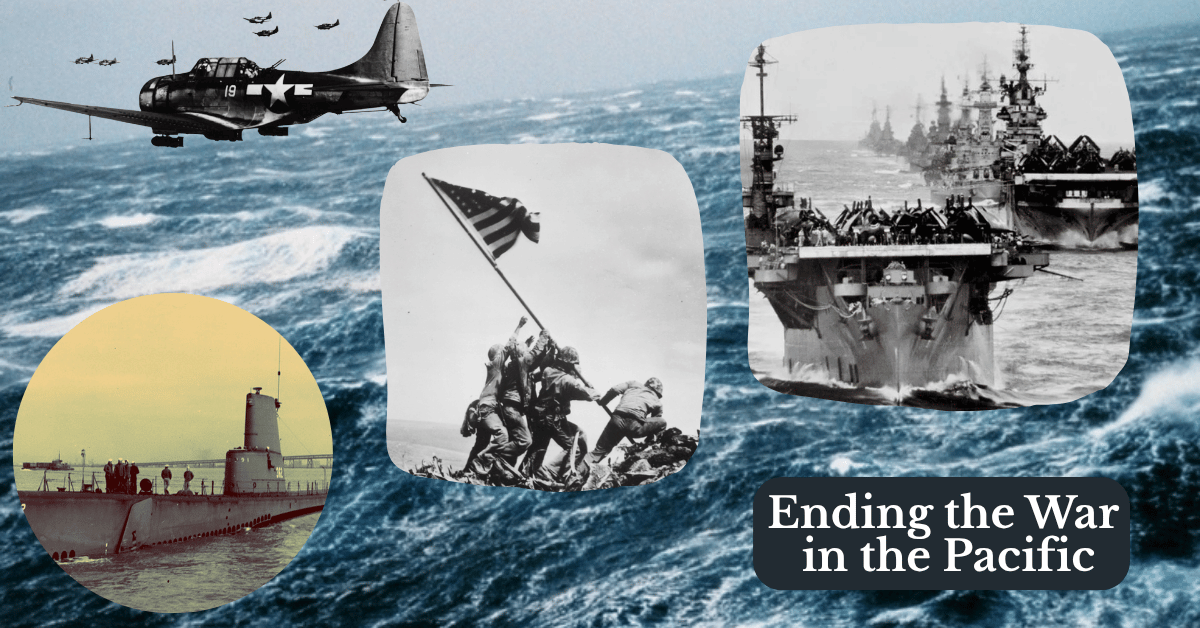
Image credit: various photographs from Naval Aviation Museum, National World War II Museum, and US Navy Archives.
Source credit: Operations Downfall and Ketsugo – November 1945 by Samuel J. Cox, Director, Naval History and Heritage Command | January 2021
Discover more from friarmusings
Subscribe to get the latest posts sent to your email.
 friarmusings