
Many years ago I prepared a couple for Sacramental Marriage. He was an Army Officer assigned to a local joint operations base and had primarily served in the Quartermaster Corp (Supply). He had written a history of Army Logistics in World War II. He gave me a copy and it was very interesting. My take away from the book was that perhaps the German generals and divisions were better than the Allied counterparts, but integrated allied logistics won the war in Europe. He certainly made a case. One of the examples he used in his book was the Battle of Anzio in Italy, especially during the major German counter attack against the Anzio beachhead. It was a detailed explanation of the same observation Rick Atkinson makes in his The Liberation Trilogy, the second book, The Day Of Battle. In short, the ability of the allied forces to deliver a massive tonnage of munitions (air, shore bombardment, artillery, etc) across the entire front of the German advance turned the battle.
This post is my homage to the logistics forces of the war in the Pacific.
Task Force 38/58 was the Fast Carrier TF of the Central Pacific Command. It was TF-38 when Adm. Bull Halsey was in command; TF-58 when Admiral Raymond Spruance commanded. (For simplicity I will use TF-58… I have preference for Spruance as commander). No matter who was commanding, as the TF-58 ranged across the breadth of the western Pacific, it was always supported by Task Group 30.8, the logistic command fleet.
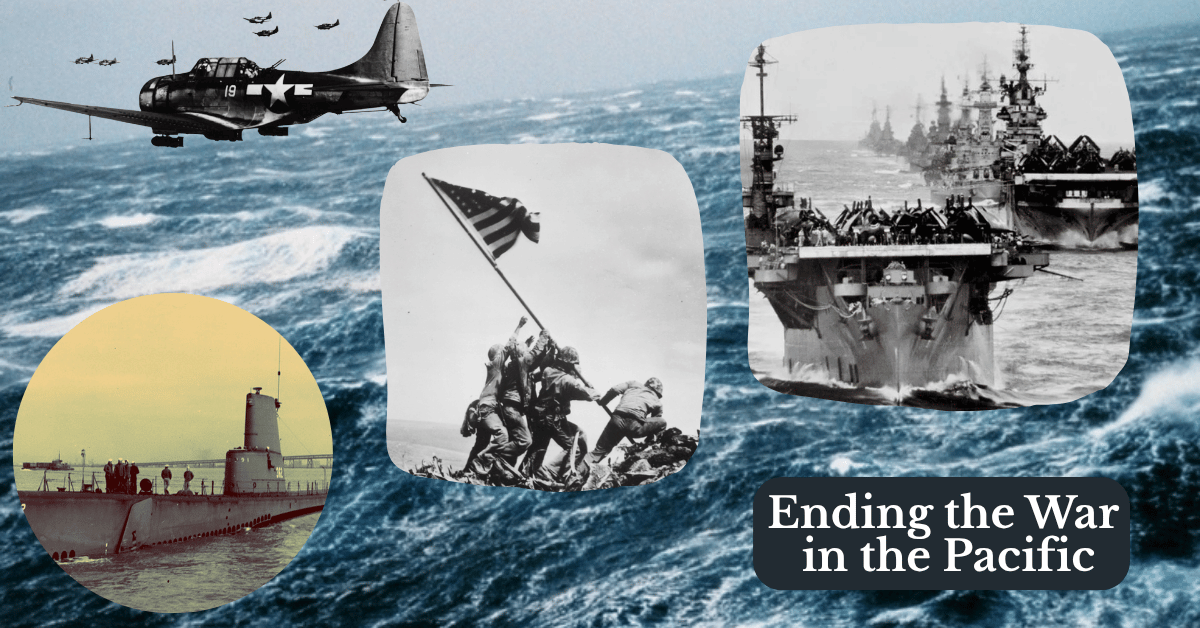
Task Force 58’s order of battle varied, but it was typically ~100 ships. The composition was centered on the large fleet carriers (like the Essex-class) and light carriers (like the Independence-class). Fast battleships (Iowa, South Dakota, and North Carolina classes) provided heavy gun support. A mix of heavy cruisers (like the Baltimore-class) and light cruisers (like the Cleveland-class) provided massive anti-aircraft protection, as well a large number of destroyers escorting and screening the carrier groups and other ships. The Task Force typically consisted of 17 carriers, 6 battleships, 13 cruisers, 58 destroyers, 1,100 aircraft. These assets were organized into four Task Groups, each task group with its own air group consisting of hundreds of combat aircraft, including fighters, torpedo bombers, and dive bombers. By the summer of 1945 the majority of the air group were fighters.
Rear Admiral Donald B. Beary commanded TG-30.8 from his flagship, the light cruiser USS Detroit (CL-8). The Task Group was organized into task/replenishment units (e.g., T.U. 30.8.1 “Replenishment Unit Able”, T.U. 30.8.2 “Replenishment Unit Baker”, T.U. 30.8.4 “Replenishment Unit Charlie”) — each made up of oilers, ammunition ships, stores ships, escort carriers for replacement aircraft, and screening escorts. A typical order of battle (or supply!) included 12 fleet oilers in December or 1944, growing to 30 by the summer of 1945. As important as the oilers were the AE / ammunition store ships which essentially were floating ammunition depots.
Ammunition ships and ammunition-carrying store ships were a central element; by the end of the war Service Squadron Ten controlled dozens of ammunition ships (e.g., historically there were ~50 ammunition ships under ServRon Ten and ~230,000 tons of ammunition in Ten’s stocks). These ships rode with or rendezvoused with TG 30.8 to transfer rounds to combatants. ServRon Ten was the “FedEx” to deliver “bullets, beans and black oil” from Guam to TG 30.8 wherever they happened to be.
Stores issue ships, refrigerated provision ships, repair ships (AF, AR types) and hospital ships were attached or issued to the Service Squadrons supporting TG 30.8 and were used to sustain the fleet between port calls. The AR (repair ships) could service battle damage at sea or at advanced repair facilities at Ulithi (and later Okinawa)
A small number of CVE escort carriers were assigned to TG 30.8 to deliver replacement aircraft, spare parts and aircrews to the fleet carriers.
All of the above was protected by destroyers and destroyer-escorts that provided anti-submarine warfare and local air/sea defence for the replenishment groups while they conducted rendezvous.
During July–September 1945, TG-30.8 supplied the US 5th Fleet (TF-58 and all other ships) with 6,369 tons of ammunition; 379,157 barrels of fuel oil; 1,635 tons of stores and provisions; 99 replacement aircraft and 412 replacement personnel.
While the fast carriers appropriately received the accolades and front page coverage, none of that would have been possible without TG-30.8.
Image credit: various photographs from Naval Aviation Museum, National World War II Museum, and US Navy Archives.
Source credit: Beans, Bullets, and Black Oil: The Story of Fleet Logistics Afloat in the Pacific During World War II by Rear Adm. Worrall Reed Carter USN (Retired)
Discover more from friarmusings
Subscribe to get the latest posts sent to your email.
 friarmusings