
We are at a point in the series at which we should depart from history and consider the counter-factual that no atomic weapons were yet available to the United States and the Allies, nor would they be for the foreseeable future. But before we take that departure, let us consider the actual events of the first 15 days of August 1945 so we might gain insight into the forces and currents within and outside of Japan.
The atomic weapon was successfully tested on July 16, 1945, ten days before the Potsdam Declaration. President Truman was briefed of the test’ success. The USS Indianapolis departed from Hunters Point, San Francisco carrying the weapon that would be dropped on Hiroshima on July 16th, delivering the weapon to Tinian on July 26th. The sequence of external events unfolded as follows:
- August 6, an atomic weapon is dropped on Hiroshima
- August 8, near midnight, the Soviets declare was on Japan
- August 9, an atomic weapon is dropped on Nagasaki
- August 15, the Emperor announced his Seidan, “sacred decision,” that Japan accepts the provisions of the Potsdam Declaration.
The word surrender is never used. The text of the official English translation (not the literal translation) is provided below.
After pondering deeply the general trends of the world and the actual conditions obtaining in our empire today, we have decided to effect a settlement of the present situation by resorting to an extraordinary measure.
We have ordered our government to communicate to the governments of the United States, Great Britain, China and the Soviet Union that our empire accepts the provisions of their joint declaration.
To strive for the common prosperity and happiness of all nations as well as the security and well-being of our subjects is the solemn obligation which has been handed down by our imperial ancestors and which lies close to our heart.
Indeed, we declared war on America and Britain out of our sincere desire to ensure Japan’s self-preservation and the stabilization of East Asia, it being far from our thought either to infringe upon the sovereignty of other nations or to embark upon territorial aggrandizement.
But now the war has lasted for nearly four years. Despite the best that has been done by everyone – the gallant fighting of the military and naval forces, the diligence and assiduity of our servants of the state, and the devoted service of our one hundred million people – the war situation has developed not necessarily to Japan’s advantage, while the general trends of the world have all turned against her interest.
Moreover, the enemy has begun to employ a new and most cruel bomb, the power of which to do damage is, indeed, incalculable, taking the toll of many innocent lives. Should we continue to fight, not only would it result in an ultimate collapse and obliteration of the Japanese nation, but also it would lead to the total extinction of human civilization.
Such being the case, how are we to save the millions of our subjects, or to atone ourselves before the hallowed spirits of our imperial ancestors? This is the reason why we have ordered the acceptance of the provisions of the joint declaration of the powers.
We cannot but express the deepest sense of regret to our allied nations of East Asia, who have consistently cooperated with the Empire towards the emancipation of East Asia….
The text continues, expressing sorrow for the suffering of the Japanese people and thanking the members of the military for their service.
I would note two phrases used in the announcement that would make any historian blink and wonder: “it being far from our thought either to infringe upon the sovereignty of other nations or to embark upon territorial aggrandizement” and “regret to our allied nations of East Asia, who have consistently cooperated with the Empire towards the emancipation of East Asia.” Japan’s allies, apart from the Axis powers, were puppet states such as Manchukuo (Japanese occupied Manchuria) which no country in the world recognized. Their thought and ambition was exactly what was denied: territorial aggrandizement as expressed in the vision of the “eight corners of the world.” Japan sought to install themselves as the new colonial masters extracting natural resources, enslaving the people, and do so with prejudice.
How much was political theater? Or preservation of the good graces of the military at home and in occupied lands by offering ‘we did not surrender,’ ‘you fought with honor’, and ‘we were defeated by something ripped out of the pages of science fiction – it wasn’t a fair fight.’ Concerns regarding the military were justified. The Imperial Army HQ could not guarantee that forces outside Japan would lay down their arms. The junior office corps had long served as the hot bed of disobedience to the chain of command instigating war in China and assassinating civil leaders (e.g. the Prime Minister who signed the Washington Naval Treaty). A group of IJA-HQ junior officers attempted to overthrow Emperor Hirohito on August 14. It was unsuccessful.
But the war was over even if the defeated’s concession speech seems removed from history. In any case, the surrender speech points to real politics that swirled behind the current of Japanese governance.
The Supreme War Council
The atomic bombing of Hiroshima seemed like a “non-event” among the Supreme War Council. The eminent WW2 historian Richard Frank describes the reaction:
“Tokyo received news of a devastating but mysterious event in Hiroshima on August 6, but only the next day learned President Truman maintained it was an atomic bomb. The reaction by Japanese armed forces to Truman’s claim is extremely important. The Imperial Army declared they would only concede it was an atomic bomb after an investigation. But the stance of the Imperial Navy was much more ominous. Top naval leaders allowed that the Americans might have used an atomic bomb, but even so, they could not possess more atomic bombs, or if they did, they would not be that powerful. This unfazed, immediate reaction stemmed from Japan’s own atomic bomb program. It produced no actual bomb, but it educated top officials that the production of fissionable material to make an atomic bomb was stupendously difficult. Hence, these top uniformed leaders refused to concede that the United States possessed more than one bomb, or perhaps a few, but not an arsenal of powerful atomic weapons. Given this reaction, it’s obvious that a one-bomb demonstration never would have convinced Japanese leaders to capitulate. The one thing the news of Hiroshima did do was to provide the warrant for a meeting of the Big Six. But military members forced postponement of the meeting until the morning of August 9.” (Bearing the Unbearable)
On the afternoon of August 8, before the Soviet declaration of war, Foreign Minister Togo met with the Emperor. According to post-war interviews with Togo and his diary, the bombing of Hiroshima was the event which convinced the Emperor it was time to end the war. But that was not the sense of the Supreme Council.
The Council met on the morning of August 9 knowing that the Soviets had declared war and begun an invasion of Manchuria. They were unaware that the major invasion effort was being launched from Mongolia. During the meeting, the Council was informed that Nagasaki had been bombed. For the first time, they worked on terms to end the war. After a prolonged discussion the Council was divided. They agreed that the war needed to end, but they disagreed with the conditions of surrender. The Prime Minister, Foreign Minister and Navy Minister wanted to accept Potsdam with a single condition: the imperial institution must be retained.
The Army Minister and Chiefs of Staff of Army and of the Navy wanted four conditions: (1) Japan would disarm her own forces; (2) Japan would conduct war crimes trials if warranted; (3) there would be no occupation of Japan; and (4) the imperial institution must be retained. It is important to remember the Supreme Council could only act when unanimous. The Council was deadlocked.
Prime Minister Suzuki reported (somewhat strangely) to Kido, the emperor’s key adviser, that the Council had agreed on the “four conditions” offer. Kido, Prince Konoe and a former Foreign Minister counseled the Emperor that were they to respond to the Allies with the “four conditions” it would be tantamount to a rejection of peace and the war would continue. An Imperial Conference was called in which the Supreme Council, the full cabinet and the Emperor would be present.
The Imperial Conference started just before midnight on August 9 and lasted well into the early morning hours of August 10. The Conference was also attended by Baron Kiichiro Hiranuma, president of the Privy Council. The members of the Supreme Council reiterated their reasons from the prior meeting with the Army members discounting Soviet entry into the war as he argued they did not have the sealift capability to invade. Hiranuma emphasized the growing domestic situation, especially noting food shortages. When all had spoken, the Emperor spoke. He stated he had given serious consideration to the situation at home and aboard. He then announced his support of the “one condition” offer. He and Japan must “bear the unbearable.” The Big Six and later the full cabinet made Hirohito’s decision official government policy. This was the first direct imperial intervention to decide national policy.
The American and Allied reply accepted the Japanese surrender offer, except that it stated clearly that the emperor would be subordinate to the occupation commander. This produced another dispute as to whether Japan could accept these terms. The emperor intervened again to announce he was satisfied with the American cable.
Ending the War
Why did the emperor decide to end the war? Again, Richard Frank writes: “In his contemporary statements, he consistently cited three reasons. First, he had lost faith in Ketsu Go, referring to the long record of “discrepancy between plans and performance.” This statement delivered a crushing blow to the high command’s whole rationale to continue fighting. Second, the emperor cited the increasing devastation of conventional and nuclear bombing. Third, he referred to “the domestic situation”—the burgeoning fear of internal revolt. Later in a private letter to the Crown Prince he did not expect to be made public, the emperor stressed Japan’s deficiency in “science”—a euphemism that encompassed atomic weapons—and an underestimation of the United States and Great Britain. He did not mention Soviet entry into the war. ”
“Prime Minister Suzuki in a December 1945 interview also admitted something else. The advent of atomic bombs showed the Americans no longer needed to invade Japan. In other words, the Nagasaki bomb laid waste to the argument that the United States had no arsenal of powerful atomic weapons. If the Americans did not mount an invasion, Ketsu Go was bankrupt and the high command had no strategy short of national suicide.”
August 1945 was the month when Emperor Hirohito stepped into his role as arbiter, personally deciding in favor of surrender in two critical meetings. Without his intervention, the deadlock between the peace and war factions might have continued even after Hiroshima, Nagasaki, and the Soviet invasion.
With a summary of the actual history given, in the next post we will begin to consider the counter factual: no atomic weaponry was available.
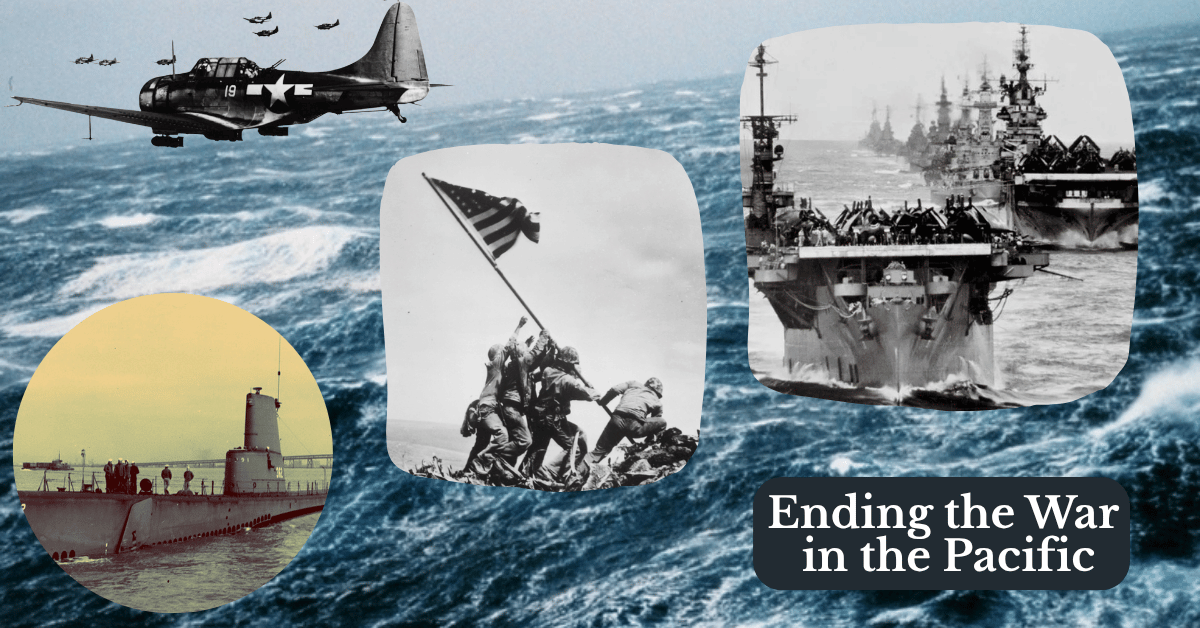
Image credit: various photographs from Naval Aviation Museum, National World War II Museum, and US Navy Archives.
Discover more from friarmusings
Subscribe to get the latest posts sent to your email.
 friarmusings