
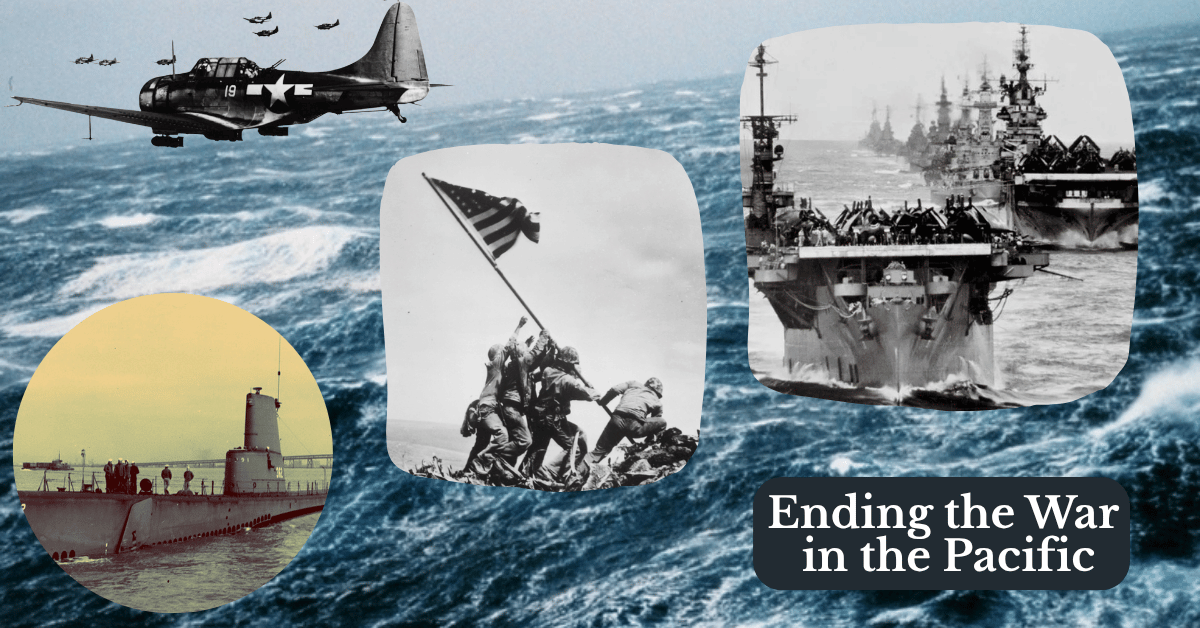
Having described the actual history of August 1945 in the previous post, it is time to consider our counter-factual: what if the US and Allies did not possess atomic weapons and did not expect to possess them any time in the immediate future? How does the Asia-Pacific War come to an end?
But then we need to be sure we are talking about the same war. Here is the most commonly offered timeline:
- September 1, 1939 World War II began in Europe with Germany’s invasion of Poland
- September 3, 1939 France, Britain, Australia, and New Zealand declared war on Germany
- September 6, 1939 South Africa declared war on Germany
- September 10, 1939 Canada declared war on Germany
- May 10, 1940 the Netherlands, officially neutral to this point, declared war after German troops invaded.
- July 10, 1940 Italy, an Axis ally, declared war on Britain and France after seeing German success. It is generally thought Mussolini felt it was an opportune moment to enter the war on Germany’s side, believing France was on the verge of defeat and that Italy could secure a place at the eventual peace negotiations with minimal cost.
- June 22, 1941 Germany declares war on Russia and begins the invasion. Russia did not technically declare war … They were busy fighting against a blitzkrieg.
- December 7, 1941 Japan declared war on the United States (but failed to deliver the diplomatic message prior to the Pearl Harbor attack)
- December 8, 1941 Japan attacked Singapore, Hong Kong and Malaya. Diplomatically no message was delivered to Britain who learned about the attack via military channels. In Japan the information was printed in the newspapers.
- December 8, 1941 the United States, Britain, Australia, Canada, New Zealand and the Netherlands declared war on Japan after the Pearl Harbor attack. Interestingly the following countries also declared war on Japan that same day: Cuba, Costa Rica, Guatemala, Panama and the Dominican Republic.
- January 11, 1942 Japan declared war on the Netherlands the same day it launched its invasion of the Dutch East Indies
- May 22, 1942 Mexico declares war on Japan, Germany and Italy. Thousands of Mexican citizens enlisted in the US armed forces but most notably the Mexican Expeditionary Air Force’s Escuadrón 201, also known as the “Aztec Eagles,” fought alongside the U.S. in the 1944 and 1945 Philippines Campaign.
- August 8, 1945 – late to the battle, Russia declared war on Japan. Russia’s goal was control of the inland sea, warm water ports, Manchuria, Korea and possibly the resource rich Hokkaido.
With that all the major combatants were formally engaged in World War II. At least these are the dates that are given from a western perspective. When did it all end?
- September 3, 1943, the Italian government formally agreed to an armistice with the Allies although the German-backed Italian Social Republic in northern Italy continued fighting until April 29, 1945.
- May 8, 1945 Germany unconditionally surrendered its military forces to the Allies
- August 15, 1945 Japan announced it accepted the unconditional surrender terms (with one condition – maintenance of the kokutai). The formal surrender was signed September 2, 1945.
Six years and 1 day after the start, it was finally over – at least from a western perspective.
The Asia-Pacific War
The war in the Pacific, better said, the Asia-Pacific War began on July 7, 1937, following the Marco Polo Bridge Incident near Beijing, which escalated into full-scale conflict between China and Japan. Historian Richard Franks notes the immense scale of the ensuing conflict. “At the zenith of Japan’s imperial reach, about 516 million people lay within her control, more than 20 percent of the population of the globe. At the zenith of Hitler’s empire there were about 360 million people under his heel, about 14 percent of the population of the globe.”
More than midway through the Asia Pacific War, Japan attacked the United States and her allies in December 1941. We have called that part of the conflict “The War in the Pacific”, but it really was only a subpart of the Asia Pacific War. One factor defines the vast difference between the Asia Pacific War and the Pacific War: the toll of dead.
When we think of Nazi Germany, most western minds think of the Holocaust as the great loss of life during WW II – and it was – some 6 million lives. When the Russians think of the losses, they think of the 872 day siege of Leningrad as part of civilian deaths (estimated at 14-17 million) from famine, disease, Nazi atrocities, and forced labor. Very few 21st century westerners think of the loss of non-combatant life in the Asia Pacific War apart from the atomic bombings of Hiroshima and Nagasaki.
Richard Frank, as well as Japanese and Chinese historians, have spent years attempting to estimate some measure of the toll on human life inflicted by the Japanese military from 1937-1945. Speaking of the “low end” of the estimates, Frank comments: “A conservative accounting shows 25 million people died in the Asia Pacific War. About six million were combatants, mostly Chinese and Japanese. That leaves 19 million noncombatant deaths. Japanese noncombatant deaths may have reached, at the upper limit, one to 1.2 million. This math tells us that for every Japanese noncombatant who perished, some 17 or 18 other noncombatants died—about 12 of them were Chinese. By the summer of 1945, most of these 17 or 18 million noncombatants were already dead.” “Excluding Japanese, every single day the war continued [in the summer of 1945] between 8,000 and perhaps 14,000 noncombatants were dying.” That is between 56,000 and 98,000 each week or 240,000 and 420,000 per month. These were Asian people in French Indochina (largely Vietnamese of whom 1 million died in the last 12 months of the war), Indonesian, Burma, Malaysia and other Pacific nations.
“By contrast, the Pacific War, the struggle between the United States and Japan across the Pacific, produced about two to 2.5 million deaths at most, or eight to 10 percent of the deaths in the Asia Pacific War.” (Richard Frank)
By the summer of 1945 and after the battles of Manila, Iwo Jima, and Okinawa, the Pacific War noncombatant deaths were limited to Japan. In the month of July there were no major ground combat operations. Combat was principally allied and tactical and strategic bombing of key targets in preparation for Operation Olympic, the invasion of Kyushu. There are no accurate statistics but post-war survey put the estimate at 10,000-15,000 due to all causes including the first indication that disease and poor nutrition were beginning to take a toll.
The point is this: if one simply thinks of the “the War in the Pacific” then one excludes from the death toll the massive loss of civilian life of those not Japanese. If one keeps in mind the United States entered the “Asia-Pacific War” allied to the Chinese along with allied partners Australia, New Zealand, Britain and the Dutch, the fuller picture of what is at stake in the summer of 1945 becomes clear. “Excluding Japanese, every single day the war continued [in the summer of 1945] between 8,000 and perhaps 14,000 noncombatants were dying.” (Richard Frank) That is between 56,000 and 98,000 each week or 123,000 and 396,000 per month. (Note: Frank’s numbers are at the low end of the estimates of these losses)
With these numbers in mind, by summer 1945 the Asia Pacific War ranked high on any scroll of history’s greatest human tragedies. The tragedy increased each day, and by far the greatest impact of that tragedy was borne by people who were not Japanese and who were not Westerners.
To not understand this basic reality of the summer of 1945 is to not consider the common humanity of all people involved in this epic battle. It was the dilemma of August 1945 for Allied planners (not having any atomic weapons in this counter-factual)
- Japan is militarily defeated by any meaningful measure and is isolated in the “castle” of the home islands that is surrounded and under siege.
- Surrender is not a military decision but a political one.
- The polity of Japan, via the Supreme Council (Big 6), allows hard-core militarists and nationalists to essentially veto all war decisions not to their liking. These people are committed to Ketsu-Go, the decisive battle that will bring the Allies to a negotiating table – regardless of the costs of lives. “The sooner the Americans come, the better… One hundred million die proudly”
- The junior officers in Army Headquarter and in the units operating outside Japan in the occupied territories have a history of setting their own agenda. In other words, there is no surety that they will lay down arms even if Japan surrenders. This is where the non-Japanese civilian death toll continues like a firestorm.
As long as Japan does not surrender, the death toll of civilians outside of Japan will continue to increase.
What are the viable options available to the Allies?
Image credit: Image credit: various photographs from Naval Aviation Museum, National World War II Museum, and US Navy Archives.
Discover more from friarmusings
Subscribe to get the latest posts sent to your email.
 friarmusings