
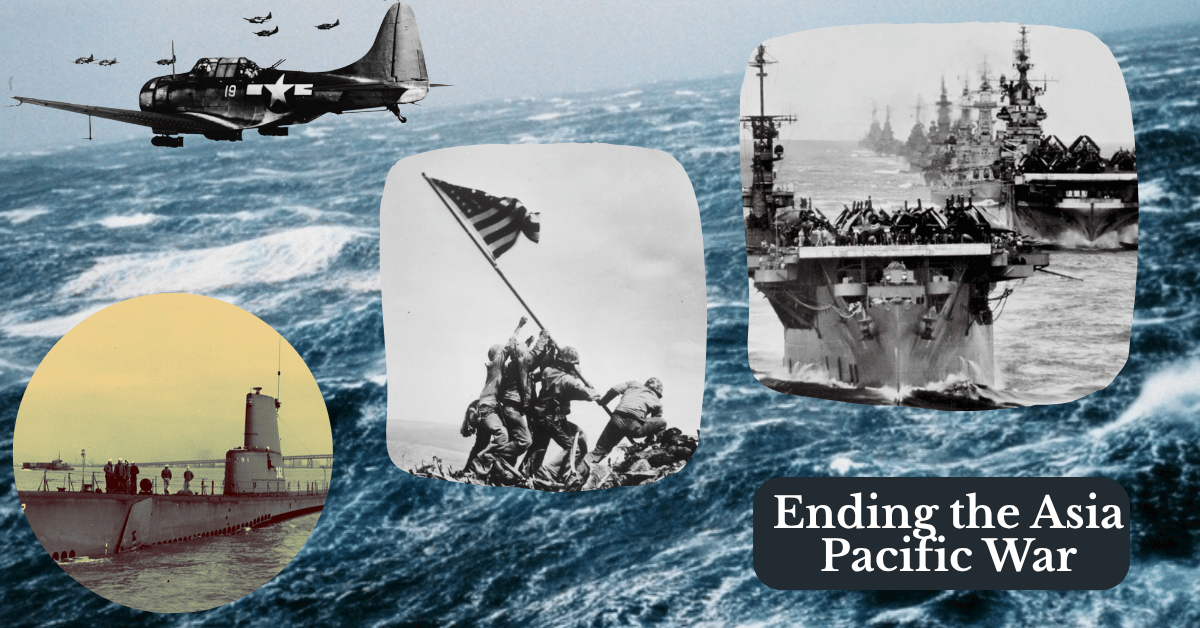
You may have noticed the change in the series graphic from “Ending the War in the Pacific” to “Ending the Asia Pacific War.” The reasons were made clear in the two posts immediately preceding this post. One of the key points to keep in mind is “Excluding Japanese, every single day the war continued [in the summer of 1945] between 8,000 and perhaps 14,000 noncombatants were dying.” (Richard Frank) That is between 56,000 and 98,000 each week or 240,000 and 420,000 per month. The tragedy increased each day, and by far the greatest impact of that tragedy was borne by people who were not Japanese and who were not Westerners.
To not understand this basic reality of the summer of 1945 is to not consider the common humanity of all people involved in this epic battle. It was the dilemma of August 1945 for Allied planners (not having any atomic weapons in this counter-factual speculation) and facing this reality:
- Japan is militarily defeated by any meaningful measure.
- Surrender is not a military decision but a political one.
- The polity of Japan, via the Supreme Council (Big 6), allows hard-core militarists and nationalists to essentially veto all war decisions not to their liking. These people are committed to Ketsu-Go, the decisive battle that will bring the Allies to a negotiating table.
- The junior officers in Army Headquarter and in the units operating outside Japan in the occupied territories have a history of setting their own agenda. In other words, there is no surety that they will lay down arms even if Japan surrenders.
- As long as Japan does not surrender, the death toll of civilians outside of Japan will continue to increase.
What are the viable options available to the Allies? There are not many and what is available is not good.
What is left aside
In the post, July 1945, I noted that even as the Supreme War Council had affirmed the “Fundamental Plan” again affirming Ketsu-Go as the national plan to bring the Allies to the negotiating table, Lord Kido was beginning to have “the ear” of Emperor Hirohito. Kido’s draft memorandum indicated that Japan needed to begin feelers to end the war before the nation’s total destruction. Sadly, they believed that the Soviets were their best path. Meanwhile the Soviets were already executing the largest movement of troops in world history as they assembled a massive invasion force in Mongolia and Siberia, ready to attack Japan as promised at the Yalta Conference of 1944. As tempting as it is to say, “See, they were ready to surrender!” that historical record (and that we were ready MAGIC diplomatic message in real time) indicate that when Ambassador Sato cabled Foreign Minister Togo that the only viable option was to accept Potsdam with the proviso that the kokutai (Emperor) would be retained – Togo immediately cabled back that the Supreme Council would never accept those terms. Lord Kido might be seeing clearly, but not the Supreme Council nor Hirohito.
In other posts, I have noted that Hirohito seemed to be (primarily?) concerned with continuity of the Imperial Household. At the same time he was not unaware of the on-going civil destruction on the home islands. There are no records or diary entries that he was aware of the growing belief among Japanese citizens that the war was not winnable and needed to end. He had concerns about Army-Navy cooperation, preparation on the Kanto Plain/Honshu, but seemed satisfied that the preparations on Kyushu were going well,
So, in this post what I will “leave aside” is any viable peace initiative being extended from the Japanese side. The reasons for this are three: (1) the Supreme War Council is committed to Ketsu-Go and the military controls the Council. (2) Emperor Hirohito, to date, remains in a self-imposed neutrality to decision making – not uninformed – but uninvolved. It is assumed he does not change his mode of operation. (3) The peace initiative via the Soviets has zero traction and at no point have the Japanese offered “terms.” Additionally, there is no indication that they viewed anyone else as a viable candidate as described in the post Japanese Diplomacy.
In the post August 1945 in History it seems clear that the 2nd atomic bombing, Nagasaki, was the catalyst for Emperor Hirohito to take the unheard of action of declaring his imperial desire to the Supreme Council – not only as Emperor, but as Supreme Commander of the Military (so designated by the Meiji Constitution) – to end the war. When Hirohito had finished speaking and left the Imperial Conference meeting room, Prime Minister Suzuki simply turned to the Supreme Council for War and asked that they officially confirm the Emperor’s desire. And so it was done.
Why would the Emperor take such an unheard of action? Richard Frank succinctly remarks: “the Nagasaki bomb laid waste to the argument that the United States had no arsenal of powerful atomic weapons. If the Americans did not mount an invasion, Ketsu Go was bankrupt and the high command had no strategy short of national suicide.” That comments on the actual history.
In this counter factual speculation, it is my contention that there is no critical moment at which Hirohito pivots and directs the Council to end the war. This leaves the “Fundamental Plan” in place. And as described in Japan Prepares for Invasion the focus and efforts are on preparations for the landings on Kyushu. At this point after the July 24th and 28th air raid on Kure, the Imperial Japanese Navy (IJN) does not exist, aircraft and pilots are being husbanded for counter-invasion kamikaze attacks – as is aviation fuel, and the available resources are limited to surface and sub-surface kaiten suicide boats as described in Japan Prepares for Invasion. The Imperial Japanese Army (IJA) is moving and amassing troops, artillery and other resources on the southern home island of Kyushu in (correct) anticipation of allied landings. An Imperial Rescript has mobilized a citizen defense force which will place civilians with little training and no uniforms in the Kyushu combat zone.
There will be no terms being offered by the Japanese that will be acceptable to the united Allied front that has already accepted unconditional surrender from Germany and expects no less from Japan.
Thus, the allies need to bring the war to an end with only a catalog of bad options.
The Catalog of Bad Options
Civilian deaths across Asia in Japanese occupied lands are continuing at a staggering rate. Civilian deaths in Japan continue due to allied fire bombing, however, for every Japanese civilian who dies, 4-5 Asian civilians are dying with Japanese military action and occupation being the root cause. The Allies have to find a way to stop the war – and there are only bad options.
- Submarine blockage and aerial mining of the sea lanes and harbors.
- Strategic and fire bombing of manufacturing centers and cities on the Japanese home islands.
- Naval shore bombardment and tactical bombing from aircraft carriers.
- Major invasion of Kyushu by U.S. forces in the south of Japan
- Major invasion of Manchuria by Soviet Forces
- A minor invasion of Sakhalin Island (and Kurils) by Soviet Forces
The Soviet Threat
In August 1945 a new threat emerged writ large: the Soviets. The Soviets had amassed more than a million men on the western and eastern/southeastern borders of Manchukuo (Manchuria) – Operation August Storm. At the same time there were reinforced Soviet army troops in the northern half of Sakhalin Island. Soviet entry into the war threatened all the areas shown in red – including the home Japanese island of Hokkaido. In addition, the Soviets would have driven southwest from Soviet Siberia into the Korean peninsula.
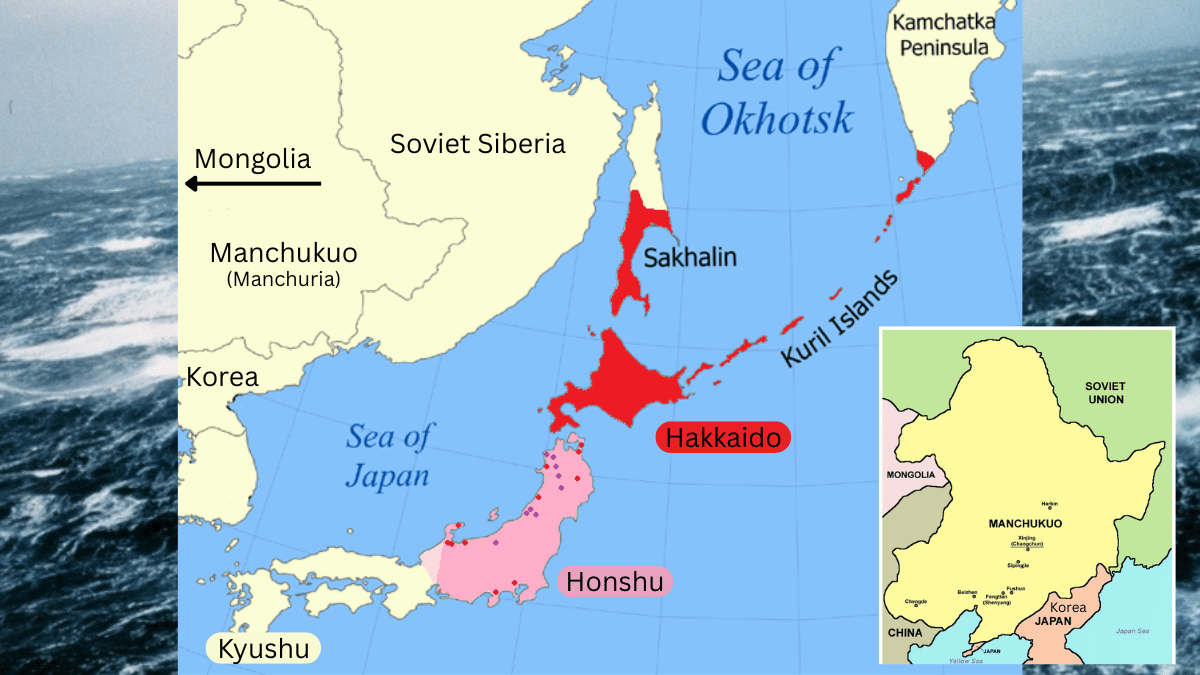
The once proud and powerful “Kwantung” Japanese Army in Manchuria known for its successes during the early years of the war (1937-1943) had been reduced as its best leaders and divisions were transferred into the battles in the Southwest reaches of the Imperial Empire and the island battles of the Central Pacific. In August 1945 the Soviets would have been unstoppable on mainland Asia. (That will be covered in a separate post) The island campaigns were a different story.
In the Spring and early summer of 1945, under Project Hula promised in the Yalta Conference, the U.S. began assembling amphibious shipping for transfer to the Soviets as part of a Lend-Lease program operating out of Cold Bay, Alaska. Through Project Hula about 150 U.S. landing craft (LSTs and LCIs) along with several older destroyer escorts were transferred to the Soviet after crew training. These vessels were used in the limited Soviet amphibious assaults on the Kuril Islands and southern Sakhalin in August 1945. Otherwise the Soviets lacked large-scale amphibious capability and experience. Also unlike the Allied forces, they also lacked coordinated command and control capability, preferring to operate independently. Given the small size of the Soviet Eastern Fleet, it is conceivable that the U.S. would, at most, provide transport, escort service, and supply items – as long as it served the war and post-war interests of the Allies.
As regards operations against Sakhakin and the Kurils, any Soviet action in those areas would have served to keep in place Japanese divisions in Hokkaido and northern Honshu as a defensive measure. There were ~150,000 armed troops on Hokkaido in August 1945 with a small detachment of army aircraft. As in Kyushu, they knew well the potential landing areas and the defenses in those areas were being built up, especially in terms of shore batteries/artillery.
The Soviets would quickly take Sakhalin and most of the Kurils (as they actually did in 1945, but after the surrender). However, there were four islands near Hokkaido that the Japanese would have defended with force to ensure that the Soviets did not have a close base of operations to move against Hokkaido.
A part of the Soviet Plan “August Storm” included a potential invasion of Hokkaido at Rumoi on the west of the island. Their intelligence was reasonably accurate in order of battle but too optimistic about Japanese collapse and too dismissive of terrain and weather difficulties – and weather conditions over the Sea of Japan. Communications with Moscow show that the Soviets judged Hokkaido a tempting but risky objective but saw it as a strategic lever to gain a share in Japan’s occupation. (Hasegawa, Racing the Enemy: Stalin, Truman, and the Surrender of Japan with reference to the “Soviet General Staff Study: The August Storm – The Soviet Strategic Offensive” (translated by David Glantz))
Both Churchill and Roosevelt had reservations about Stalin and the Soviets at Yalta, but then “the enemy of my enemy is my friend.” But there were limits. It is highly unlikely that the U.S. and Britain would support any ambitious amphibious landings of Soviet troops on Hokkaido – and without U.S. amphibious support the Soviets had insufficient capacity for such endeavors. (Note: on a historical note, the Soviet amphibious landings on Hokkaido did not go well. The Soviets were contained on the beach suffering heavy casualties only stopped by the mid-August surrender of Japan) The “threat” of Soviet invasion was all that was needed to keep the northern Japanese divisions from moving to the Kanto Plain in central Honshu for the Spring 1946 Operation Coronet – part two of Operation Downfall.
That being said, the open question is how the invasion of Sakhalin and the Kurils – and the threat against Hokkaido – would have been perceived among the Supreme Council, the Privy Council and by the Emperor himself. Would the Soviet invasion of Sakhalin and the Kurils, by itself, have “moved the needle” off the Fundamental Policy’s commitment to Ketsu Go and the defense of Kyushu?
For argument’s sake, I think it would not. Why? Because the whole goal of Ketsu-Go is to pull the allies to a negotiating table with some semblance of leverage. I think Japan would have adopted a “hold ‘em” strategy against the Soviets waiting for the November Kyushu invasion. Initiating “peace feelers” because of the Soviet movement on Sakhalin, the Kurils and attempts on Hokkaido evaporates all leverage and reduces the Supreme Council to some version of unconditional surrender.
That is one possibility. What about the remainder of the catalog of bad options? Stay tuned.
Image credit: Image credit: various photographs from Naval Aviation Museum, National World War II Museum, and US Navy Archives. Map of Japan from Wikimedia Commons | CC-BY-SA 3.0 | original images from Kwamikagami
Discover more from friarmusings
Subscribe to get the latest posts sent to your email.
 friarmusings