
In 2005 the translated diary of Admiral Yonai, the Japanese Navy Minister and member of the Supreme Council, was released. In the days between the Imperial Saiden (Sacred Decision) to accept the terms of Potsdam and before it was announced, Yonai wrote that “It may be inappropriate to put it in this way, but the atomic bombs and the Russian entry into the war were in a sense, God’s gifts…Now we can end the war without making it clear that we have to end the war because of the domestic situation.. I have long been advocating the conclusion [of the war], not because I am afraid of the enemy’s attacks or because of the atomic bombs, the most important reason is my concern over the domestic situation.”
The atomic weapons offered an external excuse for surrender, allowing Japan to end the war without explicitly revealing that the domestic situation had become untenable. Emperor Hirohito, once considered a demigod, was losing public support for continuing the war amid growing hostility toward him and his government. The official propaganda was losing traction in the face of unopposed allied bombers and fighters over the home islands, growing food shortages – the “domestic situation.” Yet even then the general public did not know the extent to the “situation.”
Yoshio Kodama was not a government leader during World War II, but an ultranationalist and powerful political fixer who operated behind the scenes. During the war, he was an agent for Japanese military intelligence and amassed a fortune through smuggling and procuring materials for the Imperial Japanese Navy. He had a unique view of the war from the ground level to halls of power. After the war he wrote a memoir, I Was Defeated, in which he wrote:
Although the nation was resigned to the fact that the decisive battle on the Japanese home islands could not be avoided . . . they still thought that the Combined Fleet of the Japanese Navy was undamaged and expected that a deadly blow would be inflicted sometime either by the Japanese Navy or the land-based Kamikaze suicide planes upon the enemy’s task forces. Neither did the nation know that the Combined Fleet had already been destroyed and neither could they imagine the pitiful picture of rickety Japanese training planes loaded with bombs headed unwavering towards an imposing array of enemy [aircraft carriers and battleships].
In history, after the dropping of the second atomic weapon on Nagasaki, Emperor Hirohito called an Imperial Council, a meeting of serious consequence. The Supreme War Council was deeply divided yet, for the first time, they worked on terms to end the war. After a prolonged discussion the Council was divided. They agreed that the war needed to end, but they disagreed with the conditions of surrender. The post August 1945 in History outlines the divisions between the group that would only accept the Potsdam Declaration for unconditional surrender with four conditions vs. the group that wanted to accept with the only condition being the retention of the Imperial House (kokutai). At the August 9/10 Imperial Council, when all had spoken, the Emperor had the final word. He then announced his support of the “one condition” offer. He said that Japan must “bear the unbearable.” One can only imagine that Hirohito was referring to the psychological impact of defeat after so many years of propaganda.
Without the availability of atomic weapons, as this series has assumed, and as the war continued it would be the civilian people of Japan that truly have to “bear the unbearable.” But it would not be limited to the psychological. The impacts would also be physiological and sociological at the national and the personal levels.
Means to the End
The means of the Allies to end the war, given the intransigence of the Supreme Council, the self-imposed inaction of the Emperor, and the ultranationalism of the junior officer corps, were limited. The means included:
- Continued naval blockade and aerial mining of the sea lanes, harbors and inland waterways.
- Tactical bombing of the home island rail system including stations, switching yards, rail lines, and especially tunnels.
Japan’s war and internal economies were highly dependent on the sea and rail as means of distribution – especially the coastal and inland waterways. Japan had no developed road system. In addition the national supply of coal was located on Hokkaido and depended on rail and ferries to move the coal southward to Honshu. The other allied options included:
- Continued strategic and fire-bombing of Japanese centers of war production and cities.
- Naval shore bombardment in support of the above
- Soviet invasion of Manchuria and Korea
- Allied invasion of the southern home island of Kyushu, Operation Olympic (Nov 1945), and if needed
- Allied invasion of the main home island of Honshu, Operation Coronet (April 1946). Note: together Olympic and Coronet comprised Operation Downfall.
A Point Failure
Among all the industrialized nations of the world – and Japan was counted among those nations – Japan alone was highly dependent on coastal shipping. The bulk of internal transportation typically moved food, manufactured goods and raw materials to the nearest seaport for domestic shipping and redistribution within Japan, especially to the population centers. The rail system was primarily short-haul lines. In other words, by August 1945 submarine and sealane mining operations had greatly interrupted not only importation but also internal redistribution of all critical items. The importance of the rail system and Japan’s dependence upon it can not be overstated.
Because of the mountainous landscape of Japan on all the home islands, the main rail lines ran near the coast. Even then the railways passed through a fair number of tunnels, making those a target in addition to rail lines, switching yards, and bridges. Compounding the problem, the Japanese had made no provision for rail system repair. They had neither plans, crews, and even elementary materials such as railway steel and bridge timbers.
In the background, both MAGIC and ULTRA message traffic in the summer of 1945 pointed to the growing problem of food shortages. By the beginning of August, analysts, who had wondered if there was true widespread shortages or if stockpiling was in play, understood the true nature of the shortages and the uber-dependence on the rail system. All of the food shipped to southwest Honshu moved via one of ten rail lines supplying half of the total supply to the area. Most of these rail lines were vulnerable to allied air attacks and shore bombardment.
The Japanese rail system was a single point failure in a system critical to feeding the nation. 75% of the population lives on Honshu with half of them in the southwest part of the island. But the great bulk of its food was harvested on the northern island of Hokkaido, the southern island of Kyushu, and northern Honshu. 97% of Tokyo’s food items required delivery.
By August 8, 1945 the allied strategic bombing plans were placing the priority on the rail system: lines, tunnels, bridges and the ferries that moved bulk items to Honshu from Hokkaido and Kyushu.
Blockade and Bombing
Few historians take on the project of predicting counter-factuals. It is not their role. But there were several wartime Allied forecasts from intelligence planners in the Navy and Army that examined the expected effects of blockade, mining, and bombing on Japan’s economy and food supply in a scenario without atomic weapons. These analyses were written before Hiroshima. From early 1945 onward, the Joint Chiefs of Staff (JCS) and Joint Intelligence Committee (JIC) repeatedly studied whether Japan could be forced to surrender through economic strangulation rather than full-scale invasion. The two primary studies were
- Joint Intelligence Committee (JIC 266/1, April 1945): “Estimate of the Enemy Situation, 1945–46”
- U.S. Navy’s Combined Intelligence Center, Pacific Ocean Areas reports, May–July 1945
In addition the U.S. Strategic Bombing Survey (USSBS) Preliminary Economic Effects Section’s draft work was begun before August 1945 and later supplemented with post-war assessments.
Operation Starvation (yes, that was its official name) began in March 1945, seeding Japan’s coastal waters and harbors with sea mines dropped from B-29s. This was in addition to the already in-place naval blockade being executed by the US submarine forces. The aerial mining operation reached locales too risky for submarine operations and greatly accelerated the blockade effects. Within 3 months Japan’s domestic maritime transport system was collapsing. Major ports were shut or made repeatedly inoperable. Intelligence estimates in July 1945 indicated that over 80% of Japan’s merchant tonnage had been sunk or immobilized. The last oil tanker reached Japan in March 1945. Neither oil or food items (notably rice) was being imported/received on the home islands. At the same time domestic coastal shipping, essential for moving rice to northern Japan and coal from Hokkaido south, was paralyzed.
JIC 266/1 report concluded: “By autumn of 1945 the Japanese economy will reach the point of exhaustion. Large-scale starvation is probable if current destruction of shipping and transportation continues.” The Naval Intelligence Division forecasted: “the collapse of the Japanese economy and the paralysis of internal transport will result in famine conditions among the civil population during the winter of 1945–46.” Even without atomic bombing, the blockade and mining were expected to trigger food shortages severe enough to produce famine by late 1945 or early 1946.
Perhaps the unanswerable question was whether the predicted severe food shortages would erode public support and contribute to the “domestic situation” and as a result move the Supreme Council and Emperor to accept Potsdam – or would the leadership allow increasing starvation rather than accept unconditional surrender. One wonders given this was the leadership whose operating slogan was: “The sooner the Americans come, the better… One hundred million die proudly”
Post war data from a July 1945 report out of the Japanese Ministry of Agriculture and Forestry and the Home Ministry projected that food supplies for 1945–46 were sufficient for only 60% of the population’s caloric needs. In addition, rice production had dropped by over 30% due to lack of fertilizer and transport. (In history it actually fell to less than 50% of annual levels). The Japanese officials also warned of mass starvation by early 1946 unless imports resumed. These were reports being raised on the civil government side of leadership. The reports would have been part of the Diet and at cabinet levels, but it was not clear that the same attention would have been given within the Supreme Council.
In a scenario where blockade and bombing are used, without invasion of Kyushu, if the war continues until March 1946 estimates are that 6 to 10 million Japanese would die of starvation. Would the domestic situation allow the war to continue until March 1946? A possible timeline of suffering and collapse be:
| Month | Expected Condition |
| Aug–Sep 1945 | Urban food ration breakdown begins; coastal transport essentially halted. |
| Oct–Nov 1945 | Coal shortages cripple industry and electric power; rail transport is minimal. |
| Dec 1945–Mar 1946 | Famine and disease on a nationwide scale; mortality potentially in the millions. |
| Mid–1946 | Economic and social collapse, food riots, and potential regime breakdown. |
Would this bring about surrender? President Truman did not receive a consensus on the blockade-bombing only option in summer 1945. The naval leadership (Admirals King and Nimitz) believed blockade, mining, and bombing could force surrender within months, avoiding invasion. They pointed to the WWI experience with the British blockade of Kaiser’s Germany which collapsed under the pressure of the blockade. Army leadership (Gen. Marshall) and the War Department (Secretary Stimson) doubted starvation alone would bring surrender. They pointed out that Japan’s military regime might choose national suicide over surrender and let the people perish. They pushed for Operation Olympic to begin as soon as practical.
When the U.S. Strategic Bombing Survey (USSBS) interviewed Japanese leaders after the surrender, they confirmed that the blockade-sea mining-bombing combination was the most feared weapon — more than the atomic bomb itself, because it struck at national survival. Admiral Toyoda (Chief of Naval General Staff) commented: “The destruction of shipping and the mining of home waters made it impossible to transport food and materials. Continuation of the war much longer would have meant the death by starvation of millions.” In July 1945 starvation projections were discussed in the full cabinet under Prime Minister Suzuki’s cabinet. They reportedly recognized they could not endure more than a few months.
USSBS analysts later summarized: “Even without atomic bombing or invasion, it is probable that Japan would have been forced to surrender before the end of 1945 due to the cumulative effects of blockade and air attack. Starvation on a massive scale would have been unavoidable.”
Japanese historian Daikichi Irokawa agrees with the projections noting these do not account for those whose malnutrition led to a co-morbidity associated with disease, wasting, and extended illnesses associated with compromised immune systems, especially among the young. These concerns were already being tracked by the Japanese civil authorities who were tracking food reserves as only having a 4-day reserve.
Would devastation to the rail system and the deteriorating food situation amplify the “domestic situation” to the point that would lead to a rupture between the Emperor/Supreme Council and the civil government? Within the inner circle only Hirohito, Kido and Konoe were of the view that the “domestic situation” was as great a threat to the Kokutai of the nation as was an allied invasion. Would this have been enough for the Emperor to reach a “sacred decision” that forced the Supreme Council to accept unconditional surrender?
Assuming that the Japanese surrender on December 1, 1945, that still means the war continued for another 4 months (August thru November). Without an invasion, losses to the Allied military would have been minimal as Japan began to wither on the vine. If the estimates of blockade lasting until March 1946 yielded 6-10 million deaths due to starvation and disease, what would be the effect by December 1945? Other famine studies suggest that deaths would have been in the 20-25% of total by the half-way point. That translates to roughly 1.4 and 2.25 million people in Japan. Outside Japan in the occupied territories, in the same 4 month period approximately 1 million non-Japanese Asians will die.
The resulting death toll of the blockade-mining-bombing (only) is projected to be between 2.4 and 3.25 million civilian deaths across the Asia-Pacific region. Truly an unbearable end.
The Specter of Death
To be sure, there is no way to forecast the effect of one, all, or some combination of the means to end the war. No matter what path was chosen, the spectre of death – military and civilian – was unavoidable. As noted in previous posts, these deaths would not be limited to Japan and would continue in every nation and locale occupied by the Japanese Imperial Army. Outside of Japan 70,000 to 100,000 Asian civilians were dying each week. Inside Japan it should be noted that also at risk were the 15,000 American POWs and more than 100,000 Allied POWs.
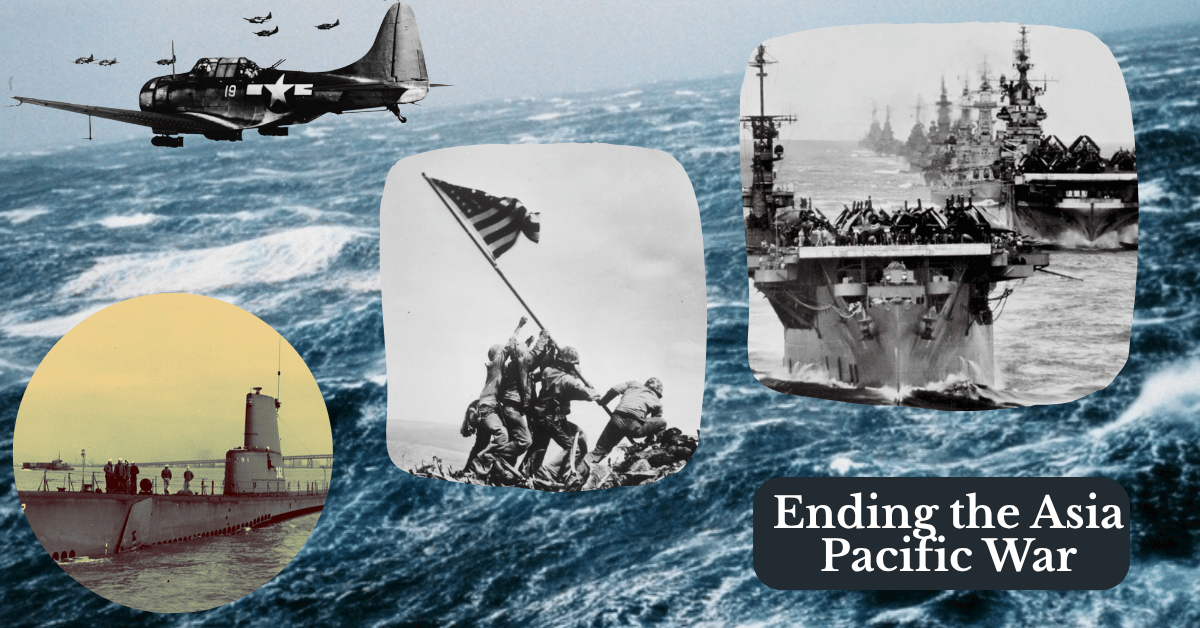
Image credit: Image credit: various photographs from Naval Aviation Museum, National World War II Museum, and US Navy Archives.
Discover more from friarmusings
Subscribe to get the latest posts sent to your email.
 friarmusings