
Over the course of the last few months, a lot of you have let me know that you regularly forward the series of emails to friends, relatives and interested parties. Thank you! Yesterday I received an email letting me know that one of the friends – a US Naval Academy graduate from the Class of 1959 – let them know that his father, a Lt. Colonel in the US Marine Corp – had been assigned post-war duty on the island of Chichijima. Curiosity kicked in.
Chichijima is the largest and most populous of the Bonin Islands. Chichijima is located in the Pacific Ocean about 620 mi south of central Tokyo and 150 mi north of Iwo Jima. The island is only 9 sq. miles in size. It is the largest of the Bonin Islands and has traditionally (and still today) the seat of local government. The name “Chichijima” means “Father island.”
The Early Years. The island shows some evidence of early inhabitants and various explorers sighted the island (Dutch in 1639; English, Prussians and Russians in the 1820s ) but the “discovery” of the island was when a Japanese merchant shipwrecked there in 1669. The crew eventually repaired the ship 72 days later and sailed home to Japan but reported the unknown island. In May 1675 a specially commissioned expedition located the island, came ashore, collected samples of plants and animals, created preliminary charts and maps, and then returned home to Japan. The island was claimed by Japan, but since Japan was in full isolation, it was more pomp and ceremony since the island remained uninhabited.
The first settlement was established in May 1830, by a group formed in Hawaii which was an independent nation at the time. Their first visitor was Commodore Matthew Perry’s and his flagship USS Susquehanna while on their way to Tokyo to open up the country for western trade. Perry anchored for three days in Chichijima’s harbor in June 1853. While there he also laid claim to the island for the United States to use as a coaling station for steamships. There was a U.S. citizen, Nathaniel Savory, living there who was the de facto island leader. He was appointed as an official agent of the US Navy. On behalf of the US government, Perry purchased 50 acres from Savory.
Perry’s visit opened up Japan to the world…and the world to Japan. In 1862 the Japanese claimed sovereignty over Chichijima and the other Bonin Islands. They acknowledged Savory’s leadership but over time more Japanese settlers arrived and the first wave of western settlers passed away. An interesting side effect was that a unique Japanese language was spoken on the island: standard Japanese with strong elements of English and Hawaiian.
The War Years. By the time of the Asia-Pacific War, Chichijima was a long range radio station. By Pearl Harbor, an Army force of about 4,000 men were garrisoned at Chichi Jima. In addition, about 1,200 naval personnel manned the naval station which was home to a small seaplane base, the radio and weather station, and various gunboat, subchaser, and minesweeping units.
The Japanese developed a heavy network of fortifications, bunkers, tunnels, and coastal guns. They were well prepared for the American landing that never came. As part of the “island hopping” strategy, the Allies had instead isolated and bypassed the island while keeping it under blockade and heavy air/naval bombardment. At the time of surrender in September 1945 the island was still organized and capable of fighting. Approximately 14,000 Japanese personnel remained on the island. The local surrender of Chichijima took place on 3 September 1945, the day after the Tokyo Bay ceremony. The surrender was accepted by a U.S. Navy and Marine landing party. The Japanese forces laid down arms peacefully, and the island was formally occupied without fighting.
Officers and enlisted men were interned and processed as prisoners of war with most being repatriated to Japan in 1946. However, several senior officers were arrested and tried for war crimes.
The Tachibana War Crimes Trial. Chichijima is most remembered because of crimes committed earlier in the war (1944–45) by some of its officers. Lt. Gen. Yoshio Tachibana, along with several naval officers and a doctor, was charged with ordering or permitting the execution of captured U.S. airmen and cannibalism of their remains (in several documented cases). Tachibana and several others were convicted by a U.S. military tribunal at Guam in 1946. Tachibana was hanged in 1947. Other officers received prison terms.
Did you know? One of the downed airmen who survived capture near the island was a future U.S. President, George H. W. Bush. During an August 1, 1944 attack on Chichijima, Bush’s aircraft successfully attacked several targets but was downed by enemy fire. Though both of Bush’s fellow crew members died, Bush successfully bailed out from the aircraft and was rescued by the submarine USS Finback.
The Westerners. Prior to the war, the “westerners” living on Chichijima were forced to move to Japan as they were considered not trustworthy. One, technically an American citizen, was drafted in the Japanese army serving in the home islands as a communications specialist. After the war, they were only allowed to return to their homes in 1947 – but the non-western citizens were not permitted to return. Today, most residents are Japanese who came to the island after Japan took back control from the US in the 1970s.
Today the island serves as a naval station for the Japanese Defense Force, hosts an observatory, and is home to a marine biology research center. There is a local fishing industry and a small eco-based tourism business: hiking, bird watching, snorkeling on the local coral reefs, and whale watching. The island has no air service and can be reached by ferry. It is a 24-hour trip one way and the ferry runs every 6 days or so. If you go, plan on staying for a week.
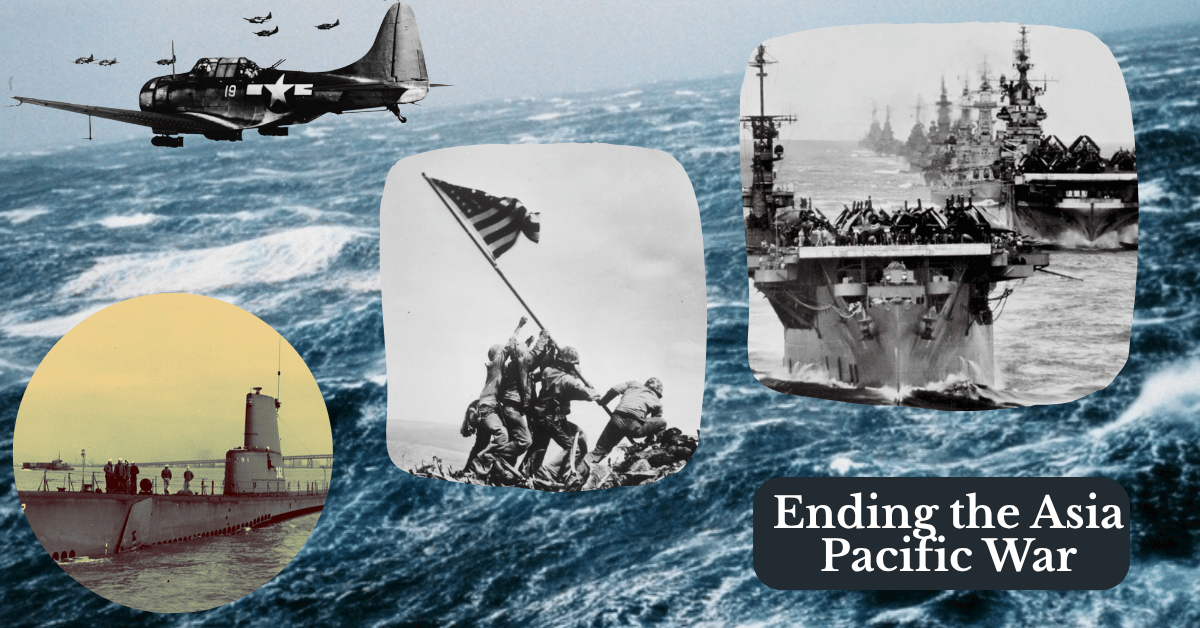
Image credit: Image credit: various photographs from Naval Aviation Museum, National World War II Museum, and US Navy Archives. Source credit Wikipedia and others
Discover more from friarmusings
Subscribe to get the latest posts sent to your email.
 friarmusings