
At the end of the previous post, a question was posited: “How did the currents of history bring the U.S. and Japan to this point in history when sanctions and an embargo were the final domino that moved the flames of war to become the firestorm that was the Asia-Pacific War from December 1941 until September 1945?” There is a lot of history upstream of the 1930s and 1940s to consider, but when one reads widely about the period, one recurring topic is China. Japan seemed to be possessed by an inexorable attraction for China. Look at a modern map of China and compare it to a map of East Asia in 1940. Japan occupies all of Manchuria (while trying to pass it off as the independent nation of Manchukuo), has encroached southward into what the Japanese called “mainland China” or simply “China.” Japan also controls virtually every major port along the South China Sea, East China Sea and the Yellow Sea. Meanwhile in the interior of China, Japan controlled vast areas to the Northeast and set up collaborationist regimes, with the Nationalist (KMT) government under Chiang Kai-shek and a loose affiliation of local war lords retreating to the interior and the Communists fighting from their bases to the Northwest. It created an incredibly complex military and political landscape.
If the Japanese were interested in securing the flanks of their advance to the oil and resource rich areas to the south, it would seem diplomatic means and mutually benefiting treaties and agreement would be more efficient and economical. But when one looks at the arc of history between the two nations it tells the tale of an apprentice who grows up and seeks to dominate the one who was once master. And so, in this post, I will attempt to paint with the broadest of strokes and cover 2,000 years of history between the two nations. There will be gaps, a lack of historical details, and a rash of broad assertions trying to summarize periods of the history. But the purpose is to place the 20th century conflict in a large current of regional and world history.
In the beginning
The Japanese archipelago was largely inhabited by the Jōmon people who were hunter-gatherers. During the 1st millennium BC, the Yayoi people migrated to Japan and quickly became dominant. There are different theories as to their origin: Korea or different parts of China, but what is clear is that they brought rice farming with them, beginning a slow transition from a hunter-gathering period to an agrarian society. If one took a snapshot of Japan in the 3rd century (AD), it would largely be an agrarian society. The people (known variously as Wajin or Yamoto) were marked by settled farming (largely rice), metal tools and metallurgy learned from mainland Asia, the development of fortified villages, early social stratification where accumulation of wealth through land ownership and grain storage fostered social hierarchy, and all the elements for later more developed social and political structures. Over time, as with most cultures, the politics moved from clans to chiefdoms, but without centralized government. But by 300 AD Japan experienced the rise of powerful regional leaders. The history of this period is thin, but the legends are plentiful.
The first recorded encounters, taken from Chinese dynastic histories, describe Japan (Wa) as a group of polities engaged in tribute and trade. It was clear that China was in the dominant position as the Japanese leaders sent tribute missions to Chinese courts to gain prestige, acquire recognized titles, and especially to gain access to advanced technology and knowledge. The Chinese character 倭 denoted the nation and the people of Japan. It translated to “dwarf” – which as you can imagine did not find favor with Japan who replaced it with 和 “harmony, peace, balance”.
Nonetheless, unwanted moniker aside, Japan gained writing (Chinese characters), bronze and iron technologies, and the introduction of Confucian ethical ideas. In the mix and middle of all this It is noteworthy that Baekje (one of the ancient three kingdoms that form Korea) often acted as a main intermediary. Its geographical location allowed it to trade with China and Japan and made it the natural route from Japan to the heart of China. Baekje’s contribution to Japanese culture is notable in pottery and Buddhism.
In what is known as the Yamato and Asuka Periods (6th–7th centuries) there was an active effort on the part of the Japanese to learn Chinese models of statecraft. Japan adopted and adapted centralized bureaucracy, legal codes and a calendar system. Students were sent to study administration, law, architecture, and religion but one can see the first movements of the apprentice beginning to rise. Records reveal correspondence asserting Japan’s dignity and implying an equality with the Chinese Emperor.
Part of that insistence is likely related to the idea of the Japanese Emperor. Legend holds that the first was Emperor Jimmu believed to have been born around 711 BC on the island of Kyūshū. He is said to be a descendant of the sun goddess Amaterasu. Most modern scholars regard Jimmu and the nine first emperors as mythical. Emperor Sujin, the 10th emperor, may have been a real historical figure, but even then the reach and reign of control was likely very regional and not across the entire archipelago.
In any case, in the early 8th century, known as the Nara period, was the age when the Emperor began to exert control. Administrative, civil and criminal codes were introduced (Ritsuryō), the land was organized into Provinces and Districts, and a caste system was introduced. The city Nara was the first urban population center. It had 200,000 residents – approximately 7% of the nation. The Nara period was the high point of Chinese influence. At this point Japan was fully embedded in the East Asian order with all traces of subordination to China largely gone.
By 894 AD, Japan stopped official missions to China. The Chinese Tang dynasty was greatly diminished, the Japanese were confident in their own institutions, and Chinese knowledge was considered acquired and was beginning to be considered “classical” rather than current/modern. For the next 800 years or so, until the late 16th or early 17th centuries, the relationship was largely trade with occasional moments of diplomacy when one side or the other wanted something. When China was in the ascendancy, it required Japan to become a tribute state in order to trade. When Japan was in the ascendancy, it left the tribute status. But in the big picture of East Asia, for thousands of years, China had been the intellectual, economic, military, and political center of East Asia.
During the Edo Period, things changed – and not for the better. On the Korean peninsula an internal reconfiguration of power led the Korean Emperor to become a tribute state to China – but as the most favored state – now a virtual part of China. Meanwhile, by the last decade of the 16th century, Toyotomi Hideyoshi, the most preeminent daimyo, had unified all of Japan, bringing about a period of peace. Hideyoshi was not emperor or part of the imperial lineage (and that is a complicated story, best left to others) but he was a “man with a plan.” He planned to invade China, in effect attempting to claim for Japan the role traditionally played by China as the center of the East Asian international order. As relayed to Jesuit missionaries, Hideyoshi spoke not only of his desire to invade China, but also subjugating the smaller neighbouring states of the Ryukyu Islands (Okinawa), Formosa (Taiwan), and the Philippines.
This was the first evidence (I found) of a Japanese vision of supreme leadership of East Asia. If the metaphor of apprentice-master once had meaning, that was no longer true. From this point in history, China and Japan are dedicated rivals.
Hideyoshi’s first international action was to invade Korea. He tried to solicit the assistance of Portugal, to no avail. Nonetheless he started what became known as the Imjin War, a series of two Japanese invasions of Korea. The first was in 1592 with a brief truce in 1596, and a second invasion in 1597. The conflict ended in 1598 with the withdrawal of Japanese forces from the Korean Peninsula after a military stalemate in Korea’s southern provinces. This period is interesting in that it sets a pattern: unified government, warrior culture dominated society (samurai), a reasonable naval force was available, and a vision of regional leadership as ordained by the gods – and in the background was the Imperial line, descendents of the sun goddess Amaterasu.
While still in the Edo Period, now post-1600, Japan stabilized internally during the Tokugawa shogunate. This ended the period of expansionism, but also restricted diplomacy. China remained a cultural source but no longer considered politically superior. The Tokugawa shogun initiated policies designed to limit the access of the word to Japan. The collection of policies issued between 1633 and 1639 are known today as Sakoku which essentially translates as the “locking of the country.”
And so remained the nation until Admiral Perry sailed into Tokyo Bay.
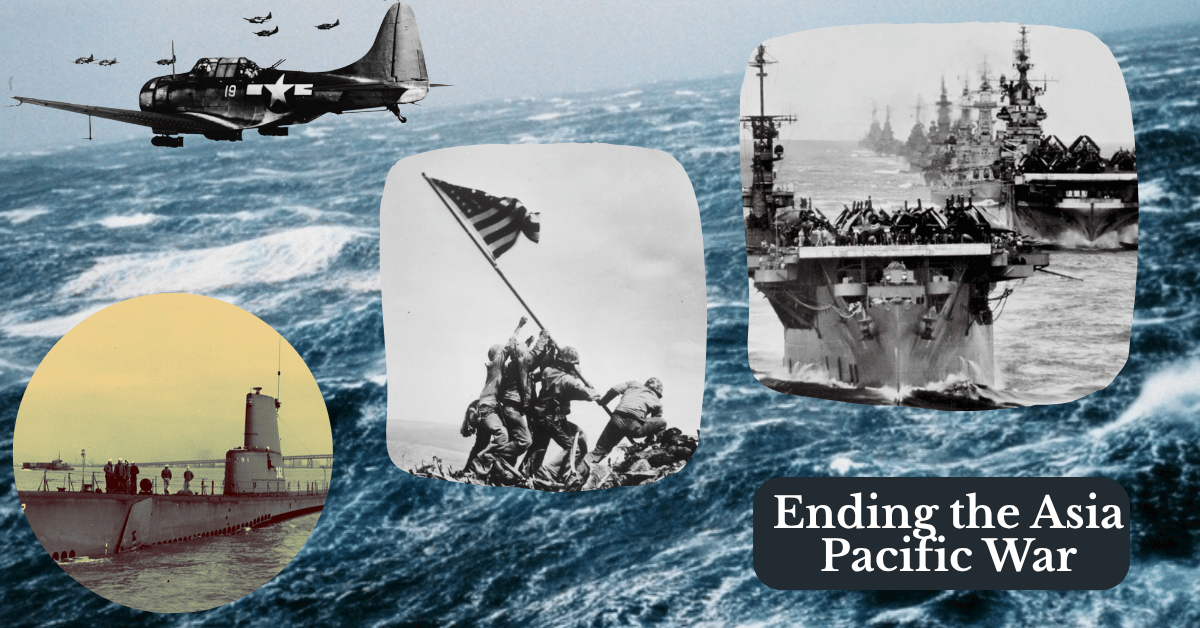
Image credit: various photographs from Naval Aviation Museum, National World War II Museum, and US Navy Archives. Top image generated by WordPress AI on Jan-526
Discover more from friarmusings
Subscribe to get the latest posts sent to your email.
 friarmusings
Thanks for the history lesson Fr. George. That took a lot of research and I appreciate the information.