
At this point in the series we have tried to give some sense and introduction to the currents of history that led the political, economic, and military stew that was the Asia-Pacific region in the mid-19th century. Some of the key elements include (and certainly not limited to):
- The Opium Wars in China (1839 and 1857) and the fallout of these conflicts;
- The U.S. fleet’s arrival in Tokyo Bay (1853) which led to the Treaty of Kanagawa which, not immediately, but eventually led to a more open posture of Japan to the world after 200 years of isolation; and
- A self-view within Japan that in terms of culture, ethics, learning and more they were ready to be leaders in the Asian sphere
Via Dutch traders, Japan was aware of the Opium Wars in China, the unequal treaties that forced foreign trade upon China, and what the foreign powers were willing to do via military advantage. It became aware of how unprepared it was should these same foreign powers turn to Japan with the same intent. Concerned by Western incursions into Asia, particularly the Opium Wars’ impact on China and Commodore Perry’s forced opening of Japan, the Japanese sought firsthand intelligence on how China was handling the situation and the policies it adopted.
To that end, after two centuries of self-imposed isolation, in 1862, the Tokugawa Shogunate sent the sailing ship Senzai Maru to Shanghai as an unprecedented official mission by the shogunate to investigate trade and diplomatic conditions in China and learn from the Chinese experience with Western powers. The mission also hoped to open commercial and possibly diplomatic ties with China, which had been suspended for over 2 centuries.
The journey had a profound impact on Japan’s internal deliberations and future direction. The lessons learned in Shanghai, particularly witnessing the vulnerability of a closed-off nation to Western imperial powers, helped shift Japanese policy from isolationism to a reformist approach. This critical understanding contributed to the climate that enabled the eventual overthrow of the Tokugawa Shogunate
From Tokugawa to Meiji
The Tokugawa shogunate had established itself in the early 17th century. Under its rule, the shōgun governed Japan. About 180 lords, known as daimyōs, ruled autonomous realms under the shōgun. There was an Emperor, but the shōgun ruled. He set the tone and established a code of behavior for the nobility in 1605. Under the code, the emperor was required to devote his time to scholarship and the arts and was confined to the palace in Kyoto. Later, at the arrival of Western colonial powers as trading partners, a new power dynamic was introduced and with that an era of change. The western powers played the regional daimyōs against one another, who positioned themselves in regard to the Shogun (but not in ways always discernable for ill or for good). All the while the Emperor remained in Kyoto as something akin to a cultural icon of the ideals of Japan.
By the early 19th century the changing dynamic brought about within Japan led to a period of high inflation while at the same time samurai stipends were fixed. The same effects were felt among the feudal peasants but not among the ruling class and the merchants. All of this led to a crisis of authority. The Shogun, daimyōs, and their administrators (bakufu) appeared militarily weak, diplomatically incompetent, and unable or unwilling to defend Japan’s sovereignty against western manipulation. This triggered debate over who truly possessed legitimate authority to act in Japan’s name.
Some of the more powerful leading daimyōs invoked the Emperor as the source of ultimate legitimacy and as a rallying point against the controls and constraints of the bakufu. It was couched as a restoration of ancient practice but it was really a reinvention of imperial authority. As unrest spread a large number of young samurai, known as shishi or “men of high purpose”, began to meet and speak against the shogunate. The shishi revered the Emperor and rallied people to their side with the slogan “Revere the Emperor, Expel the Barbarians.” In January 1868, these shishi executed a coup d’état and seized the Imperial Palace in Kyoto, announced the abolishment of the Shogunate, and declared authority restored to the Emperor who adopted the reign name Meiji, meaning “enlightened rule”. There was a short civil war (Boshin War) that ended with the defeat of Tokugawa loyalists and the formal end of the Shogunate by 1869.
Long story, told short, these were the animating force that brought about the Meiji Reforms and ultimately the Meiji Constitution.
Japanese leaders realized they needed to modernize to avoid the humiliation suffered by China during the First and Second Opium Wars. After the old Tokugawa shogunate was overthrown during the Meiji Restoration, Japan initiated structural reforms resulting in rapid modernization, industrialization, militarization and imperialism modeled after the imperialistic Western powers.
The Meiji Restoration
It is important to understand that Meiji restoration was not, as claimed, a movement to restore ancient imperial rule. In reality it dismantled the existing means of governance, repurposed the bakufu, centralized power far beyond anything previously known in the history of Japan. The focal point of the restoration was the Meiji Emperor. He became the formal head of state and the symbolic center of loyalty and identity. But the real power lay with a small oligarchy of former samurai from the more powerful pre-Meiji domains: Satsuma, Chōshū, Tosa, and Hizen. The Tokugawa institutions were not completely discarded; many were adapted including the bureaucratic governance, legal codification, and the elites of the domains were incorporated into the positions wherein their expertise could be used, their ambitions controlled, and their wallets enhanced.
In the early Meiji period (1870s) the oligarchs and councils were the decision makers but the Emperor was cautiously used as the moral center of the coming changes. Some of the early and rapid reforms meant to consolidate power and control included the abolition of domains, end of samurai privileges, start of military conscription, national taxation, and education reforms.
Slowly the Emperor became the sacred focal point of the modern nation-state. This was enhanced even further when Shinto became the official “religion” of the nation. In 1889 the Meiji Constitution framed national sovereignty as emanating from the emperor – this was the notion of kokutai which held that national sovereignty and the emperor were identical.
The transition from Tokugawa to Meiji was not a popular uprising, nor a simple return to ancient rule, but a carefully managed elite revolution that used the emperor as a legitimating symbol to dismantle the old order and construct a modern state. A state that was preparing to face the challenge of western imperialism that had dismantled China.
Meiji and the Foundation of Expansionism
Under the Constitution, the emperor was no longer merely a symbol of unity. He was redefined not only as he kokutai, but as the moral center of the nation and the living embodiment of Japan’s historical destiny. This shift was crucial. Expansion could now be framed not as policy choice, but as moral obligation.
All of this was held to reside in the emperor by divine lineage. As such, the emperor possessed supreme command of the army and navy and authority over diplomacy and war. This structure had two consequences: military autonomy from civilian government and expansionist decisions could be justified as expressions of imperial will rather than partisan ambition. Once these actions were linked to the emperor’s sacred authority, opposition became disloyalty, not disagreement.
Sacred Nationalism
Long tradition held that the emperor was a descendant of Amaterasu, the Sun goddess. This belief was not part of Confucianism or Buddhism, but was grounded in Shinto, Japan’s indigenous religion that pre-dated history. Shinto is focused on reverence for nature, ancestors, and spirits called kami. Shinto emphasizes purity, harmony, gratitude, and sincere living rather than strict dogma or the teachings of a single founder. The Emperor was considered an embodied kami.
During the Meiji period Shinto was transformed into what is referred to as “State Shinto.” This was the government-promoted, nationalist ideology that fused Shinto traditions with state power, establishing the Emperor as a divine figure descended from the sun goddess, fostering national unity, and demanding loyalty through shrines and education, effectively making Shinto a quasi-official religion to support the goals of Imperial Japan. State Shinto transformed loyalty to the emperor into religious devotion. Under this veneer, expansion became a sacred mission and a fulfillment of Japan’s divine role in history. That divinely appointed role was the moral leadership to bring order and enlightenment to Asia under imperial benevolence.
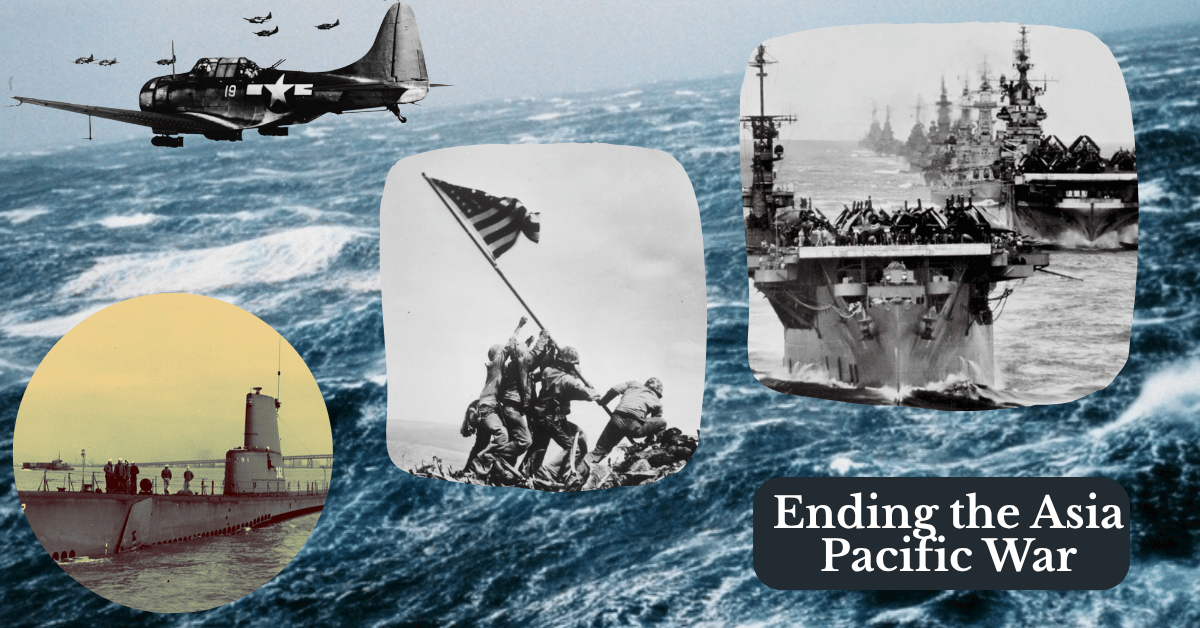
Image credit: various photographs from Naval Aviation Museum, National World War II Museum, and US Navy Archives. Source Credit: “The Meiji Restoration and the rise of the Japanese Empire 1868–1931” | Office of the Historian, Department of State.
Discover more from friarmusings
Subscribe to get the latest posts sent to your email.
 friarmusings