
The history of how Hawaii came to be part of the United States is not, in my opinion, a shining moment in our nation’s history. The Hawaiian archipelago consists of five major islands and a number of smaller islands – including Midway at the extreme northwest. The five major islands and several smaller ones in proximity were united under the great King Kamehameha in 1795. It was not a bloodless unification, but the Kamehameha dynasty was the reigning monarchy of the Hawaiian Kingdom. The Kingdom was formally recognized by the United States in 1846 and as a result of the recognition of Hawaiian independence, the Hawaiian Kingdom entered into treaties with the major nations of the world and established over ninety legations and consulates in multiple seaports and cities.
Europeans had first come across the islands in the late 1700s and by the 1790s was an active destination for American merchants. The arrival of outsiders brought new technologies, goods, diseases, and political dynamics, ultimately leading to Kamehameha’s unification of the islands. One of the key elements of Hawaiian that outsiders quickly encountered was that the land is a gift and not to be owned by individuals. It is a concept that the Hawaiians managed well enough in the normal matters of houses, villages, farms and the such. It was a concept unthinkable to merchants, missionaries, and members of the western business community.
Over the next 100 years more and more outsiders came to the islands. American merchant ships began stopping in Hawaii for supplies, and some sailors jumped ship to live among Hawaiians. The first wave of Americans were the New England missionaries who arrived in 1820. They were soon followed by business men, investors, and all manner of commerce. Plantation agriculture first appeared in Hawaii with the establishment of the first permanent sugar plantation in 1835, marking the start of large-scale commercial sugarcane production that would define the islands’ economy for over a century. It also led to immigration from China and Japan.
Immigration to Hawaii
Between 1852 and 1899, around 46,000 Chinese immigrated to Hawaii. Although many came as laborers for sugar plantations in Hawaii, they concentrated on getting education for their children. When their contracts expired, many decided to remain in Hawaii and opened businesses in areas such as downtown Honolulu’s Chinatown.
In 1868 the first documented group of Japanese immigrants arrived seeking work in Hawaii’s sugarcane and rice fields, though this initial wave was small. The major waves began in 1885 when the first large-scale, government-sponsored group of almost 1,000 Japanese laborers arrived, following King Kalākaua’s diplomatic efforts to secure workers from Japan for the plantations. Following this, many Japanese women arrived as “picture brides,” marrying men they’d only seen in photographs to join the growing immigrant community. In time, the Japanese community was well established in the islands.
All during this period land ownership was a constant source of friction between the native Hawaiians and the outsiders. In 1875, the U.S. considered Hawaii as critical to their national interest in the Pacific region and began discussions with the Hawaiian government about the use of Pearl River Lagoon as a naval base. We know the area as Pearl Harbor.
Imperialism from within
During the summer of 1887, while the Legislature was out of session, a group of Hawaiians (most also U.S. citizens) with land and business interests, essentially hijacked the nation. Under the threat of armed revolt and assasination, King Kalakaua signed what is known as the Bayonet Constitution. This resulted in disenfranchising two-thirds of the native Hawaiians as well as other ethnic groups who had previously held the right to vote but were no longer able to meet the new voting requirements. The new constitution was to the benefit of the white, foreign plantation owners. Of interest to this series is that Asian immigrants were completely shut out and were no longer able to acquire citizenship or vote at all.
The ruling elite almost immediately began to petition the U.S. to annex Hawaii. They sent a delegation to Washington in 1894 seeking annexation, but the new President, Grover Cleveland, opposed annexation and tried to restore the Queen. Spurred by the nationalism aroused by the Spanish-American War, the United States annexed Hawaii in 1898 at the urging of President William McKinley. Hawaii was made a territory in 1900.
Why annex Hawaii?
What were the considerations when the U.S. annexed Hawaii? Perhaps it can best be explained in three arenas: strategic considerations, economic motivations, and political rationale.
The strategic motivations can arguably be seen as an extension of “manifest destiny” extended into the Pacific for access to Asian markets. At the same time, acquiring territories like Florida and Louisiana was crucial to secure borders, control Gulf Coast ports, and prevent European powers from establishing footholds near U.S. territories. In the same light, security and economics merged by establishing Hawaii (Pearl Harbor) and the Philippines as vital naval bases and coaling stations, projecting American power into the Pacific and challenging European empires. This was also part of the political calculus
Economic motivations were basic: American industry needed raw materials and new consumers, making territories rich in resources or with potential trade routes in the Pacific highly valuable. This also gave added impetus to the development of west coast ports such as San Francisco, Los Angeles and Portland.
From a distance
By the 1880s Hawaii had become strategically and demographically important to Japan as Japanese laborers were the single largest ethnic group on the islands with many under state-supervised emigration contracts. Hawaii was also strategically important sitting astride Pacific sea lanes. Japanese naval planners viewed it as vital to Pacific security. Hawaii also had a symbolic importance to the Japanese. It was an independent non-Western monarchy, like Japan. Thus, its fate was watched closely as a test of whether non-Western states could survive. Thus Hawaii was both a practical concern (citizens, trade, security) and a symbolic mirror of Japan’s own vulnerability.
After the Hawaiian coup, Japan formally protested, viewing the coup as an illegal seizure of power and a threat to Japanese residents’ rights. The protests focused on unequal treatment of Japanese subjects as agreed to under international law. Japan dispatched the warship Naniwa to Honolulu (1887) to signal their protest in sign of deliberate restraint as there was no attempt to restore royal authority.
Despite outrage in some Japanese newspapers and among naval officers Japan feared diplomatic isolation and being labeled an “uncivilized” power – and mostly conflict with the United States and Britain. Many Japanese commentators concluded: “Even civilized, independent states can be destroyed if they lack power.” This sentiment was to come to a fuller fruition in the years to come.
When the U.S. annexed Hawaii, there were diplomatic objections similar to the ones a decade earlier, but there was also a pragmatic realism: Hawaii was firmly within the U.S. sphere. At the same time Japan was between wars in their own home region. The First Sino-Japanese War had just concluded and other war clouds were gathering for possible conflict with Russia. Japan protested symbolically but accepted the new reality.
Lesson learned
The events in Hawaii had a tremendous influence on the Japanese strategic mindset. The elites and military of Japan drew these lessons:
- International law follows power
- Legal sovereignty offers no protection without force.
- Western powers will not tolerate non-Western autonomy in strategic zones
- Emigration creates strategic vulnerability
- Japan must secure its own buffers and so Korea and Manchuria became increasingly urgent.
Japan responded to the Hawaiian crisis with protest and symbolic force but no intervention, and it accepted U.S. annexation as unavoidable—drawing from Hawaiʻi the sobering lesson that even “civilized” non-Western states could not survive without overwhelming power, a conclusion that hardened Japan’s later imperial strategy.
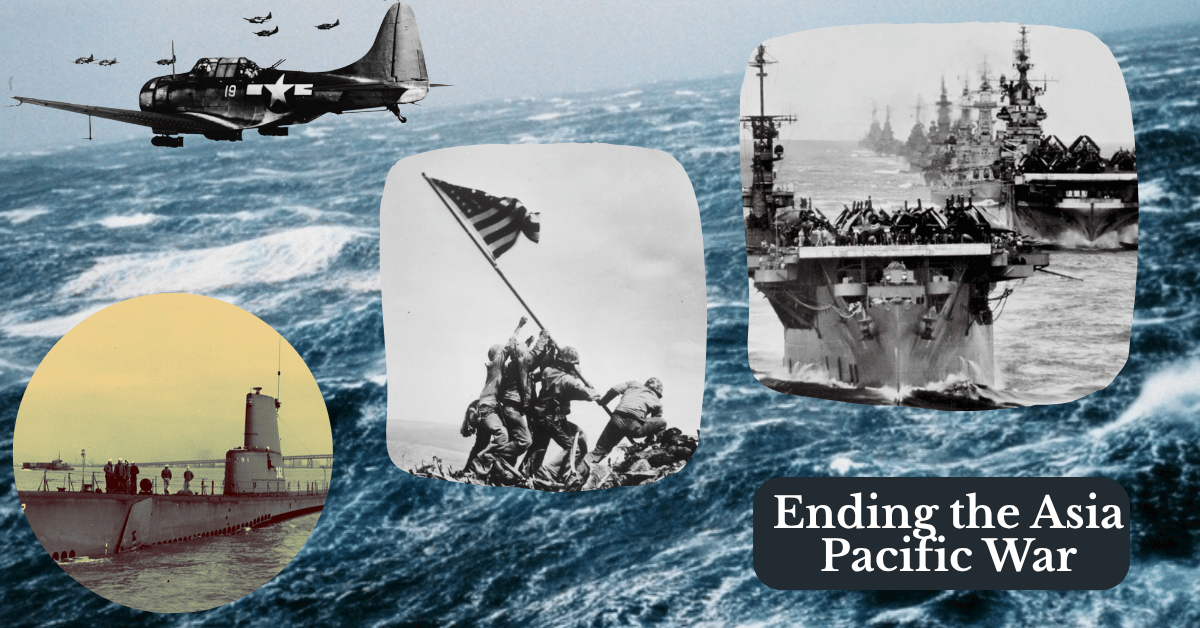
Image credit: various photographs from Naval Aviation Museum, National World War II Museum, and US Navy Archives.
Discover more from friarmusings
Subscribe to get the latest posts sent to your email.
 friarmusings