
The First Sino-Japanese war marked Japan as a military power – but was Japan capable of engaging a western military power? That question would be put to the test in the Russo-Japanese War of 1904–1905.
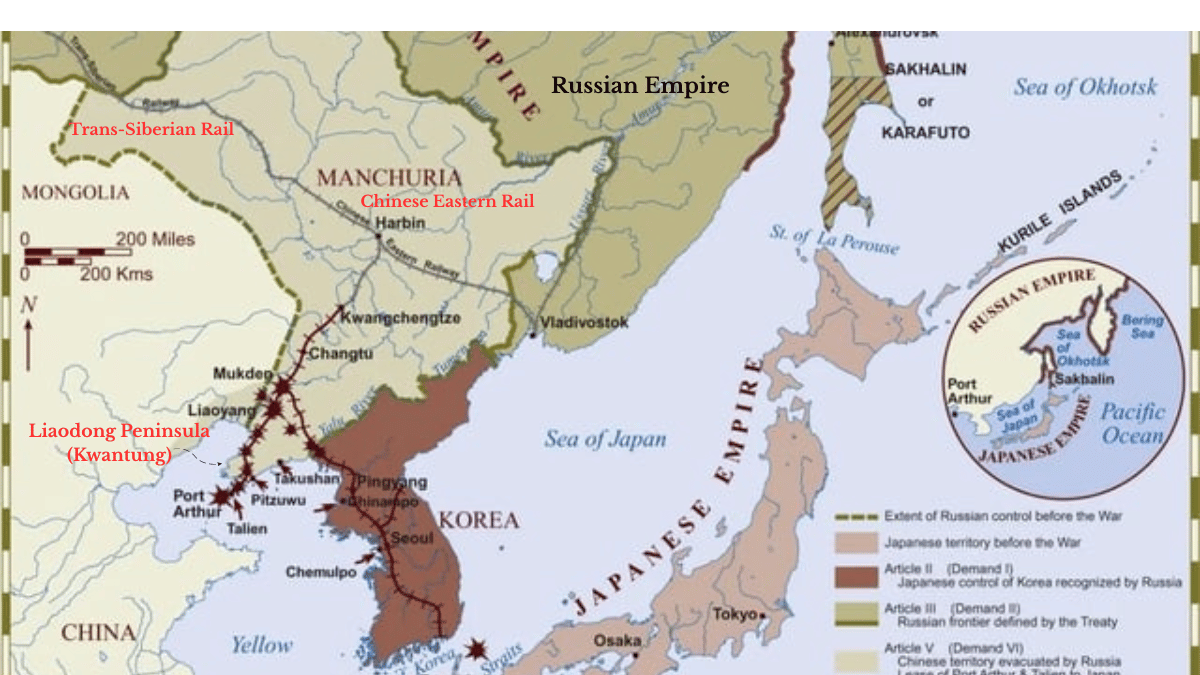
In the previous post we noted that the transfer of Liaodong Peninsula and its warm water Port Arthur were ceded to Japan in the treaty that ended the First Sino-Japanese War. Via the “Triple Intervention,” (of which Russia was the primary animator), Japan reluctantly agreed to return Liaodong to China in 1895, the same year the war ended. In 1898 the ports of Liaodong and Port Authur were leased to Russia. The news was not received well in Japan. Beyond the humiliation, this meant the very thing Japan feared: a western imperial power gaining a foothold in what Japan considered its “security zone.” But Japan also realized Russia’ long term goals and objectives were even more ominous.
Russia had a similar view of Japan and sought to construct “security zones” that provided protection, strategic depth while providing economic and diplomatic leverage. Russia’s Far Eastern policy aimed at the warm-water port of Port Arthur. In addition Russia wanted to extend its influence southward from Siberia into Manchuria and Korea. This would link the Pacific coast firmly to European Russia.
All this brought Russia even more deeply and directly into Japan’s perceived security zone.
Precursors to War
After 1895, Russia steadily entrenched itself in Manchuria as it had gained rights to build the Chinese Eastern Railway across Manchuria to connect to the Trans-Siberian Railway. In 1898 the aforementioned lease of Port Arthur was secured and in 1900 the Russian military took advantage of conflict and occupied Manchuria during China’s Boxer Rebellion. Then Russia failed to fully withdraw from Manchuria afterward, despite repeated promises. Japanese leaders interpreted this as bad faith and evidence of permanent annexation plans. All this transformed Russia from a distant empire into a direct territorial rival.
Although Manchuria was vital, Korea was the emotional and strategic trigger. After 1895, Russia increased diplomatic, financial, and military involvement in Korea. Russian advisers appeared at the Korean court. Russia was giving all the signs and indications that their goal was for Korea to become a Russian protectorate, mirroring what had happened in Manchuria. Japan was willing to compromise on Manchuria; it was not willing to compromise on Korea.
From 1901–1904, Japan sought negotiated settlements, proposing that Japan recognize Russian predominance in Manchuria in exchange for Russian recognition of Japanese predominance in Korea. Russia repeatedly delayed responses and when they did reply the concessions or counters were vague or conditional. At the same time the Russians continued strengthening their military position. Japan rightly concluded that Russia was using diplomacy to buy time.
Internal pressures pushed Japan toward war. After the Triple Intervention, Japan believed its status as a great power depended on resisting further humiliation. Many Japanese believed they must fight before Russia completed the Chinese Eastern Railway and achieved overwhelming superiority – it was now or never – and the nation, for 20 years, had been investing in the military for a contingency just like this. Further delay favored Russia and so “now” seemed to be the window for victory; a window that might soon close. War increasingly appeared to be the least bad option.
How to understand the Russo-Japanese War
The Triple Intervention’s legacy went beyond immediate grievance. It convinced Japan that international law and diplomacy favored the strong, hardened Japanese elites against reliance on Western goodwill, and reinforced the belief that only decisive force could secure Japan’s place. The Triple Intervention was not a cause of war, but a lesson learned.
Other world powers had their own concerns about Russia. Britain and the United States preferred a strong Japan to check Russian expansion and applied no serious pressure on Japan to back down. In addition the Britain–Japan Alliance (1902) reassured Japan that it would not face a multi-power coalition. And so Japan did not fear diplomatic isolation in the way it had regarding the First Sino-Japanese War. All of this gave indications that perhaps Japan was being accepted as a world power or at least acknowledged as the preeminent Asia power.
Meanwhile, Russia never prepared for war. On one hand Russia was far more concerned with European matters and internal court intrigue. On the other, Russia severely underestimated Japan’s military power, the existential threat they were imposing upon Japan, its willingness to attack a European power, and other factors that likely included racial and cultural assumptions that Japan was a “second-rate” power. Besides, time was on their side; or so they believed.
Over time, historians have developed different views of the war. In part, because more primary source information became available and the lenses of understanding changed between generations. Up until the 1950s, the understanding was that Russian aggression and imperial expansion were the primary causes; Japan fought a defensive, pre-emptive war. It was believed that Japan exhausted diplomatic options and struck only when delay became fatal. Overall, the clash is viewed as a case of a rising regional power resisting European imperialism. Any Japanese imperial ambitions are downplayed and priority is given to the perceived threat from Russia.
In the 1960s the assertion was that Japan deliberately chose war to secure imperial expansion. Russia was cautious, divided, and often defensive while Japan overstated the Korean security threat to justify expansion. Captured by internal politics, Tokyo rejected workable compromises to avoid diplomatic limits on its freedom. At the same time, military and naval elites used war to secure budgets, cement political influence and validate the expenses of the modernization efforts. Russia, lacking a coherent Far Eastern strategy, repeatedly sought delays. This view underplays how threatening Russian actions appeared to Japanese decision-makers at the time.
From the 1990s onward the view judges that the war resulted from mutual imperial ambitions, compounded by misperception, bureaucratic politics, and structural insecurity. This approach does not split blame cleanly but asks, “Why did compromise fail when it seemed possible?”
The general conclusion is that diplomacy failed because Russia’s bureaucracy was fragmented causing delays which Japan interpreted as deception. Both sides believed time favored the other, creating a commitment trap. Along with other factors, war was not inevitable, but once certain thresholds were crossed, it became likely.
When one looks at the analysis of the later Asian-Pacific War, you will discover elements of the same pattern. Often these phases are described as orthodox, revisionist, and modern (sometimes followed by neo-orthodox). It is especially in the last phases, when more primary source documents become available that specialists begin to view through specific lenses reflecting what the historian thinks is the primary driver: economics, diplomacy, policy, politics, security, and more.
Why do I mention this? Because later in this series we will review that same morphing historiography as concerns Pearl Harbor and the Asia-Pacific War.
The War
After years of failed diplomacy, Japan launched a surprise attack on the Russian fleet at Port Arthur in February 1904. Japan quickly seized the initiative on land and sea, winning major battles at Liaoyang, Mukden (remember this name), and decisively at the naval Battle of Tsushima, where Japan destroyed Russia’s Baltic Fleet. Tsushima turned a prolonged war of attrition into a rapid path to Japanese victory.
Despite Russia’s larger population and resources, she suffered from poor leadership, long supply lines, and domestic unrest all of which crippled her war effort. Japan’s modernized army and navy achieved rapid, coordinated victories but at high cost. The war ended with the Treaty of Portsmouth (1905), mediated by the United States, recognizing Japan’s predominance in Korea, transferring Port Arthur and southern Manchuria to Japan, and confirming Japan as the first Asian power to defeat a European great power in modern war.
The Aftermath
The Japanese victory in the Russo-Japanese War is described as coming “at high cost” because military success pushed Japan close to the limits of its manpower, finances, and social cohesion, even while it won on the battlefield. The costs were real, visible, and politically destabilizing, leaving deep scars beneath the triumph.
Japan won most major engagements, but often through frontal assaults against entrenched Russian positions. The losses (deaths and casualties) were exceptionally high for a small nation. Total casualties (killed, wounded, missing) were 70,000–80,000. While the Russian losses were higher in absolute numbers, the losses were not as devastating or proportionally large. Further, for Japan the losses fell heavily on young, conscripted males, straining villages and families. The army began to fear it was winning battles faster than it could replace men.
Japanese doctrine emphasized an offensive spirit and tactical mindset regardless of the cost. While it worked tactically in this war, attrition favored Russia in the long run. Japan’s leaders quickly came to understand that they could not sustain another year of fighting. By early 1905 ammunition stockpiles were low, replacement soldiers were less well trained, and the army was nearing exhaustion. Victory arrived just before exhaustion became defeat.
In a certain sense Japan lost the war. Japan had financed the war largely through Britain and U.S. loans supplemented by heavy domestic taxation. As a result national debt skyrocketed as war expenditures consumed well over half of government spending. Japan emerged victorious but financially dependent on international credit, and most importantly, had no leverage to impose a punitive peace as it had done after the First Sino-Japanese War. Punitive peace was the expectation of the people after such a great sacrifice.
But unlike earlier wars, Russia had suffered casualties and loss, but overall their army and navy were still substantial, no Russian territory was occupied, and the regime of Russia was not really threatened, nor was the Trans-Siberian Railway. In addition, the U.S. had moderated the treaty/settlement. President Roosevelt’s priorities were ending the war quickly, preserving a balance of power in East Asia and avoiding Russia’s complete humiliation which might destabilize Europe. Roosevelt pressed Japan to drop indemnity demands and accept territorial and political concessions instead
Japan accepted because it needed peace more than money.
Back home, the public expected indemnity payments, territorial expansion of more than Korea and southern Manchuria, and some step-up in recognition. The perceived gap between sacrifice and reward sparked riots in Tokyo and a growing disillusionment with the current political leaders. Victory felt incomplete, even humiliating to some.
The war reinforced dangerous lessons for the Japanese military that cemented the bushidō philosophy in their ranks. It became, not just an understanding, but doctrine that bushidō spirit could overcome material disadvantage. Also, that decisive victory required willingness to accept massive losses. These lessons contributed to later tolerance for extreme casualties in future wars. In a way, the cost was not only human and financial, but ideological. And to the western mind, irrational.
Image credit: various photographs from Naval Aviation Museum, National World War II Museum, and US Navy Archives.
Discover more from friarmusings
Subscribe to get the latest posts sent to your email.
 friarmusings