
At this point in the series we have reached 1905. The Russo-Japanese War had just concluded with a peace settlement reached, moderated by the United States. China was technically at peace, but as we’ll explore later in this post, there was a lot of conflict ongoing within China’s borders – foreign states fighting one another and internal actors seeking to overthrow the Chinese Qing Dynasty government (the last of the Chinese imperial governments established by the Manchu people of northern China). What becomes confusing is the ebb-and-flow of the control of “areas” of China in the first half of the 20th century. This post will attempt to offer a primer in area and names that will be bandied about in the following posts.
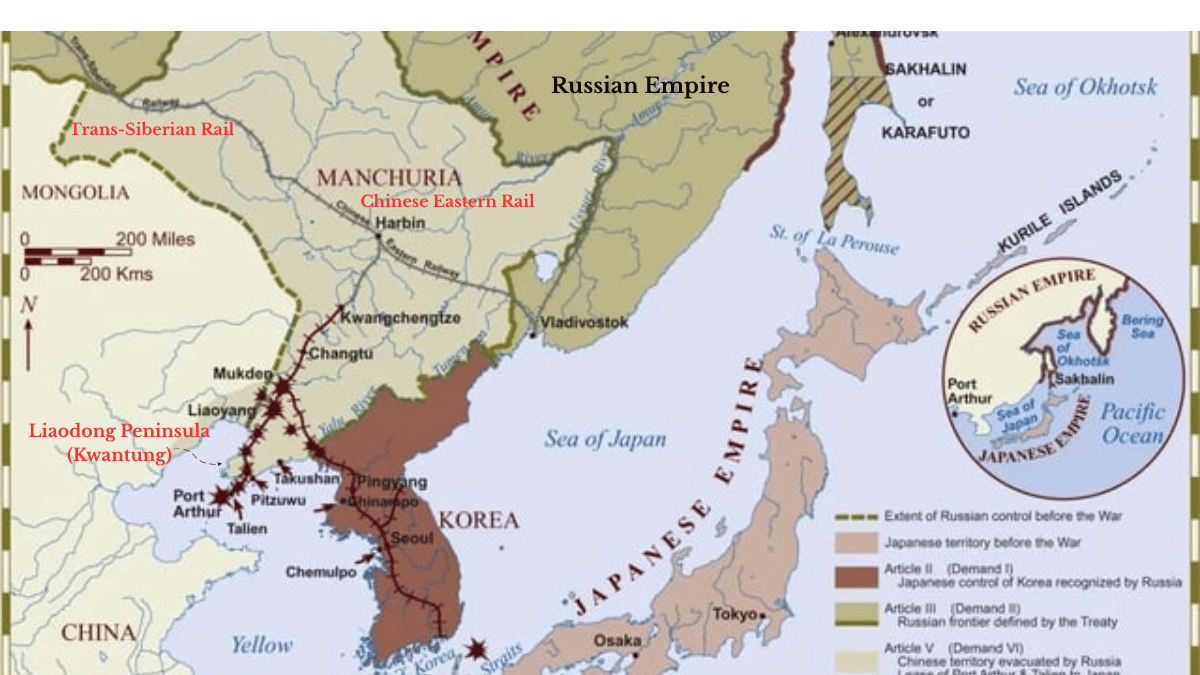
The major “areas” are as follows – and some of the nomenclature is mine in an attempt to (hopefully) make it easier to follow the storyline:
- China: the southern part of the nation nominally in control of the Chinese government(s) and unoccupied by a foreign power. Under the China “Open Door” policy (not a treaty but a working understanding) most European powers had enclaves in port cities and important cities of the interior prior to WW2.
- Manchuria: the traditional area in the northernmost bounds of the nation of China that was occupied, reoccupied, and in conflict between non-Chinese nations for the first half of the 20th century. It shares a border with Korea and Liaodong to the south and Siberia to the north. Importantly the railroad across Manchuria connected the TransSiberian Railroad to Russia’s eastern port of Vladivostok.
- Northern China: a “made up” term that will be used to describe the area south of Manchuria and north of the rest of China. It is the area during the Second Sino-Japanese War (b. 1937) and incidents leading up to that conflict in which Japanese and Chinese forces clashed. While not exactly accurate, it is an area north of the Great Wall of China.
- Inner Mongolia: a crescent shaped area north of “Northern China” and west-southwest of Manchuria. It largely borders Mongolia (a Russian state) with some shared border area with Russia (Siberia)
- Laiodong (Kwantung): a peninsula west of Korea peninsula that is important for its warm water ports (notably Port Arthur) and the terminus of a railway system that connected the ports to the Trans-Siberian Railroad. The Chinese Eastern Railroad will later be called South Manchurian Railroad and later designated the North Manchurian Railroad
- Korea: the boundaries then are the same as now. In the early 20th century it was technically an independent nation with its own king and queen.
- Formosa: now known as Taiwan.
Korea
Korea has its own rich and varied history, but for purposes of this post, by the 20th century Korea was either a tribute state subject to China or a battleground for China, Russia, and Japan. Korea had once been a land of the “Three Kingdoms” – Goguryeo, Paekche (Baekje), and Silla. At the height of its powers the three kingdoms occupied the entire peninsula and roughly half of Manchuria and small parts of the modern Russian Far East. Goguryeo controlled the northern half of the peninsula, as well as Liaodong Peninsula and Manchuria. Paekche and Silla occupied the southern half of the peninsula.
Paekche was a great maritime power and was instrumental in the dissemination of Buddhism and its culture/skills to ancient Japan. This included Chinese written characters, Chinese and Korean literature, and technologies such as ferrous metallurgy and ceramics, architectural styles, sericulture (silk worms) and Buddhism.
The history of Korea is far more complicated than the “Three Kingdom” but that was the foundation that became modern Korea (after many twists and turns!) In the late 19th century, the government implemented a strict isolationist policy, earning Korea the nickname “Hermit Kingdom”. Like Japan, the policy had been established primarily for protection against Western imperialism, but soon the ruling dynasty was forced to open trade, beginning an era leading into competing Chinese and Japanese pressures. Prior to the First Sino-Japanese War, Korea was a tribute state to China. The 1895 post-war settlement gave them independence and the King became the Emperor of Korea.
Japan, Russia and China were the major foreign powers with interests in Korea, but at the end of the Russo-Japanese War in 1905, the Korean Empire effectively became a protectorate of Japan. At point of great contention, then and now, is that the 1905 Protectorate Treaty promulgated without the Emperor. It was not dissimilar to the U.S. annexation of Hawaii in 1898. Japan annexed Korea in 1910 and so things remained until 1945 and the defeat of Japan.
There is a long history of animosity between Korea and Japan stemming from the 1905-1945 period. Even today, Korea feels that Japan has not sufficiently acknowledged numerous injustices from the period, with grievances focusing on an alleged lack of a clear, straightforward admission of historical wrongdoing, denial of specific atrocities, and failure to provide appropriate reparations to individual victims. The list of injustices includes:
- Sexual slavery (“comfort women”): the forced recruitment of tens of thousands of women, mostly Korean, into Japanese military brothels across Asia and the Pacific as sexual slaves.
- Forced labor: millions of Koreans were forced to work in harsh conditions in mines, factories, and on construction sites in Japan and its colonies with little to no payment.
- Cultural suppression: Japan implemented policies aimed at erasing Korean national identity, including banning the Korean language in schools and public spaces, forcing Koreans to adopt Japanese names, burning Korean historical documents, and converting Korean temples to honor Japanese deities.
- Massacres and war crimes: Koreans highlight several mass murders and atrocities committed by Japanese forces, such as the Gando and Kantō massacres, not acknowledged by Japan.
- Legality of annexation: There is an ongoing dispute over the legality of the 1910 Annexation Treaty itself, which many Koreans view as having been signed under duress and therefore invalid.
Japan and Korea
Japan had long been interested in Korea, “the dagger pointed at the heart of Japan.” Neutrality was not an option. Japan wanted control as part of its vision of strategic buffers. But in addition, Japan needed Korea’s food production, natural resources, and land for Japanese emigrants due over population concerns in the home islands.
Image credit: various photographs from Naval Aviation Museum, National World War II Museum, and US Navy Archives. | Map courtesy of MapWorks 2005
Discover more from friarmusings
Subscribe to get the latest posts sent to your email.
 friarmusings