
In the previous post, it was noted that at the end of the First World War the Imperial Japanese Navy (IJN) had expectations but were realistic. They expected that their coalition work with the British in the Indian Ocean, Mediterranean, and taking on maritime security in the Pacific had earned them recognition, respect and parity with the western navies. They had just successfully operated as a “global navy.” They also recognized that maintenance and expansion of their fleet was directly tied to shipyard capacity, raw materials and industrial throughput. These were industrial limits impossible to ignore and were not limitations on either British or the Americans.
Japanese Naval Planning
The nation of Japan continued to struggle financially with the burden of Russo-Japanese war debt, expenditures on military replenishment, expenses on the build up and securing their footholds in Manchuria, Korea, and Liaodong. At the same time, like all nations post-WW1, there was a desire to return to a consumer economy after the deprivations of the war years.
The Navy’s planning division began to look ahead a decade to see what would be needed in the 1930s in order to support nascent plans for a Japanese-led Asia prosperity zone. The conclusion was that the Navy required two fleet groups, each consisting of 4 battleships and 4 heavy cruisers. Thus was born the 8-8 plan. The basis of the plan was the theory of sea power of Alfred Thayer Mahan which was the foundation of both Japanese and American naval strategy. One of the central theses of Mahanian thought was the “decisive battle” after which “control of the sea” would automatically default to the winner. The Japanese had to control the Western Pacific.
The problem was that in 1918-1919 Japan was experiencing a post-WW 1 economic depression making their 8-8 fleet plan financially impossible. Nishihara Hajime, Vice Minister of Finance noted to the Navy Minister Kato that not only would the capital budget for new construction consume 20-30% of the national budget, the outyear expenses for maintenance, operations, etc, for a fully operations 8-8 fleet would extend the budgetary consumption at similar percentage rates. It was not viable or sustainable. And the problem with that was the overall naval strategy was based on several premises:
- The U.S. would not construct any fortifications/bases west of the Philippines or Guam.
- So that in the event of a US-Japan conflict, the U.S. fleet would have to cross the Pacific for any hostile action against Japan.
- Based on Mahan’s theory, the U.S. would lose 10% of its force effectiveness for every 1,000 miles of steaming – so after 3,000 miles of Pacific transit, the U.S. fleet would effectively be 70% of its original force structure.
Japan was in a position that it needed to understand what it could afford to build and maintain a 10:7 ratio of naval combatants. In other words, the two nations that had access to raw materials, finances, and shipyard capacity to outbuild Japan – they needed to be constrained to a limitation that fit within Japan’s strategic plan.
Forestalling an Arms Race
Meanwhile, there were growing tensions in East Asia over an unstable China, Japanese occupation of Shandong (former German territory), Manchuria, and more. Leaders in the international community sought to prevent the possibility of another war. Rising Japanese militarism and an international arms race heightened these concerns. Within the United States there were congressional calls for the U.S. to engage Britain and Japan in naval arms limitation negotiations.
In what must have seemed like a godsend to the Japanese in this era of growing tension, in 1921, U.S. Secretary of State Hughes invited nine nations to Washington, D.C. to discuss naval reductions and the situation in the Far East. This gathering is known as the Washington Naval Conference which produced three treaties: the Five-Power Treaty, the Four-Power Treaty, and the Nine-Power Treaty. Not terribly imaginative, but nonetheless descriptive.
- The Five-Power Treaty, signed by the United States, the United Kingdom, Japan, France and Italy was the cornerstone of the naval disarmament program. It called for each of the countries involved to maintain a set ratio of warship tonnage which allowed the United States and the United Kingdom 500,000 tons, Japan 300,000 tons, and France and Italy each 175,000 tons. If you do the math the ratio between US/Britain and Japan was 5:3 (10:6 equivalent and not the 10:7 Japan desired)
- In the Four-Power Treaty, the United States, France, the United Kingdom, and Japan agreed to consult with each other in the event of a future crisis in East Asia before taking action. This nullified the Anglo-Japanese Treaty of 1902, freeing Britain from coming to the aid of Japan in the event of war.
- The Nine-Power Treaty, marked the internationalization of the U.S. Open Door Policy in China. The treaty promised that each of the signatories (the United States, the United Kingdom, Japan, France, Italy, Belgium, the Netherlands, Portugal, and China) would respect the territorial integrity of China. The treaty recognized Japanese dominance in Manchuria but otherwise affirmed the importance of equal opportunity for all nations doing business in China.
Japan and China also signed a bilateral agreement, the Shandong Treaty, which returned control of that province and its railroad to China. Japan had taken control of the area from the Germans during the First World War and maintained control of it over the years that followed. Combined with the Nine-Power Treaty the effect was meant to reassure China that its territory would not be further compromised by Japanese expansion. All of these treaties were set to expire in 1936.
The treaties of the Washington Naval Conference stabilized naval competition but ignored land-based conflicts. Rising Chinese nationalism with its own imperial privileges and Japanese ambitions. Manchuria remained unresolved as Soviet reemergence added strategic anxiety for Japan. Meanwhile, Western powers lacked capacity or will to enforce the system they had just created. East Asia was not at peace, it was balanced as long as there was restraint from all parties, but ready to topple once the first party was willing to move unrestrained.
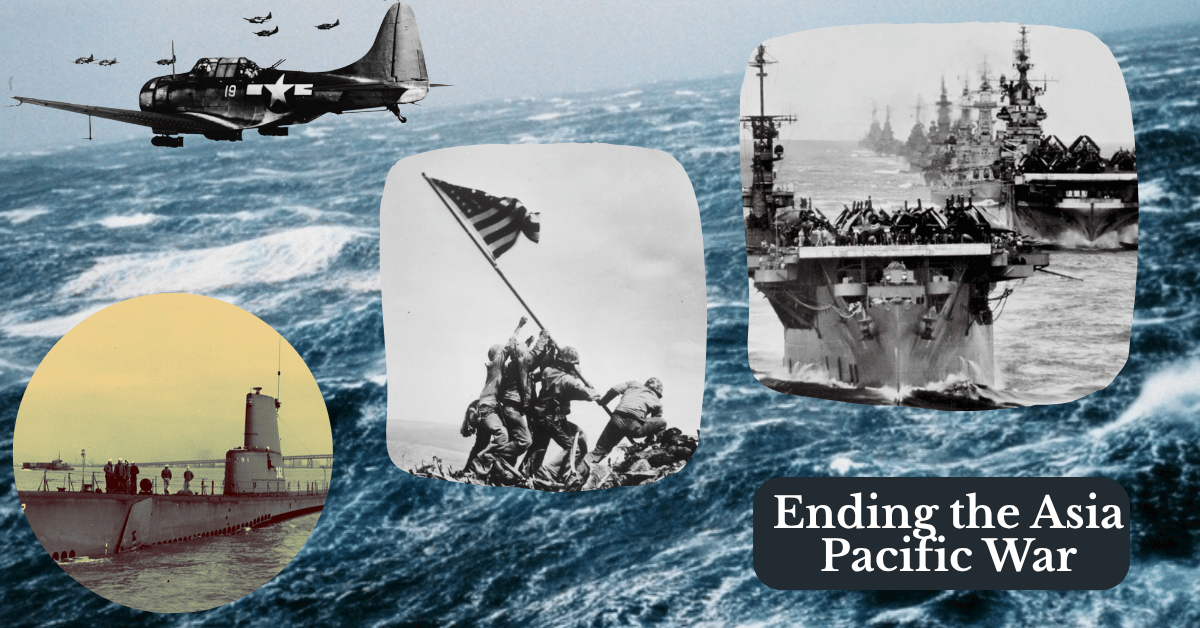
Image credit: various photographs from Naval Aviation Museum, National World War II Museum, and US Navy Archives.
Discover more from friarmusings
Subscribe to get the latest posts sent to your email.
 friarmusings