
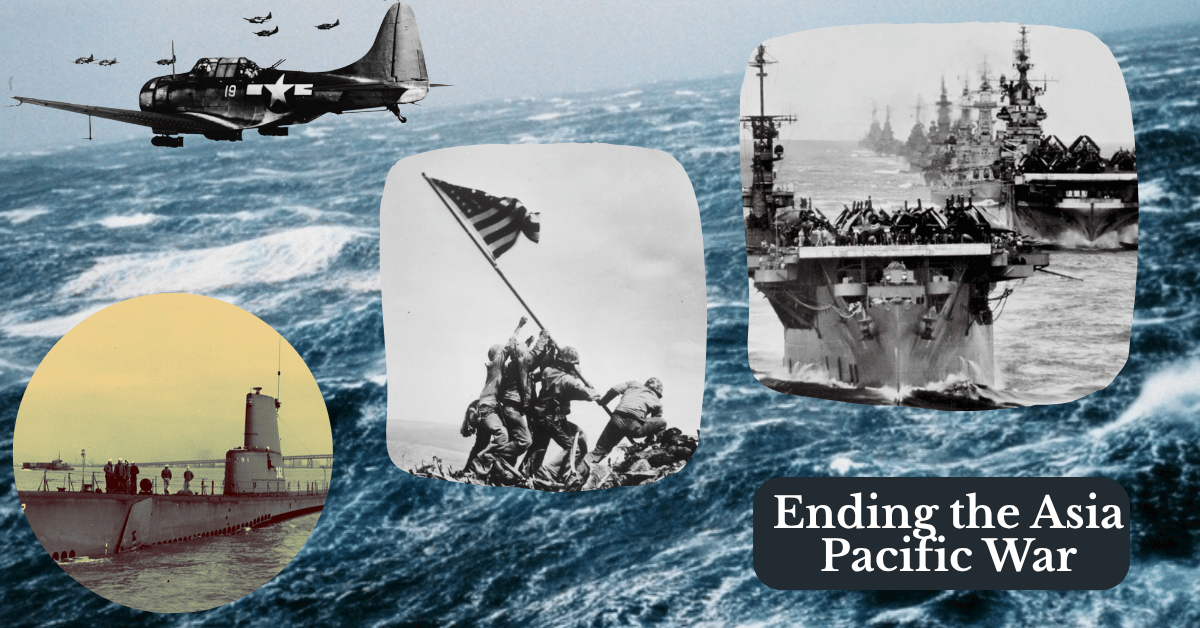
In the 2026 posts I have been working to go into more depth on the events prior 1941 that drew the U.S. to become involved in the Asia-Pacific War. In the first post of the new series I wrote that I wanted to explore:
“…the currents and eddies of history that brought Japan its wars with China (1894-1895 and 1937-1945), with Russia (1904-1905), the annexation of Korea, Manchuria and French Indochina, and to wider war in the Pacific that stretched from Hawaii to Australia and nations in between, notably the Philippines, Malay, Borneo and the Dutch East Indies.”
And more, I wanted to delve into the milieu of conditions that led Japan to think that the wars were necessary, why it felt the U.S. needed to be drawn into the war, understand revisionist historians who assigned large elements of blame on the U.S. for forcing Japan’s hand making war inevitable, and so many other questions – especially what made Japan think they had any possibility for winning a war that would involve the United States.
To that end I have posted a bare bones history of Japan, her people, the ages and epochs she experienced, changes in people, in forms of governance, her relationship with other Asian countries, and especially the changes in Japanese society from the end of the Shogunate period of her history into the modern times of the Meiji Restoration. After covering multiple centuries in a single post, the focus began to narrow to cover decades, and sometimes events of just a single year.
What is common to so many of the posts was something I began to explain in the post “There’s Something About China.” That post tried to address the swirl of history surrounding China, European nations, and Japan in the days of the 19th and early 20th centuries. For business people, pirates, adventurers, explorers, seekers of the mysterious and exotic – all roads lead to China. The 1930s are no different.
But the 1930s are a confluence of many emerging influences within the Japanese world, changing the lenses by which she viewed the outside world. Although Japan had been an open country after Admiral Perry’s appearance in Tokyo Bay in the 1850s, had established a robust international trade, was an allied partner in World War I, and more – she was still a closed country in many other ways. Many of those trends were discussed in the web of previous posts and are just highlighted here:
- Social Darwinism had found its way into national strategy. Control of Korea and Manchuria were seen as strategic buffers and reserves of critical resources. This allowed Japanese leaders to claim: “We do not seek conquest; we seek existence.” It is a logic that removed ethical restraint.
- The traditional Samurai spirit had been morphed into bushidō as Japan’s equivalent to Western chivalry, and proof Japan possessed a moral civilization worthy of great-power status. This was installed in the military and imperial strategy of the 20th century – as well as popular culture.
- The Imperial Army (IJA) and Navy (IJN) received heavy investments in equipment and personnel in order to become a military of a leading world power. The goal for the IJA was control of China and Russia. The measure for the IJN was the U.S. Navy as seen in Japan’s war plan, Kantai Kessen (“Decisive Battle Doctrine”). For details see the post War Plan Orange.
- While the Meiji Constitution made provisions for a Constitutional Monarchy similar to Great Britain’s, the 1920s brought new challenges to that understanding. Liberal democracy was discredited by the post-WW1 financial crises and the Wall Street crash. Rising nationalism led to a decade of Governance by Assassination which led to a military operating with impunity, free of civilian controls and juridical consequences.
Whatever national restraints that were present in the 1920s had given way to the trends above. The 1930s were marked with a rejection of the Western nations that Japan felt had already rejected her in the Washington Conferences, the League of Nations charter, and host of other post-WW1 matters. At the same time there was an embrace of a selective account of Japanese history, culture and values. The Pan-Asian aspirations had been subsumed by Japanese nationalism so that Pan-Asian aspirations and Japanese conquest were the vision and destiny. All of this is wrapped into the promotion of racial superiority in spirit and morals, a homeland that had never been successfully invaded, all under the leadership of the divine Showa Emperor, Hirohito. Destiny called. The first call was China.
The Manchurian Campaign – Mukden
“On the roads that led Japan to and beyond Pearl Harbor, the Manchurian campaign was the first signpost. Milestones had been passed, but it was in Manchuria where the road, for the first time, divided.” (Tohmatsu and Willmott, 25).
Until 1928 or so, China was a patchwork of local war lords and shifting alliances. It made Japan’s governance of Korea, Manchuria and the Liaodong Peninsula relatively simple. But in 1928 and 1929 the Nationalist Chinese Party (Kuomintang under the leadership of Chiang Kai-shek) began to assert control over central and northern China including large swaths of Manchuria. The Manchurian warlord Zhang Zuolin has been assassinated by elements of the Japanese Kwantung Army (Kwantung is the Japanese name for Liaodong) only to see his son Chang assume power and align with the Kuomintang. Japan had formally adopted a non-interference policy for China. In the eyes of the military it was time to ignore that policy.
In 1930 nationalist operatives shot Prime Minister Hamaguchi, who survived, but the vacuum of power allowed space for the military to plan and put in place their conspiracy to expand its presence in Manchuria. The conspiracy was rooted in the Kwantung Army as well as the Army Ministry and General Staff in Tokyo. They believed a pre-emptive strike would allow Japan to take advantage of Chinese weaknesses and division. The origin of the plan was among middle-ranking officers in the Kwantung Army who believed that their actions could not be repudiated by Tokyo given the popularity of the military at home. They firmly believed that if they took the unauthorized initiative they would be able to dictate national policy. They were firm in their convictions that neither senior Kwantung officers nor the Army Ministry and General Staff in Tokyo would be able to repudiate their insubordination even insubordination that brought war. The 1928 assassination of Zhang had been the test case.
By early September 1931 the conspiracy was evident. Chiang Kai-Shek had information of what was afoot but knew he was powerless to stop it militarily and a series of river floods within China complicated his never ending power struggles with warlords and the traditional government in Nanking. He instructed the Manchuria Chang to not resist.
The conspiracy was also known to the Emperor and Prime Minister Wakatsuki. An officer from the General Staff, Major General Tatekawa, was sent to Manchuria specifically to ensure restraint, but he found himself distracted and attentive to other matters.
On September 18, 1931, officers of the Kwantung Army staged a small explosion on the South Manchurian Railway near Mukden and blamed it on Chinese forces. Although the damage to the railway was minimal and no Japanese trains were seriously affected, the Kwantung Army treated the incident as justification for full-scale operations. Within two hours virtually every Japanese unit in Manchuria undertook pre-planned offensive action leading to a rapid, unauthorized military takeover of Manchuria. Tokyo’s civilian government ultimately accepted the fait accompli. The Mukden Incident led to the creation of the Japanese puppet state of Manchukuo (1932), Japan’s withdrawal from the League of Nations (1933), and marked another decisive step toward unchecked military expansion and the erosion of civilian control in Japan.
There are a host of events between Mukden and 1934 that are important but can largely be described as unsuccessful attempts by the Kuomintang and affiliated groups in other parts of Northern China and Inner Mongolia to thwart the expanding control of Japan over all of Manchuria. In April 1934 Japan issued the Amau Declaration that asserted Japan had a special responsibility and leadership role in East Asia, particularly in China, and warned that Japan would oppose any foreign actions that interfered with its efforts to maintain order and stability in the region. While it stopped short of announcing formal annexations, it made clear that Japan would not tolerate outside powers, especially Western nations, challenging its political, economic, or military influence in China.
The Amau Declaration formalized Japan’s claim to regional dominance in East Asia and marked another step away from international cooperation toward coercive imperial policy in the 1930s It effectively proclaimed a Japanese sphere of influence in East Asia and was seen as an Asian version of the Monroe Doctrine, but backed by military force rather than diplomacy. The declaration further isolated Japan diplomatically and reinforced perceptions that Japan was abandoning collective security in favor of unilateral expansion.
The campaign in Manchuria proved to be the first of three Japanese offensives north of and astride the Great Wall: within Manchuria itself, in Inner Mongolia, and then in northern China. These efforts, following one after the other, lasted until early 1937, by which time Japan had secured Manchuria and, by a combination of military and other means, had largely neutralized Chinese and Kuomintang influence in Inner Mongolia and northern China.
The Response of Nations
All that was left for China was the posture of no resistance, no recognition of Japanese gains, and no negotiations with Japan. The League of Nations issued the Lytton Commission report condemning Japan. It was ignored and the report’s failure to initiate international sanctions or action proved to be the death knell of the League of Nations. Since the United States was not a League member and was Japan’s largest western trading partner, Japan saw no need to take any action.
In the United States, Franklin D. Roosevelt became president in January 1933 and started to govern amidst a powerful isolationist sentiment among the people and in Congress. We had been drawn into the European morass of World War I and would not be fooled again.
Meanwhile… the Navy
In December 1934, Japan announced it would not renew its participation in the Washington Conference treaties, especially the limits on naval combatants and auxiliary ships. In fact, Japan was already “cheating” on the accords. The Navy began to mimic the Army’s attitude as it longed for the freedom of action that the Army had simply taken for its own. The difference is that the Navy is a capital intensive investment with long lead times. At issue was the need to be unrestrained from a naval inferiority to British and American fleets as a step into support of the vision of Japan’s Asian “Monroe Doctrine” to be implemented by force of arms.
More than a decade before Admiral Kato, chief negotiator at the 1922 Washington Naval Conference, had pointedly noted that the only eventuality that could be worse for Japan than an unrestricted naval race with the United States would be war against that country. The Washington Conference had not been perfect and had required unwanted compromises from Japan, but whatever its faults, it had limited naval construction, and provided Japan with a level of naval security in the western Pacific that had never been its own to command. “This advantage was to be thrown away, and the American and British navies were to be challenged to a naval race by a service that was convinced of Japan’s special place in history. Moreover, it was equally convinced that it had in place an organization and doctrine that, given assured moral superiority over the Americans, would ensure Japan against defeat in a naval war in the Pacific. It was somewhat ironic, under these circumstances, that once limitation arrangements lapsed, both Britain and the United States laid down battleships before Japan, and it was doubly ironic that after the end of limitation, the United States laid down as many capital ships as the rest of the world put together.” (Tohmatsu and Willmott, 40)
The Aftermath
From 1934 through 1944 Japan invested in Manchuria to the extent it promoted export of critical natural resources and food. Perhaps the key investment was in the railroads. In 1931 Manchuria had 3, 600 miles of railbed. Japan added another 2,650 miles. This extended the reach of the rail system to areas of coal mining, iron ore prospecting as well as areas with valuable reserves of magnesite, molybdenum, tungsten, and vanadium. In general, production doubled between 1931 and 1936 – most of which was exported to Japan. Geological exploration saw estimates of iron ore reserves increase from 400 million tons to 2,700 million tons. All of these resources were critical to the military and the supporting industrial complex.
Ten years of Japanese rule witnessed the construction of 2,650 miles of railway to add to the 3,600 miles that had existed in 1931. Coal production in Manchuria rose from 8,950,000 tons in 1931 to 13,800,000 tons in 1936, and iron output rose from 673,000 tons to 1,325,000 tons in the same period. Japanese surveys and prospecting resulted in the revision of estimated reserves of iron ore from 400 million tons to 2,700 million tons and of coal from 4,800 million tons to 20,000 million tons as well as in the discovery of valuable reserves of magnesite, molybdenum, tungsten, and vanadium (critical to steel alloy production).
U.S. Reaction
From 1931 to the outbreak of the Second Sino-Japanese War in 1937 the U.S. reaction was largely restrained and limited to what might be best described as moral opposition. The Stimson Doctrine refused to recognize Manchukuo, the Japanese puppet state in Manchuria as well as other territorial changes achieved by force. It placed U.S. opposition on record, but was otherwise meaningless to Japan.
In 1943 Congress passed The Tydings–McDuffie Act that granted a path to Philippine independence by 1946. Japan concluded that the U.S. was starting a long-term reduction in their military presence in what Japan considered its sphere of influence. It was also seen as a sign that America’s isolationist movement was also evidence of a lack of U.S. willingness and resolve to resist further Japanese expansion in the Asia-Pacific region.
In the period 1935-1937, Congress passed a series of Neutrality Acts aimed at avoiding entanglement in foreign wars. These laws restricted arms sales to belligerents and, it seemed to Japan, more indication of the strong isolationist sentiment in the U.S. This reinforced Japanese assumptions that the U.S. would avoid direct involvement in an Asian conflict and limited Roosevelt’s freedom to act forcefully even if he had wanted to.
Within the diplomatic and intelligence circles, observers increasingly warned that Japan was moving toward full-scale war in China and that moderate civilian control in Tokyo was collapsing. The U.S. quietly increased naval planning and contingency studies, though without public confrontation with Japan.
Up to this point in time there were no embargoes, no assets were frozen, and no trade restrictions specifically targeting Japan. This restraint contrasts sharply with post-1937 policy, when sanctions gradually escalated.
All in all, U.S. actions signaled disapproval but not deterrence. This left a gap that Japanese leaders and officers increasingly understood.
Image credit: various photographs from Naval Aviation Museum, National World War II Museum, and US Navy Archives
Source credit: A Gathering Darkness: The Coming of War to the Far East and the Pacific, 1921–1942 by Haruo Tohmatsu and H.P. Willmott
Discover more from friarmusings
Subscribe to get the latest posts sent to your email.
 friarmusings
FR. GEORGE, THANKS FOR A GREAT SERIES. I REALLY APPRECIATE YOUR HARD WORK TO GATHER THE INFORMATION AND PRESENT THEM IN A EASY TO READ PRESENTATION