
In previous posts, we have tried to trace the Japanese strategic commitment to the southern strategy focused on the resource rich Southeast Asia mainland and Pacific Islands. The movements into Indochina brought about increasingly more stringent export controls and licensing for Japanese concerns, ratcheted up and hardened positions inside and outside government – especially within Japan where when the “military coughed, the Japanese cabinet developed pneumonia and collapsed.” With each cycle, the military was increasingly dominant in Japanese policy and strategy. There was a lot going on…
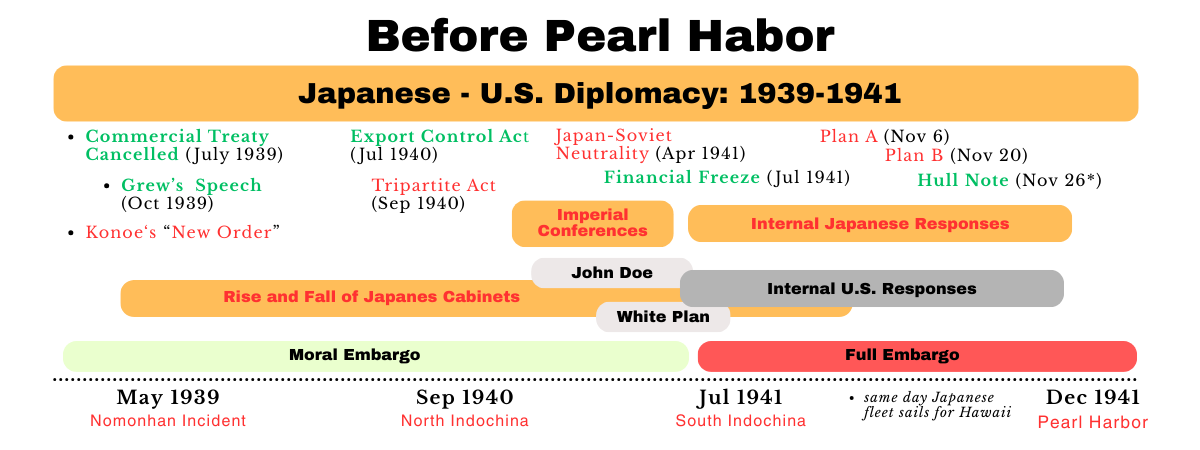
The “roadmap” above is nowhere as complex as the underlying reality and labyrinth pathways. Over the next several posts, the conversation will advance along threads that move from January 1941 until Pearl Harbor on December 7, 1941. Those posts are meant to be part of the buildup of background to understand organizations, factions within organizations, government departments, key persons and personalities, and more – all to set the context as we move ahead.
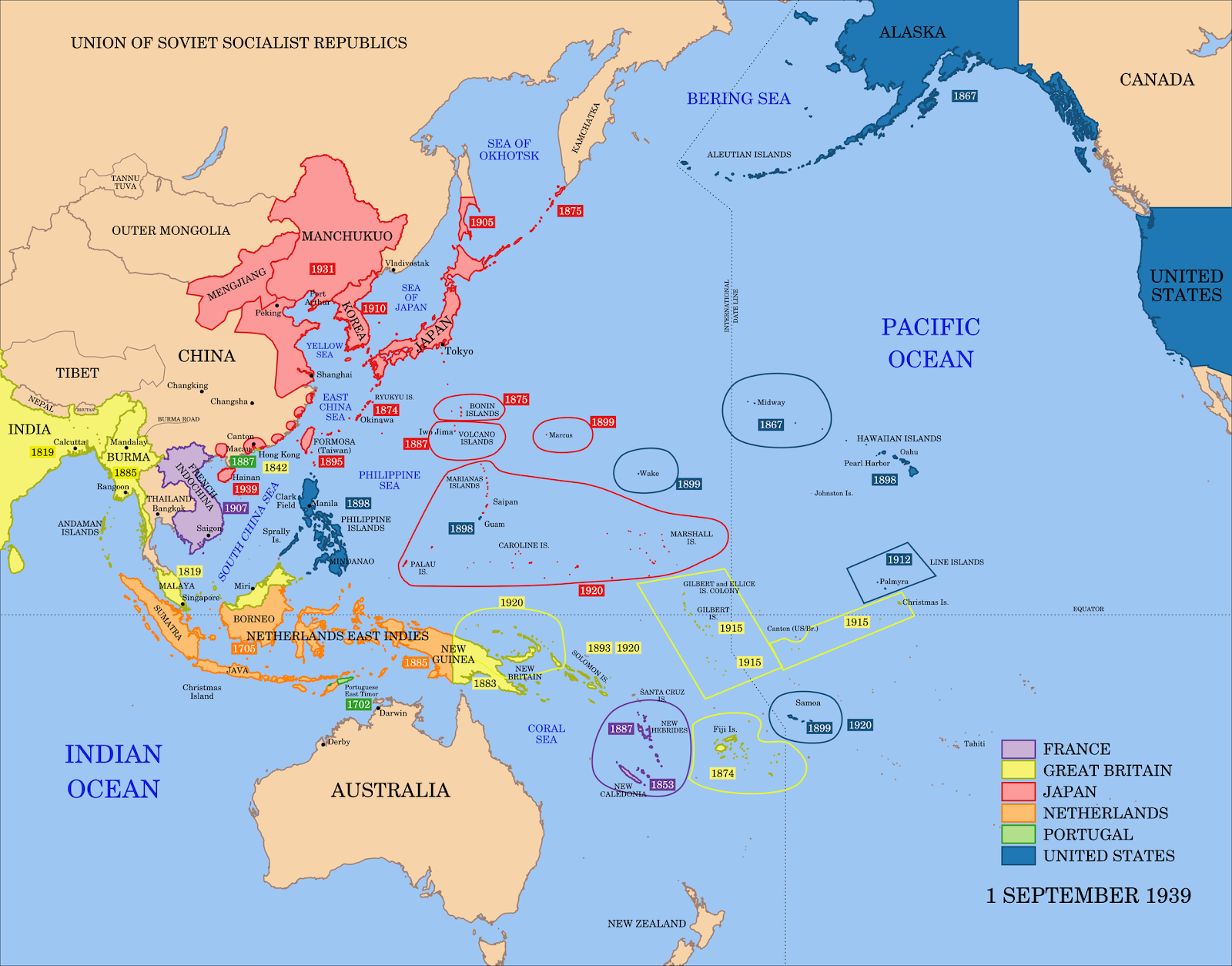
Back in one of the first posts, I asserted that the August 1941 “oil” (full) embargo did not start the war. The war in the Asia-Pacific region was already underway. One only needed to ask the Chinese, Vietnamese and Mongolians, as well as the Koreans. The full embargo of late July 1941 was a calculated political action by the U.S. in reaction to the Japanese occupation/invasion of French Indochina. It was a political action whose hope was to deter Japan from further expansion even further south to Hong Kong, Malay, Java, Borneo and the rest of the Dutch East Indies. Consider the map below (Sep 1939) and then add Indochina (Vietnam) and one can see Japan’s dagger is clearly aiming south.
To focus on only the oil embargo because Japan’s “economy” needed it, one has to remember it was a wartime economy that had already led to the deaths of 7 million Chinese by July 1941. Even if one chooses to only focus exclusively on the full embargo, one can ask:
- Was the embargo the decisive reason why Japan attacked Pearl Harbor or just more proximate than a collection of other reasons that was denying Japan unfettered access to war resources?
- The U.S. understood the goals for Japan southwest incursion, but did the U.S. truly understand the underlying motivations? I would suggest the U.S. perfectly understood Japan’s motivations and disagreed on moral and political grounds. Japan was fascism in the Asia-Pacific region – aligned to the fascist nations of Europe via the Tripartite Act.
- Did the U.S. have a clear understanding of the internal Japanese dynamic that increasingly marginalized any peace/negotiation faction as the military grew in stature and power? This was the shift that was transforming a potential Asia-Pacific trading partner into a deadly rival fixated on status, honor, and establishing its equivalent of the Asia-Pacific Monroe Doctrine.
- Was the embargo a virtual declaration of war hoping to draw Japan to military action so that the U.S. could enter the war in Europe? If so, then why was the U.S. so unprepared to fight any war, much less a two-ocean war?
- Clearly the December 1941 and early 1942 “blitzkrieg” across Southeast Asia, the Southwest Pacific, and Central Pacific regions accomplished the mission of (a) capturing the resource rich nations and (b) setting a “line of defense” west of Hawaii. Was the attack on Pearl Harbor necessary for the plan to access the resource rich lands to the southwest of Japan? Couldn’t they just have moved south and left a “blocking force” against the Philippines and prevented U.S. resupply?
- How did Japan so misjudge the U.S. public’s reaction to Pearl Harbor? Thanks to the movie “Tora!, Tora!, Tora!” we have Admiral Yamamoto, the architect of the Pearl Harbor attack, iconically uttering, “We have awoken the sleeping giant.” He never said that, but he should have because he clearly understood Japan could not win a protracted war.
Most, if not all, of the questions are not simply military moves and political reactions – but they form the milieu in which diplomatic dialogue swims. The external and internal dynamics make the path to diplomatic resolution akin to walking a moonless night in the wilderness with but only a lighted candle to show the way. There is light but its glow only reveals so much of the dark night. And as we will see in a later post, there are lots of things that “go bump in the night.”
Image credit: various photographs from Naval Aviation Museum, National World War II Museum, and US Navy Archive. | Mapworks | Original timeline by G. Corrigan
Discover more from friarmusings
Subscribe to get the latest posts sent to your email.
 friarmusings