To those reading the new World War 2 posts

Thanks to all who have been reading the series. I wanted to let you know that I have divided the series “Ending the Asia Pacific War” into different categories as I ran into a technical limit on the blog for showing previous posts on their own page with an associated menu item.

  • The original series which ran from August to November 2025 can be found under the menu item: WW II
  • The new series which began in 2026 can be found under the menu item WW 2

Enjoy


Image credit: various photographs from Naval Aviation Museum, National World War II Museum, and US Navy Archives

The United States in the Central and Western Pacific

In the previous post we considered Japan’s 19th century transition from the Tokugawa Shogunate to the Meiji Restoration which transformed the nation of Japan to an outward facing nation, under the Imperial guidance of the divine Emperor, with a moral obligation to bring order and harmony to the Asian world in the face of western colonial power.

In this post, we need to “back up” and catch up with U.S. activities since the time of Admiral Perry’s 1853 visit to Tokyo Bay. In a previous post we noted that making the journey to China and maintaining the U.S. presence there also required a network of ports extending across the Pacific Ocean, and as such, the China trade soon drove the United States to expand its presence throughout the Pacific region.  At its root, Perry’s primary mission was to establish a foothold that would strengthen the U.S. position for trade and diplomacy in the region. In other words, the United States opened relations with Japan in large part to enhance its status in China. On a smaller scale, as U.S. merchants began to stop at many of the Pacific Islands to replenish supplies and acquire goods to trade with Chinese merchants, the U.S. Government appointed consuls to several of these places. For example, consulates were established in Fiji in 1844, Samoa in 1856, and the Marshall Islands in 1881. 

There was a lot going on in the period 1889-1900. I will mention some of the key events in order to keep them in context – and then go on to mention some later events with the United States – before returning the series to a more orderly arrangement.

  • The First Sino-Japanese War (1894-1895)
  • The U.S. annexation of Hawaii in 1898
  • The defeat of Spain in the the Spanish-American War of 1898

The China trade led to a growing U.S. presence in Hawaii that grew out of the need for a substantial base of maritime operations in the Pacific to support U.S. interests in China. Ultimately this need became so great, and the U.S. presence so large, that the United States annexed the islands in 1898. We will cover the annexation of Hawaii in its own post.

Following the defeat of Spain in the Spanish-American War of 1898, the United States acquired overseas colonies in the Caribbean and the Pacific. The two key Pacific acquisitions were the Philippines, Wake Island, and Guam in the Mariana Islands. Overnight the U.S. was solidly ensconced in the Central Pacific. 

In one year the U.S. was in possession of locales that would be critical places in the Asia-Pacific War: Hawaii, Wake Island, Guam, and the Philippines. U.S. possession of Guam and the Philippines would be of principle concern for Japan.

In its new status as a global power, the United States pursued a series of policies designed to protect American territories and aggressively expand its international commercial interests. These policies included the promotion of the “Open Door” policy in China and the attachment of the Roosevelt Corollary to the Monroe Doctrine that formally announced the intention to use military force to defend the Western Hemisphere against European incursions. It was in this same period that President Theodore Roosevelt oversaw the construction of the Panama Canal, which would have profound economic implications for American trade and ease the movement of merchant and military shipping between Atlantic and Pacific regions. In just over a decade, the United States had redefined its national and international interests to include a large overseas military presence, overseas possessions, and direct engagement in setting priorities in international affairs.

It is noteworthy that from 1909 to 1913, President William Howard Taft and Secretary of State Knox followed a foreign policy characterized as “dollar diplomacy.” Taft shared the view held by Knox, a corporate lawyer who had founded the giant conglomerate U.S. Steel, that the goal of diplomacy was to create stability and order abroad that would best promote American commercial interests. Knox felt that not only was the goal of diplomacy to improve financial opportunities, but also to use private capital to further U.S. interests overseas. “Dollar diplomacy” was evident in extensive U.S. interventions in the Caribbean and Central America, especially in measures undertaken to safeguard American financial interests in the region. In China, Knox secured the entry of an American banking conglomerate, headed by J.P. Morgan, into a European-financed consortium financing the construction of a railway from Huguang to Canton. In spite of successes, “dollar diplomacy” failed to counteract economic instability and the tide of revolution in places like Mexico, the Dominican Republic, Nicaragua, and China. But the idea reflects the underlying principle: diplomacy, military capability, and business were at the root of America’s international interests.


Image credit: various photographs from Naval Aviation Museum, National World War II Museum, and US Navy Archives. Source credit: “Dollar Diplomacy, 1909–1913” | Office of the Historian, Department of State.

From Shogunate to Meiji

At this point in the series we have tried to give some sense and introduction to the currents of history that led the political, economic, and military stew that was the Asia-Pacific region in the mid-19th century. Some of the key elements include (and certainly not limited to):

  • The Opium Wars in China (1839 and 1857) and the fallout of these conflicts;
  • The U.S. fleet’s arrival in Tokyo Bay (1853) which led to the Treaty of Kanagawa which, not immediately, but eventually led to a more open posture of Japan to the world after 200 years of isolation; and
  • A self-view within Japan that in terms of culture, ethics, learning and more they were ready to be leaders in the Asian sphere

Via Dutch traders, Japan was aware of the Opium Wars in China, the unequal treaties that forced foreign trade upon China, and what the foreign powers were willing to do via military advantage. It became aware of how unprepared it was should these same foreign powers turn to Japan with the same intent. Concerned by Western incursions into Asia, particularly the Opium Wars’ impact on China and Commodore Perry’s forced opening of Japan, the Japanese sought firsthand intelligence on how China was handling the situation and the policies it adopted.

To that end, after two centuries of self-imposed isolation, in 1862, the Tokugawa Shogunate sent the sailing ship Senzai Maru to Shanghai as an unprecedented official mission by the shogunate to investigate trade and diplomatic conditions in China and learn from the Chinese experience with Western powers. The mission also hoped to open commercial and possibly diplomatic ties with China, which had been suspended for over 2 centuries. 

The journey had a profound impact on Japan’s internal deliberations and future direction. The lessons learned in Shanghai, particularly witnessing the vulnerability of a closed-off nation to Western imperial powers, helped shift Japanese policy from isolationism to a reformist approach. This critical understanding contributed to the climate that enabled the eventual overthrow of the Tokugawa Shogunate 

From Tokugawa to Meiji

The Tokugawa shogunate had established itself in the early 17th century. Under its rule, the shōgun governed Japan. About 180 lords, known as daimyōs, ruled autonomous realms under the shōgun. There was an Emperor, but the shōgun ruled. He set the tone and established a code of behavior for the nobility in 1605. Under the code, the emperor was required to devote his time to scholarship and the arts and was confined to the palace in Kyoto. Later, at the arrival of Western colonial powers as trading partners, a new power dynamic was introduced and with that an era of change. The western powers played the regional daimyōs against one another, who positioned themselves in regard to the Shogun (but not in ways always discernable for ill or for good). All the while the Emperor remained in Kyoto as something akin to a cultural icon of the ideals of Japan.

By the early 19th century the changing dynamic brought about within Japan led to a period of high inflation while at the same time samurai stipends were fixed. The same effects were felt among the feudal peasants but not among the ruling class and the merchants. All of this led to a crisis of authority. The Shogun, daimyōs, and their administrators (bakufu) appeared militarily weak, diplomatically incompetent, and unable or unwilling to defend Japan’s sovereignty against western manipulation. This triggered debate over who truly possessed legitimate authority to act in Japan’s name.

Some of the more powerful leading daimyōs invoked the Emperor as the source of ultimate legitimacy and as a rallying point against the controls and constraints of the bakufu. It was couched as a restoration of ancient practice but it was really a reinvention of imperial authority. As unrest spread a large number of young samurai, known as shishi or “men of high purpose”, began to meet and speak against the shogunate. The shishi revered the Emperor and rallied people to their side with the slogan “Revere the Emperor, Expel the Barbarians.” In January 1868, these shishi executed a coup d’état and seized the Imperial Palace in Kyoto, announced the abolishment of the Shogunate, and declared authority restored to the Emperor who adopted the reign name Meiji, meaning “enlightened rule”. There was a short civil war (Boshin War) that ended with the defeat of Tokugawa loyalists and the formal end of the Shogunate by 1869.

Long story, told short, these were the animating force that brought about the Meiji Reforms and ultimately the Meiji Constitution.

Japanese leaders realized they needed to modernize to avoid the humiliation suffered by China during the First and Second Opium Wars. After the old Tokugawa shogunate was overthrown during the Meiji Restoration, Japan initiated structural reforms resulting in rapid modernization, industrialization, militarization and imperialism modeled after the imperialistic Western powers. 

The Meiji Restoration

It is important to understand that Meiji restoration was not, as claimed, a movement to restore ancient imperial rule. In reality it dismantled the existing means of governance, repurposed the bakufu, centralized power far beyond anything previously known in the history of Japan. The focal point of the restoration was the Meiji Emperor. He became the formal head of state and the symbolic center of loyalty and identity. But the real power lay with a small oligarchy of former samurai from the more powerful pre-Meiji domains: Satsuma, Chōshū, Tosa, and Hizen. The Tokugawa institutions were not completely discarded; many were adapted including the bureaucratic governance, legal codification, and the elites of the domains were incorporated into the positions wherein their expertise could be used, their ambitions controlled, and their wallets enhanced.

In the early Meiji period (1870s) the oligarchs and councils were the decision makers but the Emperor was cautiously used as the moral center of the coming changes. Some of the early and rapid reforms meant to consolidate power and control included the abolition of domains, end of samurai privileges, start of military conscription, national taxation, and education reforms.

Slowly the Emperor became the sacred focal point of the modern nation-state. This was enhanced even further when Shinto became the official “religion” of the nation. In 1889 the Meiji Constitution framed national sovereignty as emanating from the emperor – this was the notion of kokutai which held that national sovereignty and the emperor were identical.

The transition from Tokugawa to Meiji was not a popular uprising, nor a simple return to ancient rule, but a carefully managed elite revolution that used the emperor as a legitimating symbol to dismantle the old order and construct a modern state. A state that was preparing to face the challenge of western imperialism that had dismantled China.

Meiji and the Foundation of Expansionism

Under the Constitution, the emperor was no longer merely a symbol of unity. He was redefined not only as he kokutai, but as the moral center of the nation and the living embodiment of Japan’s historical destiny. This shift was crucial. Expansion could now be framed not as policy choice, but as moral obligation.

All of this was held to reside in the emperor by divine lineage. As such, the emperor possessed supreme command of the army and navy and authority over diplomacy and war. This structure had two consequences: military autonomy from civilian government and expansionist decisions could be justified as expressions of imperial will rather than partisan ambition. Once these actions were linked to the emperor’s sacred authority, opposition became disloyalty, not disagreement.

Sacred Nationalism

Long tradition held that the emperor was a descendant of Amaterasu, the Sun goddess. This belief was not part of Confucianism or Buddhism, but was grounded in Shinto, Japan’s indigenous religion that pre-dated history. Shinto is focused on reverence for nature, ancestors, and spirits called kami. Shinto emphasizes purity, harmony, gratitude, and sincere living rather than strict dogma or the teachings of a single founder.  The Emperor was considered an embodied kami

During the Meiji period Shinto was transformed into what is referred to as “State Shinto.”  This was the government-promoted, nationalist ideology that fused Shinto traditions with state power, establishing the Emperor as a divine figure descended from the sun goddess, fostering national unity, and demanding loyalty through shrines and education, effectively making Shinto a quasi-official religion to support the goals of Imperial Japan. State Shinto transformed loyalty to the emperor into religious devotion. Under this veneer, expansion became a sacred mission and a fulfillment of Japan’s divine role in history. That divinely appointed role was the moral leadership to bring order and enlightenment to Asia under imperial benevolence.


Image credit: various photographs from Naval Aviation Museum, National World War II Museum, and US Navy Archives. Source Credit: “The Meiji Restoration and the rise of the Japanese Empire 1868–1931” | Office of the Historian, Department of State.

There’s Something about China

The post title might cause you to wonder if there is a veiled reference to the 1998 movie, “There’s Something About Mary.” Nothing veiled about it. The basic plot of the movie is the infatuation of a host of suitors for a woman named Mary: Ted, Patrick, Dom, Norm (aka Tucker) and Brett. I would explain the plot but it is way too complicated – funny, but complicated. The basic plot of this post is that “China” is wooed and pursued by a host of suitors: Japan, Britain, France, Holland, Germany, Russia, and the United States. The plot is complicated but not by any means a comedy. But it is an element in the origins of the Asia-Pacific War.

Why was everyone interested in China? She is the mysterious woman whose charms and beauty were the speculation of Western Europe since the writings of Marco Polo. China and the Indies were the goal of the Spanish and Portuguese expeditions westward into the uncharted ocean regions where “beyond here, there be dragons.” The Americas got in the way, so they went the other way around Africa and in time reached India, Malaya, the Philippines, China and Japan. For the historical record let me add a completely unnecessary note: in 1291, 250 years before those expeditions, Pope Nicholas IV sent the Franciscan John of Montecorvino on mission to the Great Khan in response to a diplomatic inquiry from Great Khan Khubilai carried by the Nestorian monk Rabban Sauma.  Traveling on the “silk road” through India Montecorvino reached Beijing (the new capital of the Mongol empire) in 1294; by then a new emperor had ascended—Termur or Emperor Chengzong. The first Portuguese traders arrived 200 years later.

Where was I? …Why was everyone interested in China? The great lure of China has not only been for its exotic exports but the possibilities of exports to China with their population in the millions. In the mid-19th century Britain had a massive trade deficit with China, as they imported huge amounts of tea, silk, and porcelain but China wanted little in return. An import/product was needed that would balance the trade relationship. Unfortunately the British East India company began the importation of opium from India. It became the commodity that reversed the cash flow, paying for Chinese goods but causing widespread addiction in China.

The Opium Wars

The Chinese Qing government, China’s last imperial dynasty, a centralized bureaucratic state ruled by the Manchu people, seeing the social and economic devastation, banned opium in 1839. They confiscated and destroyed over 20,000 chests of British opium in Guangzhou (Canton), the merchants demanded compensation, viewing it as an attack on property. Their demand was backed by the British government who further demanded “free trade” and an end to China’s restrictive Canton system which limited each foreign nation’s traders to one port and imposed strict rules for transactions. The conflict was fundamentally about sovereignty – China asserting its right to control its own internal affairs versus Britain’s assertion of international trade rights and extraterritoriality for its citizens.

The First Opium War between Great Britain and China was fought from 1839 to 1842. After defeating the Chinese in a series of naval conflicts, the British were in a position to make a large number of demands from the weaker Qing Government of China and obtained them in the Anglo-Chinese Treaty of Nanjing. Not to be outdone, U.S. negotiators sought to conclude a similar treaty with the Chinese, to guarantee the United States many of the favorable terms awarded the British. The Chinese readily agreed in an effort to keep all foreigners on the same footing.

The 1844 Treaty of Wangxia replicated many of the key terms of the Treaty of Nanjing. Most importantly, it established five treaty ports as open for Chinese-Western trade (Guangzhou, Xiamen, Fuzhou, Ningbo, and Shanghai). These treaty ports became key crossroads for Western and Chinese culture, as they were the first locations where foreigners and foreign trading operations could own land in China.

In the 1850s, the United States and the European powers grew increasingly dissatisfied with both the terms of their treaties with China, and the Qing Government’s failure to adhere to them. The British forced the issue by attacking the Chinese port cities of Guangzhou and Tianjin in the Second Opium War (1857–1858). Under the most-favored-nation clause, all of the foreign powers operating in China were permitted to seek the same concessions of China that Great Britain achieved by force. As a result, France, Russia, and the United States all signed treaties with China at Tianjin in quick succession in 1858.

The agreements reached between the Western powers and China following the Opium Wars came to be known as the “unequal treaties” because in practice they gave foreigners privileged status and extracted concessions from the Chinese. Ironically, the Qing Government had fully supported the clauses on extraterritoriality and most-favored nation status in the first treaties in order to keep the foreigners in line. This treaty system also marked a new direction for Chinese contact with the outside world. For years, the Chinese had conducted their foreign policy through the tribute system, in which foreign powers wishing to trade with China were required first to bring a tribute to the emperor, acknowledging the superiority of Chinese culture and the ultimate authority of the Chinese ruler. Unlike China’s neighbors, the European powers ultimately refused to make these acknowledgements in order to trade, and they demanded instead that China adhere to Western diplomatic practices, such as the creation of treaties. Although the unequal treaties and the use of the most-favored-nation clause were effective in creating and maintaining open trade with China, both were also important factors in building animosity and resentment toward Western imperialism.

The Open Door Policy

Secretary of State John Hay first articulated the concept of the “Open Door” in China in a series of notes in 1899–1900. These Open Door Notes aimed to secure international agreement to the U.S. policy of promoting equal opportunity for international trade and commerce in China, and respect for China’s administrative and territorial integrity. British and American policies toward China had long operated under similar principles, but once Hay put them into writing, the “Open Door” became the official U.S. policy towards the Far East in the first half of the 20th century.

The great powers that had an interest in China, included Great Britain, France, Russia, Germany, and Japan. These nations maintained significant physical and commercial presences in China, and were protective of their various spheres of influence and trading privileges there, and elsewhere in Asia.

Secretary Hay proposed a free, open market and equal trading opportunity for merchants of all nationalities operating in China, based in part on the most favored nation clauses already established in the Treaties of Wangxia and Tianjin. Hay argued that establishing equal access to commerce would benefit American traders and the U.S. economy, and hoped that the Open Door would also prevent disputes between the powers operating in China. For the United States, which held relatively little political clout and no territory in China, the principle of non-discrimination in commercial activity was particularly important. Hay called for each of the powers active in China to do away with economic advantages for their own citizens within their spheres of influence, and also suggested that the Chinese tariffs apply universally and be collected by the Chinese themselves. Although the other powers may not have agreed fully with these ideas, none openly opposed them.

In a relatively short “ballet” of negotiations, Hay was able to get all the interested nations to agree in principle. Together, the Open Door Notes served the important purpose of outlining U.S. policy toward China and expressing U.S. hopes for cooperation with the other foreign powers with a stake in the region. They were of lasting importance in U.S.-East Asian relations, and contributed to the idea of a Sino-American “special relationship.”

The articulation of the Open Door policy represented the growing American interest and involvement in East Asia at the turn of the century. Ironically, Hay articulated the Open Door policy at a time when the U.S. Government was doing everything in its power to close the door on Chinese immigration to the United States. This effectively stifled opportunities for Chinese merchants and workers in the United States.


Image credit: various photographs from Naval Aviation Museum, National World War II Museum, and US Navy Archives. Source Credit: “The Opening to China Part I: the First Opium War, the United States, and the Treaty of Wangxia, 1839–1844” and “Secretary of State John Hay and the Open Door in China, 1899–1900” | Office of the Historian, Department of State.

China Trade and US Expansion in the Pacific

U.S. merchants had been sailing to China since the first U.S. merchant, Empress of China, departed from New York on February 22, 1784. In its wake came a steady flow of merchants in search of wealth. During the first decades of the 19th century, U.S. merchants amassed sizable fortunes. As this trade grew, U.S. traders built a small outpost in China and their interactions with Chinese subjects became more complex and occasionally contentious. The U.S. Government realized that it had to establish formal diplomatic ties in order to protect the interests of its citizens. In the wake of war between Britain and China, and the subsequent opening of diplomatic relations between those two countries, the United States moved to negotiate its own treaty with the Chinese Government. The resulting agreement, the Treaty of Wangxia, was ratified in 1844, and soon thereafter U.S. ministers and consuls took up residence in China’s capital and port cities.

Making the journey to China and maintaining the U.S. presence there also required a network of ports extending across the Pacific Ocean, and as such, the China trade soon drove the United States to expand its presence throughout the Pacific region.  At its root, Perry’s primary mission was to establish a foothold that would strengthen the U.S. position for trade and diplomacy in the region. In other words, the United States opened relations with Japan in large part to enhance its status in China. On a smaller scale, as U.S. merchants began to stop at many of the Pacific Islands to replenish supplies and acquire goods to trade with Chinese merchants, the U.S. Government appointed consuls to several of these places. For example, consulates were established in Fiji in 1844, Samoa in 1856, and the Marshall Islands in 1881. The U.S. presence in Hawai’i grew out of the need for a substantial base of operations in the Pacific to support U.S. interests in China. Ultimately this need became so great, and the U.S. presence so large, that the United States annexed the islands in 1898.

The process of U.S. maritime expansion in the Pacific eventually became a goal in and of itself, culminating in the acquisition of the Philippines from Spain in 1898. The Spanish-American War began with a dispute over Cuba, but a rising tide of interest in an overseas empire among U.S. leaders, such as President William McKinley and future President Theodore Roosevelt, helped expand the conflict to Spanish possessions in Asia. After a swift victory over Spain, the United States set up a temporary military administration to govern the islands and promote their political, economic, and social development. The United States established full colonial rule over the Philippines in 1900 during the Philippine-American War.

U.S. expansion across the Pacific fundamentally changed the global position of the United States. In 1800, the United States held closely to George Washington’s advice to avoid “entangling alliances” while pursuing foreign relations based upon trade. By 1900, the United States was a recognized world power with substantial commercial, political, and military interests and territorial holdings throughout the Pacific region. Maritime expansion led to the proclamation of an Open Door policy for China and set the stage for much greater involvement in local and regional politics and trade during the early 20th century.

But we are getting ahead of ourselves. Between Admiral Perry’s arrival in Tokyo Bay in the summer of 1853 and the beginning of the 20th century, there are a lot of major events, changes, and nascent problems that are being birthed into the world.


Image credit: various photographs from Naval Aviation Museum, National World War II Museum, and US Navy Archives. Source Credit: “The United States and the Opening to Japan, 1853” and “United States Maritime Expansion across the Pacific during the 19th Century” | Office of the Historian, Department of State.

The Americans in the Western Pacific

Commodore Perry’s mission was not the first American overture to the Japanese. In the 1830s, the Far Eastern squadron of the U.S. Navy sent several missions from its regional base in Guangzhou (Canton), China, but in each case, the Japanese did not permit them to land, and they lacked the authority from the U.S. Government to force the issue. In 1851, President Millard Fillmore authorized a formal naval expedition to Japan to return shipwrecked Japanese sailors and request that Americans stranded in Japan be returned to the United States. 

Perry first sailed to the Ryukyus and the Bonin Islands southwest and southeast of the main Japanese islands, claiming territory for the United States, and demanding that the people in both places assist him. He then sailed north to Edo (Tokyo) Bay, carrying a letter from the U.S. President addressed to the Emperor of Japan. By addressing the letter to the Emperor, the United States demonstrated its lack of knowledge about the Japanese government and society. At that time, the Japanese emperor was little more than a figurehead, and the true leadership of Japan was in the hands of the Tokugawa Shogunate.

His mission was to complete an agreement with the Japanese Government for the protection of shipwrecked or stranded Americans and to open one or more ports for supplies and refueling. The following spring, Perry returned with an even larger squadron to receive Japan’s answer. 

The Japanese grudgingly agreed to Perry’s demands, and the two sides signed the Treaty of Kanagawa on March 31, 1854. According to the terms of the treaty, Japan would protect stranded seamen and open two ports for refueling and provisioning American ships: Shimoda and Hakodate. Japan also gave the United States the right to appoint consuls to live in these port cities, a privilege not previously granted to foreign nations. This treaty was not a commercial treaty, and it did not guarantee the right to trade with Japan. Still, in addition to providing for distressed American ships in Japanese waters, it contained a most-favored-nation clause, so that all future concessions Japan granted to other foreign powers would also be granted to the United States. As a result, Perry’s treaty provided an opening that would allow future American contact and trade with Japan.

There were several reasons why the United States became interested in revitalizing contact between Japan and the West in the mid-19th century. First, the combination of the opening of Chinese ports to regular trade and the annexation of California, creating an American port on the Pacific, ensured that there would be a steady stream of maritime traffic between North America and Asia. Then, as American traders in the Pacific replaced sailing ships with steam ships, they needed to secure coaling stations, where they could stop to take on provisions and fuel while making the long trip from the United States to China. The combination of its advantageous geographic position and rumors that Japan held vast deposits of coal increased the appeal of establishing commercial and diplomatic contacts with the Japanese. Additionally, the American whaling industry had pushed into the North Pacific by the mid-18th century, and sought safe harbors, assistance in case of shipwrecks, and reliable supply stations. In the years leading up to the Perry mission, a number of American sailors found themselves shipwrecked and stranded on Japanese shores, and tales of their mistreatment at the hands of the unwelcoming Japanese spread through the merchant community and across the United States.

The same combination of economic considerations and belief in Manifest Destiny that motivated U.S. expansion across the North American continent also drove American merchants and missionaries to journey across the Pacific. At the time, many Americans believed that they had a special responsibility to modernize and civilize the Chinese and Japanese. In the case of Japan, missionaries felt that Protestant Christianity would be accepted where Catholicism had generally been rejected. Other Americans argued that, even if the Japanese were unreceptive to Western ideals, forcing them to interact and trade with the world was a necessity that would ultimately benefit both nations.


Image credit: various photographs from Naval Aviation Museum, National World War II Museum, and US Navy Archives.Source Credit: “The United States and the Opening to Japan, 1853” | Office of the Historian, Department of State.

An interim thought

At the beginning of the Edo Period, Daimyo Hideyoshi had grand visions of a Pan-Asia empire that included China. Under the leadership of the Tokugawa Shogunate, the country set clear restrictions that mostly isolated Japan from face-to-face contact with the world. The nation remained open to commercial trade but not to social corruption from outside influences. Through the Dutch in Nagasaki, the advances in science and technology were available to them. But their world was largely an “internal” world. What was the impact of all this on their self-view vis-a-vis other peoples and nations?

With the advent of the Asia-Pacific war in the 20th century, there was a clear doctrine of racial, cultural and national superiority whose rightful destiny was as leader of the Asia Pacific regions (and perhaps more). But was that present in the 19th century when Japan became more open to the world?

What emerged was a layered self-view of cultural centrality and moral distinctiveness. The Tokugawa Shogunate did not view itself in terms of being the center of an empire, but it did see itself as a center of a superior civilization. Its criteria included moral cultivation, ritual propriety, and social harmony, governed by proper hierarchy and order.

This can be seen by its changing view of China. Where once China was the center of learning, governance, religious thought and social order, that view was increasingly a distant memory. Classical Chinese learning was still revered but in the present the Japanese held that the Chinese had lost their moral position in the world (Confucian) by internal revolts and external wars. Japan now viewed themselves as the true heir of classical civilization. They made this judgment as an ethical and historical assessment, not a judgement on the Chinese people.

Westerners were often described as technically skilled, morally crude, and socially disordered. Christianity was seen as a western import and was condemned not as “foreign” per se, but as socially destabilizing and politically subversive. Westerners were not viewed as racially inferior, but as culturally dangerous to the higher Japanese civilization and morally undisciplined. At the same time, the Japanese became far more certain and confident in their own institutions and traditions, becoming somewhat immune from foreign moral claims. Where once the Japanese looked to China and others for recognition and approbation, they no longer sought it or needed it. 

Sakoku was certainly cultural insulation, but one that did not mandate superiority. It is later thinkers in another time that would radicalize the fruits of the Tokugawa Shogunate to become the Japan facing the world in the 20th century.


Image credit: various photographs from Naval Aviation Museum, National World War II Museum, and US Navy Archives.

Japanese Isolation

In the previous post, in the broadest of terms, we traced the relationship of China (and by extension Korea) and Japan from pre-history up to the 17th century and the beginning of the Edo period of Japanese history. Also known as the Tokugawa period, this was a period in Japan’s history which experienced prolonged peace and stability, urbanization, economic growth, and expansion of the arts and culture. During this period (1601-1868) the country was under the rule of the Tokugawa shogunate and some 300 regional daimyo, or feudal lords.

The shogunate believed that the source of the previous era’s instability was the militarism and expansionism of Daimyo Hideyoshi, exacerbated by the dual effect of European traders and Christianity – most notably Portugal and Catholicism. Japan’s governance was dominated by regional daimyō who were rulers/war lords of regions (domains) of Japan. The daimyō discovered that direct trade with the Portuguese increased their wealth and power, even more so if the daimyō directed the people of the domain to accept Christianity. As a result, the traditional Shinto religion was weakened and, in some cases, virtually disappeared, especially among the poor and peasants. 

As a result, the Tokugawa Shogunate began to implement policies designed to limit the access of the regional daimyō to foreign trade. The collection of policies issued between 1633 and 1639 are known today as Sakoku which essentially translates as the “locking of the country.” The name was a description coined in a later period. In their own day they were known as the “maritime restrictions.” There were several issues that gave rise to these policies:

  • The need for control and stability: the Shogunate wanted to prevent powerful regional lords (daimyo) from gaining wealth and power through foreign trade, which could challenge the central government’s control.
  • Elimination of European colonial influence: to remove the colonial ambitions of Spain and Portugal, who were perceived as threats while at the same time restrict Dutch trade to Nagasaki
  • Fear of Christianity: the Tokugawa Shogunate viewed Christianity as a subversive force that threatened the social order and the Shogun’s authority, leading to the persecution of Christians and expulsion of missionaries. The advantage of the Dutch trading relationship is that the Dutch Trading companies had no interest in evangelization.

Of interest were restrictions on Japanese citizens. The 1633 edict prohibited any Japanese citizen who had lived abroad for 5 years or more from ever returning to Japan. In 1638, the prohibition was expanded to exclude any Japanese citizen who had ever resided abroad for any amount of time.

During the implementation of the policies, the Shimabara Revolt gave an added incentive to further expand the restriction so as to preserve Tokugawa supremacy, enforce a rigid social structure, and ensure internal peace.

Shimabara Revolt

There was one major disturbance to the relative peace of the Edo period: the Shimabara Revolt. The daimyō of the Shimabara Domain levied incredibly high taxes on the people in order to build Shimabara Castle and other regal endeavors. The daimyō was very anti-Christian, a faith popular among the poor, because he believed it was destructive of the social order. There were strict laws in the Domain prohibiting Christianity which was actively persecuted. In December 1637, an alliance of local rōnin and mostly Catholic peasants rebelled against the Tokugawa shogunate due to discontent over the daimyō policies. The Tokugawa shogunate sent a force of over 125,000 troops supported by the Dutch to suppress the rebels who were defeated.

After the rebellion’s end, the shogunate forces executed an estimated 37,000 rebels and sympathizers as punishment. The daimyō, whose policies had fomented the revolt, was executed. The shogunate suspected that European Catholics had been involved in spreading the rebellion. As a result, the Portuguese traders were driven out of the country, an existing ban on Christian religion was strongly enforced, and an already ongoing policy of national seclusion was made stricter by 1639. Christianity in Japan survived only by going underground.

Sakoku … sort of…

Japan highly regulated its borders to most foreigners from 1639 until the mid-1850s. This isolation, enforced by banning most foreigners from entering and Japanese from leaving, lasted over 200 years until American “gunboat diplomacy” forced Japan to change policies, leading to the Meiji Restoration and modernization. In the retelling of the event, the myth grew that Admiral Perry’s sailing into Tokyo Bay forcibly opened Japan. Japan was “closed” to economic trade with the U.S., but Japan was never “closed.”

Japan was not “closed” under the sakoku policy. There was extensive trade with China through the port of Nagasaki, in the far west of Japan, that included a residential area for the Chinese. As well there were trade and diplomatic missions received from Korea. On a smaller scale there was also trade with the people of Hokkaido (in modern times the northernmost home island of Japan, then a separate Aniu people.) There was also trade with the Ryūkyū Kingdom whose major island is Okinawa.  The only European contact permitted was the Dutch enclave on Dejima Island in Nagasaki harbor. Western scientific, technical and medical innovations flowed into Japan through Rangaku (“Dutch learning”). In this way Japan was still open to the developments in Europe of science and other topics.

Natural Isolation

Japan was “isolated” in ways that were natural to its context. It is an island nation whose closest neighbors, China and Korea, lived on the other side of the “Sea of Japan,” a body of water known by the Koreans as the “East Sea” and by the Chinese as the “Whale Sea.” It is a body of water which is often turbulent and stormy and thus naturally limits movement and trade between Japan and its mainland neighbors.

In addition to the maritime isolation, the topology of Japan contains mountain ranges that separate the eastern and western parts of Japan. This limited movement and contact between domains naturally led to a variety of dialects. By the 17th-century Japan had a variety of dialects (hōgen), with significant differences between eastern and western regions, and the Edo (Tokyo) dialect gaining influence over the traditional Kansai (Kyoto) standard during the Edo Era. The relative stability of the Tokugawa era, coupled with restrictions on movement between domains, allowed regional dialects to flourish and diverge further.

Japan was also “isolated” by language from its closest neighbors. Japanese and Korean languages are typologically similar (how the language works) and share loanwords from Chinese, but they aren’t genetically related to Chinese or necessarily each other. A whimsical description is that they are more like cousins who grew up in different houses but borrowed furniture from the same rich relative (China).

We will continue this look into Japan’s “isolation” period in our next post when the Americans arrive in the Western Pacific.


Image credit: various photographs from Naval Aviation Museum, National World War II Museum, and US Navy Archives.

China and Japan: A History

At the end of the previous post, a question was posited: “How did the currents of history bring the U.S. and Japan to this point in history when sanctions and an embargo were the final domino that moved the flames of war to become the firestorm that was the Asia-Pacific War from December 1941 until September 1945?” There is a lot of history upstream of the 1930s and 1940s to consider, but when one reads widely about the period, one recurring topic is China. Japan seemed to be possessed by an inexorable attraction for China. Look at a modern map of China and compare it to a map of East Asia in 1940.  Japan occupies all of Manchuria (while trying to pass it off as the independent nation of Manchukuo), has encroached southward into what the Japanese called “mainland China” or simply “China.” Japan also controls virtually every major port along the South China Sea, East China Sea and the Yellow Sea. Meanwhile in the interior of China, Japan controlled vast areas to the Northeast and set up collaborationist regimes, with the Nationalist (KMT) government under Chiang Kai-shek and a loose affiliation of local war lords retreating to the interior and the Communists fighting from their bases to the Northwest. It created an incredibly complex military and political landscape.

If the Japanese were interested in securing the flanks of their advance to the oil and resource rich areas to the south, it would seem diplomatic means and mutually benefiting treaties and agreement would be more efficient and economical. But when one looks at the arc of history between the two nations it tells the tale of an apprentice who grows up and seeks to dominate the one who was once master. And so, in this post, I will attempt to paint with the broadest of strokes and cover 2,000 years of history between the two nations. There will be gaps, a lack of historical details, and a rash of broad assertions trying to summarize periods of the history. But the purpose is to place the 20th century conflict in a large current of regional and world history.

In the beginning

The Japanese archipelago was largely inhabited by the Jōmon people who were hunter-gatherers. During the 1st millennium BC, the Yayoi people migrated to Japan and quickly became dominant. There are different theories as to their origin: Korea or different parts of China, but what is clear is that they brought rice farming with them, beginning a slow transition from a hunter-gathering period to an agrarian society.  If one took a snapshot of Japan in the 3rd century (AD), it would largely be an agrarian society. The people (known variously as Wajin or Yamoto) were marked by settled farming (largely rice), metal tools and metallurgy learned from mainland Asia, the development of fortified villages, early social stratification where accumulation of wealth through land ownership and grain storage fostered social hierarchy, and all the elements for later more developed social and political structures.  Over time, as with most cultures, the politics moved from clans to chiefdoms, but without centralized government. But by 300 AD Japan experienced the rise of powerful regional leaders. The history of this period is thin, but the legends are plentiful.

The first recorded encounters, taken from Chinese dynastic histories, describe Japan (Wa) as a group of polities engaged in tribute and trade. It was clear that China was in the dominant position as the Japanese leaders sent tribute missions to Chinese courts to gain prestige, acquire recognized titles, and especially to gain access to advanced technology and knowledge. The Chinese character 倭 denoted the nation and the people of Japan. It translated to “dwarf” – which as you can imagine did not find favor with Japan who replaced it with 和 “harmony, peace, balance”.

Nonetheless, unwanted moniker aside, Japan gained writing (Chinese characters), bronze and iron technologies, and the introduction of Confucian ethical ideas. In the mix and middle of all this It is noteworthy that Baekje (one of the ancient three kingdoms that form Korea) often acted as a main intermediary. Its geographical location allowed it to trade with China and Japan and made it the natural route from Japan to the heart of China. Baekje’s contribution to Japanese culture is notable in pottery and Buddhism.

In what is known as the Yamato and Asuka Periods (6th–7th centuries) there was an active effort on the part of the Japanese to learn Chinese models of statecraft. Japan adopted and adapted centralized bureaucracy, legal codes and a calendar system. Students were sent to study administration, law, architecture, and religion but one can see the first movements of the apprentice beginning to rise. Records reveal correspondence asserting Japan’s dignity and implying an equality with the Chinese Emperor.

Part of that insistence is likely related to the idea of the Japanese Emperor. Legend holds that the first was Emperor Jimmu believed to have been born around 711 BC on the island of Kyūshū. He is said to be a descendant of the sun goddess Amaterasu. Most modern scholars regard Jimmu and the nine first emperors as mythical. Emperor Sujin, the 10th emperor, may have been a real historical figure, but even then the reach and reign of control was likely very regional and not across the entire archipelago.

In any case, in the early 8th century, known as the Nara period, was the age when the Emperor began to exert control. Administrative, civil and criminal codes were introduced (Ritsuryō), the land was organized into Provinces and Districts, and a caste system was introduced. The city Nara was the first urban population center. It had 200,000 residents – approximately 7% of the nation. The Nara period was the high point of Chinese influence. At this point Japan was fully embedded in the East Asian order with all traces of subordination to China largely gone.

By 894 AD, Japan stopped official missions to China. The Chinese Tang dynasty was greatly diminished, the Japanese were confident in their own institutions, and Chinese knowledge was considered acquired and was beginning to be considered “classical” rather than current/modern. For the next 800 years or so, until the late 16th or early 17th centuries, the relationship was largely trade with occasional moments of diplomacy when one side or the other wanted something. When China was in the ascendancy, it required Japan to become a tribute state in order to trade. When Japan was in the ascendancy, it left the tribute status. But in the big picture of East Asia, for thousands of years, China had been the intellectual, economic, military, and political center of East Asia. 

During the Edo Period, things changed – and not for the better. On the Korean peninsula an internal reconfiguration of power led the Korean Emperor to become a tribute state to China – but as the most favored state – now a virtual part of China. Meanwhile, by the last decade of the 16th century, Toyotomi Hideyoshi, the most preeminent daimyo, had unified all of Japan, bringing about a period of peace. Hideyoshi was not emperor or part of the imperial lineage (and that is a complicated story, best left to others) but he was a “man with a plan.” He planned to invade China, in effect attempting to claim for Japan the role traditionally played by China as the center of the East Asian international order. As relayed to Jesuit missionaries, Hideyoshi spoke not only of his desire to invade China, but also subjugating the smaller neighbouring states of the Ryukyu Islands (Okinawa), Formosa (Taiwan), and the Philippines.

This was the first evidence (I found) of a Japanese vision of supreme leadership of East Asia. If the metaphor of apprentice-master once had meaning, that was no longer true. From this point in history, China and Japan are dedicated rivals.

Hideyoshi’s first international action was to invade Korea. He tried to solicit the assistance of Portugal, to no avail. Nonetheless he started what became known as the Imjin War, a series of two Japanese invasions of Korea. The first was in 1592 with a brief truce in 1596, and a second invasion in 1597. The conflict ended in 1598 with the withdrawal of Japanese forces from the Korean Peninsula after a military stalemate in Korea’s southern provinces. This period is interesting in that it sets a pattern: unified government, warrior culture dominated society (samurai), a reasonable naval force was available, and a vision of regional leadership as ordained by the gods – and in the background was the Imperial line, descendents of the sun goddess Amaterasu.

While still in the Edo Period, now post-1600, Japan stabilized internally during the Tokugawa shogunate. This ended the period of expansionism, but also restricted diplomacy. China remained a cultural source but no longer considered politically superior. The Tokugawa shogun initiated policies designed to limit the access of the word to Japan. The collection of policies issued between 1633 and 1639 are known today as Sakoku which essentially translates as the “locking of the country.” 

And so remained the nation until Admiral Perry sailed into Tokyo Bay.


Image credit: various photographs from Naval Aviation Museum, National World War II Museum, and US Navy Archives. Top image generated by WordPress AI on Jan-526

The Start of the Asia-Pacific War

Depending on how one phrases and frames the question, one will arrive at different and often conflicting conclusions. While writing and posting the series on World War II in the Pacific (late August – early November, 2025) one of the recurring comments was that the United States started the conflict with its complete oil embargo on Japan on August 1, 1941.  This followed the freezing of Japanese financial assets held in the United States during July 1941. Some folks asserted that those two actions were a blockade, which by international agreement is an act of war – hence the U.S. started the war.

There are two problems with that position. The first problem is that there is an important difference between a blockade and an embargo. A naval blockade is a military tactic where a belligerent power uses its navy to cut off a coastline or port, preventing all ships (enemy and neutral) from entering or leaving the nation under blockade. The intention is to stop supplies, trade, and communication, effectively starving the enemy’s war effort or economy. And yes, a blockade is indeed a recognized act of war under international law; an embargo is specifically excluded as an act of war.

In 1941 there were no U.S. naval forces operating in or around Japan. There were no restrictions on marine traffic in the western Pacific; Japan’s economic activities were unhindered for any nation that wished to trade with Japan. They were however finding that list of willing trading partners growing ever shorter given Japan’s aggressive expansion policies and military actions in the region.

And that leads us to the second problem. It is a completely myopic view to think war in the Pacific began on December 7, 1941. War in the Asia Pacific region was more than four years old with Japan being the provocateur and initiating agent in every instance. It is clear that the Asia Pacific War started in 1937 when the imperial ambitions of the nation of Japan launched military action against the nation of China, a conflict that some argue had started and been simmering since 1931. In previous posts we traced the rise of Japanese militarism that served as the agent of their colonial ambitions

To be sure, the oil embargo was one of the dominoes in the chain. A few dominoes later, the Japanese attacked Pearl Harbor, bringing the United States into the war as an active belligerent. The series to date followed the dominoes from the attack on the Hawaiian island of Oahu to the Japanese surrender in September 1945 – with few looks to events before that fateful day.

In case you are wondering about the phrase “the attack on…Oahu” it is good to remember that other installations were hit hard and suffered heavy casualties: Hickam Field, Wheeler Field, Bellows Field, Kaneohe Bay, and Schofield Barracks.

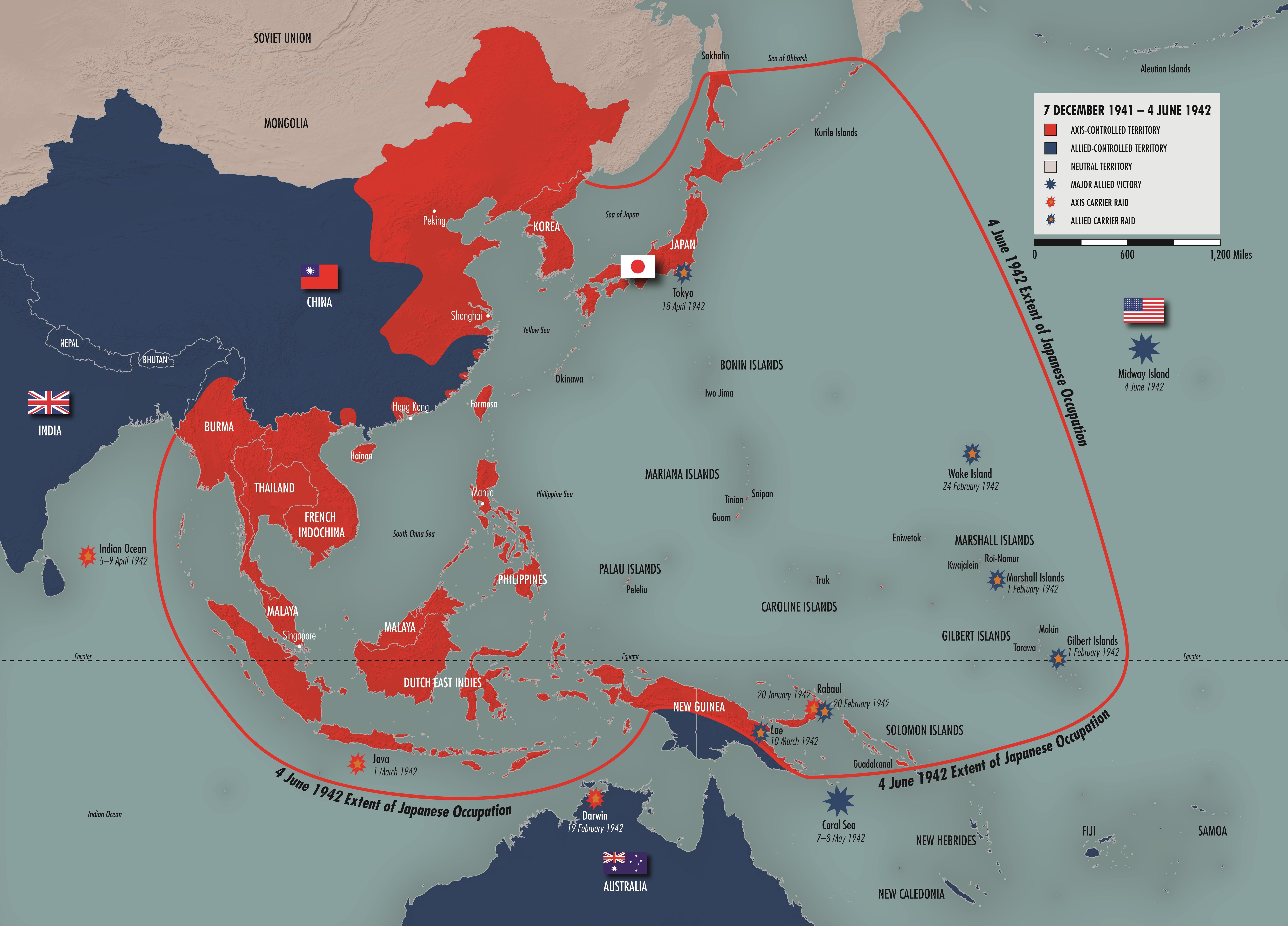
Long before December 1941, dominoes began to fall across the Asia Pacific region. China wasn’t the only nation that had been subjected to Japanese expansion. Japan had annexed Korea in 1910, taken over Manchuria in 1931 (setting up the puppet state of Manchukuo – that no nation recognized), and these are just two of the territories Japanese expansion had acquired by military means. Well prior to 1941, other nations included the Kingdom of Ryukyu (including Okinawa), Taiwan and the Penghu Islands, South Sakhalin, Saipan and Tinian in the Mariana Islands, the Marshall Islands, and the Caroline Islands. The following map shows the Asia Pacific region in September 1939 at the outbreak of war in Europe.

If the Dutch (Netherlands) East Indies and their oil field are the critical domino, you can see why French Indochina (Vietnam) was essential to the Japanese in order to secure and safeguard merchant shipping from the East Indies to Japan.. However, there are still two barriers in the way: (1) the U.S. Territory of the Philippines and (2) the British presence in Malaya, notably the major British port of Singapore. These two represented bases of operation that could interdict any marine traffic in the South China Sea and choke off critical supplies such as oil, rubber, and metals.

Without elaborating, let me simply say that there was great rivalry between the Imperial Japanese Army (IJA) and the Imperial Japanese Navy (IJN). This rivalry had existed since before the start of the 20th century, ebbing and flowing in intensity. When the 1939 IJA forays into the border areas of Soviet controlled Mongolia and Siberia (the Nomohan Incident) were easily repulsed, Japanese attention and planning turned to the Southeastern Asia region – which had always been the strategic priority in the eyes of the IJN. 

If Korea and Manchuria served as a food basket and new homesteads for an exploding Japanese home population, then Java, Malay, Borneo and other nations were seen as sources rich in oil, rubber, and other materials needed for Japan’s military-industrial complex. There was a strong sentiment among Japanese leaders that their national destiny was to be the rightful leader of the “Asia Co-Prosperity Sphere.” It was an ideology that was part of the education system and propaganda from the 1920s onward. The ideology was promoted as a means to free other Asian nations from the colonial rule of European nations, but in reality it was to establish themselves as the new colonial master. The underlying motivations for their territorial expansion was explored in a previous post, The Eight Corners of the World. In any case, the 20th century saw Japan transform itself from an island nation to an Asian Imperial Empire founded on military action.

Japan signed the Tripartite Pact on September 27, 1940, in Berlin, forming a military alliance with Germany and Italy as the primary Axis powers in World War II. The reasons were to deter the United States from intervening in Japan’s expansion in Asia, formalize its alliance with Germany and Italy, and establish distinct spheres of influence (Europe for Germany/Italy, Greater East Asia for Japan) for a new world order, all while securing mutual defense against potential attacks, especially from the U.S. and the Soviet Union (which Germany invaded on June 22, 1941)

At this point in time,  France was fully occupied by German forces with the south of France (Vichy France) as a puppet government of the Nazis. In an arrangement with the Vichy government, Japan occupied the region of modern-day North Vietnam (French Indochina) starting in September 1940.  At the same time Japanese troops began to encroach into “South Vietnam” (also part of French Indochina).  By July 1941 Japan expanded its occupation to include all of South Vietnam. Another key domino in the chain fell.

The 1941 occupation of French Indochina was a tactical and strategic military move by the Japanese to position themselves to secure the Dutch East Indies oil fields and to control the sea lanes from those fields to the home islands for merchant shipping. The Japanese viewed the Dutch colonies as vulnerable since Germany had occupied Holland in May 1940. Although Holland was occupied the Dutch army, navy and air forces had not surrendered and were able and willing to defend its colonies and the oil resources. As well, the British military held strongholds in Singapore and Malaysia, bases from which to assist the Dutch, as well as to keep open Burma Road and its supply line to the Chinese fighting the Japanese invaders – and threaten the sea lanes to Japan.

The August 1941 oil embargo did not start the war. The war in the Asia-Pacific region was already underway. One only needed to ask the Chinese, Vietnamese and Mongolians, as well as the Koreans. The embargo was a calculated political action in reaction to the occupation of French Indochina. It was a political action whose hope was to deter Japan from further expansion. Nonetheless, one can ask: 

  • What was the background, purpose, and hope as regards the August 1941 oil embargo from the United States point of view? 
  • The U.S. understood the goals for Japan southwest incursion, but did the U.S. truly understand the underlying motivations?
  • Was the embargo the decisive reason why Japan attacked Pearl Harbor or just more proximate than a collection of other reasons? 
  • Was the embargo a virtual declaration of war hoping to draw Japan to military action so that the U.S. could enter the war in Europe?
  • Clearly the December 1941 and early 1942 “blitzkrieg” across Southeast Asia, the Southwest Pacific, and Central Pacific regions accomplished the mission of (a) capturing the resource rich nations and (b) setting a “line of defense” west of Hawaii – why did the Japanese attack Pearl Harbor? Couldn’t they just have left the sleeping giant alone?

But all of the above only leads to a larger question: how did the currents of history bring the U.S. and Japan to this point in history when sanctions and an embargo were the final domino that moved the flames of war to become the firestorm that was the Asia-Pacific War from December 1941 until September 1945? It is not just an interesting question in history. Consider the terms “sanctions”, “embargo”, “frozen financial assets” and others that are current in our news here in 2026. Are there lessons to learn from history?

Stay tuned.


Image credit: various photographs from Naval Aviation Museum, National World War II Museum, and US Navy Archives.