Across military histories of the War in the Pacific the phrase “strategic bombing” is used and refers to B-29 Superfortresses flying out of the Mariana Islands (Saipan, Tinian, and Guam) and bombing the Japanese home islands of Honshu and Kyushu. Strategic bombing was an idea that grew out of the experience of air power in the First World War. Military theorists such as airpower advocates like the Italian Giulio Douhet, Britain’s Hugh Trenchard, and General William “Billy” Mitchell became influential in shaping the concept during the 1920s and 1930s. Douhet’s The Command of the Air (1921) and Mitchell’s Winged Defense (1925) became the starting point of thought and planning about the future of air warfare, strategic bombing in particular.
In Winged Defense Mitchell predicted that Japan would one day be America’s principal Pacific rival and that Tokyo itself could be struck by long-range strategic bombers launched from Pacific islands. His ideas were considered to be influential in a general way in the development of War Plan Orange but he was not personally involved in such planning. Nonetheless, the idea of strategic bombing had been planted.
During the early 1945 the war in the Pacific was inexorably drawing closer to the Japanese home islands. There were two major campaigns that were initiated in the Winter and early Spring:
Iwo Jima (Feb 19 – Mar 26, 1945)
Okinawa (Apr – Jun 1945)
Each of these campaigns were within range of Japanese aviation forces based on Kyushu and Honshu. A critical element of the above campaigns was the suppression of those aviation forces. That work fell to the U.S. Navy.
The Navy, freed from most major fleet engagements after the Philippine Sea and Leyte Gulf, shifted to directly attacking the Japanese homeland with multiple purposes in mind: suppression of aviation support for Okinawa and Iwo Jima; damage to industrial facilities, disruption of coastal shipping; elimination of the remnants of Japan’s Combined Fleet; disruption of rail-ferry links between Hokkaido and Honshu; cutting a key source of food shipments; disruption of the rail supply system leading from the Tokyo industrial area southward toward Kyushu and; presenting to the Japanese people that the Allied Forces could strike at will.
In February 1945 the first major aircraft raids were conducted in the Tokyo area. The objective was to neutralize Japanese air power prior to the Iwo Jima landings. Carrier aircraft from Task Force 58 struck Tokyo, Yokosuka, and nearby airfields, shipyards, and factories. Over 500 Japanese aircraft were destroyed (majority on the ground), some naval units damaged, including the carrier Amagi.
In the months following, US carriers pre-emptively struck Japan in preparation for the Okinawa landings. From April through June the US carriers supported the ongoing Okinawa operations by striking airfields in nearby Japan when necessary. Finally, by July 1945 Okinawa was secure and the full attention of the US and British fleets (carriers, battleships, cruisers and destroyers) could turn their attention to shore bombardment of Japan from Kyushu in the south to Hokkaido in the north with Honshu in between. While their reach was limited their accuracy was deadly. In late July the industrial and electronics-producing city of Hitachi was subject to shore bombardment. A key factory that had avoided destruction by air assault was level with four hits from the 16-inch guns of a US battleship.
While the July 1945 naval bombardment received little coverage, there are several key elements revealed regarding the state of the war in the Pacific:
Naval ships (carriers, battleships, cruisers, etc.) could approach the coast with impunity. By way of analogy, Japan was a medieval castle under siege. Outside the “walls” the Allied forces were free to operate; inside there was nothing to do except endure
At the same time, the Naval aviators and US Army Air Force bombers also operated without restriction.
The Allied fleet was free to aggressively sweep Home Island waters searching for Japanese warships and merchantmen.
The primary focus of this undeterred bombardment from sea and air was focused on Operation Olympic, the invasion of Kyushu. Targets included:
Pre-invasion bombardment of potential Kyushu landing beaches and the inland areas immediately adjacent to the beaches to begin the “softening” on the in-depth defense and on-going construction of the same.
Japanese airfields and aircraft production sites in order to minimize the operational capacity and ability to mount kamikaze attacks during
Transportation lines and hubs that would be used to supply/re-supply Kyushu (Japan was particularly dependent on coast shipping and railways as they had little to no developed roadways)
Coastal shipping and merchants attempting to import supplies – including food – to Japan
At this point, by any effective measure, Japan was under an almost complete blockade. Only the Korea-Japan shipping channels were available and only under the cover of weather which limited the ability of the allies to find and track the merchants.
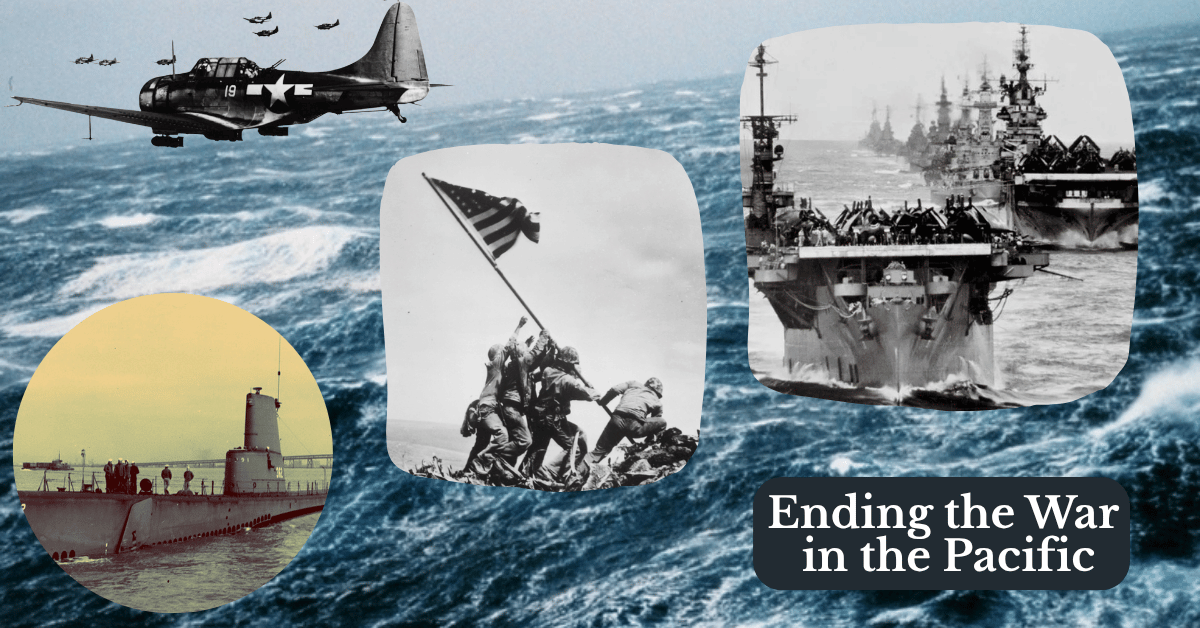
Image credit: various photographs from Naval Aviation Museum, National World War II Museum, and US Navy Archives.
The capture of the Saipan and Tinian (July 1944) gave the allies air bases for the B-29 Super Fortress bombers. The home islands of Japan were within range and the Allies were now able to initiate sustained bombing of Japan without risking aircraft carriers which would have operated within range of Japanese counter attacks. The B-29 raids began on November 24, 1944. Tokyo was the first target. It consisted of 111 B-29s striking the Musashino aircraft engine plant on the outskirts of Tokyo. The raid was executed as a high-altitude precision raid (but with little effect). As noted in a previous post, the Allies faced major challenges over Japan: high-altitude jet stream winds disrupted bombing accuracy; weather conditions, especially cloud cover, reduced visibility.
The bombing campaign was focused on Japanese cities. The goal was to destroy key industrial and military targets such as aircraft factories, shipyards, and transportation hubs. The strategy was modeled on the efforts against Nazi Germany which concentrated production in large factory settings. Japanese industry was decentralized, with small workshops spread throughout urban residential areas. These workshops were as small as home-based, then feeding large operations, still in residential areas, again working up the supply chains to large operations, often located on the edge of residential areas. While there were critical war production located apart from residential areas, e.g. shipyards, other production (ammunition, airplane assembly, weapons, etc) took place in the labyrinth of major city residential areas.
There was an early phase of B-29 bombings on the Japanese home islands as part of Operation Matterhorn. These were planes launched from China. The airfields in China were highly vulnerable. Supplies and logistics had to be flown over the Himalaya Mountains. There were no accompanying fighter escorts. Targets were typically industrial or military facilities near western coastal cities (e.g., steel works, shipyards, aircraft plants). Damage was limited due to small bomb loads, long flight distances, and weather conditions. All in all, the raids were psychologically unsettling, but neither tactically or strategically valuable.
Before we delve into the aerial bombing campaign, we should consider an event which was seared into the minds of Tokyo and Yokohama residents – an event which shaped emergency preparedness: the 1923 Tokyo earthquake, also known as the Great Kantō Earthquake (the Kantō plane is the broad area on Honshu island that encompasses some of the great cities of Japan)
The earthquake struck on September 1, 1923, at noon when people were cooking lunch. The ~8.0 magnitude earthquake caused extensive damage that was further exacerbated by widespread fires that swept across the wooden neighborhoods of Tokyo and Yokohama. Both cities were devastated as well as surrounding prefectures. The earthquake caused over 130 fires, some of which merged into firestorms. The most infamous was in the Hongō district, where around 38,000 people perished in an open space where they had taken refuge – heat and oxygen deprivation caused by the firestorm being principal causes.
Tokyo’s infrastructure—including roads, bridges, water supply, and railways—was either damaged or destroyed, crippling transportation and communication. Yokohama, then a major international port, was almost entirely flattened. An estimated 105,000–142,000 people were killed, with over 570,000 homes destroyed leaving more than a million people homeless. The event and its aftermath reshaped Japan’s approach to urban planning, emergency preparedness, and national resilience.
The final death blow to the Japanese Imperial Navy occurred during the Battle of Okinawa – the sinking of the super-battleship Yamato. This pride of the Imperial Japanese Navy (IJN) was named after Japan itself, IJN Yamato, the historic name for Japan and was the pride of the nation.
Yamato was the largest warship ever built up to that time. Compared to ships of the time it was simply a monster. It carried larger guns (18-inch) than any warship and could fire a 3,200 lb armor-piercing projectile more than 26 miles. For reference, a Ford Escape weighs about 3,200 lbs. 26 miles, as the crow flies, is about the distance from the White House to the runways at Dulles International Airport. It was armored to withstand the impact of a 3,200 lb armor-piercing shell. And it was fast.
The historian Richard B. Franks is noted for his exhaustive research centered on World War II in the Pacific – or as he emphasizes, the Asia-Pacific War. While the major combatants in the region were Japan vs. primarily the United States/Australia/New Zealand/Britain/Netherlands, Franks’ research reminds the reader that there was no nation in the Asia-Pacific region that was not impacted by Japanese occupation. In an early post, Civilian Deaths, we considered that between 1936-1945 the Empire of Japan was responsible for some 30 million civilian deaths. By and large these were not combat deaths, but were deaths by slave labor, starvation, deprivation and disease in places like Burma, Vietnam (then known as French Indochina), Korea, Indonesia, China and the Philippines. The point Franks is making is the effect of the narrow vision of the historical revisionists (in Frank’s mind) who argue that the use of atomic weapons could not be justified by an argument of saving American lives lost during an invasion of the home islands. Franks argues that ending the war as soon as any means was available was about ending massive Asian deaths in the Japanese-occupied/controlled areas of the Empire outside of the home islands. In the last 12 months of the war, 1 million people died in Vietnam due to starvation and disease.
Franks worries that history is being lost/ignored in academic circles of historians in the West and in Asia. At a recent meeting of historical scholars of the Asia Pacific region, in the sessions on World War II, there seemed to be a general unawareness of the widespread death among Asia people as the scholars only focused on allied inflicted casualties on the Japanese people of the home islands (blockade, bombing, fire bombing and ultimately the atomic bombs). While those are valid areas of historical research and consideration, it loses context of a larger war – one that the Empire of Japan started and prosecuted with a brutality to Asian people that was rooted in racism, ultranationalism, and a manifest destiny of greater Japan.
One often overlooked aspect of Catholic teaching on just-war theory is that it exists, in part, to protect the humanity of the war fighters. Much strategic war planning and just-war theorizing operates – as it should – on the “big picture.” But “big pictures” can be a composite of small pictures: the experience of battles, but also the discovery of what had come before the battle. All of this shapes and frames the picture of the next battle and the next strategy. It shapes the mindset of the war fighters as well as the war planners.
This week the posts have addressed the combat in Manila, Iwo Jima, the naval battle of Okinawa, civilian deaths and more. But I want to pause and return to the Philippines. US Army and Naval personnel had a long rich history and connection to the Philippines before the war – many having resided in the islands for 20 years or more. Their return to the Philippines in 1944 and 1945 was shocking. Before the 1944 landings at Leyte and 1945 landings at Luzon, the allies were receiving guerilla reports of deteriorating conditions in and around Manila, the treatment of POWs at Camp O’Donnell and Cabanatuan, the condition of American civilians interned at Santo Tomas College, the state of prisons and other detention facilities, and more. It was different to become an eye witness.
What was discovered had a profound emotional and psychological effect on American soldiers as well as the U.S. public when they learned about Japanese atrocities in the Philippines. The effect cannot be overstated. It had a direct impact on the ferocity of combat and the American public’s perception of the Pacific War.
American forces came face to face with evidence of years of brutal Japanese occupation. At the POW camps (Cabanatuan and Camp O’Donnell), thousands of U.S. and Filipino prisoners had died of starvation, disease, and abuse. Those liberated were emaciated, confirming the worst fears of the US authorities and their brothers in arms. At civilian internment camps such as Santo Tomás and Los Baños, internees (Americans, Europeans, and others) were found near starvation. The Los Baños raid in February 1945 was driven in part by intelligence that the Japanese planned to massacre the civilians. After the Battle of Manila, U.S. soldiers saw the aftermath of systematic atrocities — civilians bayoneted, burned, and shot, including women and children. About 100,000 civilians were killed in one month. The guerilla reports were no longer an abstraction.
In a letter home, one of the soldiers on the mission to liberate Santo Tomás wrote: “I thought I had seen suffering before, but when I walked through those gates and saw our own people, little children with their bones showing through their skin, I knew then why we were here.” It was a boost to morale knowing they were liberating their countrymen and Filipinos, reinforcing their sense of mission. The soldiers saw themselves not only as fighting an enemy but as rescuers.
A veteran of the Cabanatuan raid wrote of the liberated POWs: “They were skeletons in rags. It was like walking into a graveyard where the dead still breathed. Every man in our unit swore he’d never forget what the Japs had done to them.” Many soldiers described these experiences as creating a hatred of the Japanese after seeing what had been done to POWs and civilians. Some veterans admitted it hardened their reluctance to take prisoners in combat – as well as instilling a latent rage and desire for vengeance that needed to be addressed.
Among U.S. troops word spread quickly. Letters home, informal briefings, and direct eyewitness testimony circulated through units. Even soldiers who hadn’t seen the camps firsthand knew the stories” by mid-1945.
After the Battle of Manila, Time Magazine, March 12, 1945 wrote: “Manila is dead. Its people were butchered in their homes, its buildings reduced to ash. In Asia, as in Europe, atrocity is the enemy’s chosen weapon.” In his book Rampage, James A. Scott reaches the same conclusion, but makes the point that it did not begin at the battle of Manila. It began the day the Japanese reached the Philippines. And perhaps MacArthur and US leadership should have expected how this unfolded. It has been the same in China in 1937 with the “Rape of Nanjing.”
Across the U.S. press, editors made sure to highlight parallels between Japanese actions in Manila and Nazi crimes in Europe, reinforcing the idea that this was a war of civilization against barbarism. The point is being made that where in Europe the atrocities were committed by the elite German SS troops, in the Pacific it was the practice of the entire Japanese Imperial Army. In parallel, the Office of War Information (OWI) and Army public affairs highlighted these stories, both to inform the homefront but also to justify the sacrifices of the ongoing campaigns.
The reports fed a strong belief that the Japanese leadership (and by extension, the nation) bore collective guilt for barbarity. This made the American public more accepting of the war’s escalating violence, including strategic bombing of cities and, later, the atomic bombings.
Perhaps the most intrinsic purpose of Just War Theory is the protection of humanity, not just of society, but of the war fighters. Many of these Army units would be slated for the Nov 1945 invasion of the Japanese home islands. As Iwo Jima and Okinawa showed, resistance would be furious. As the naval battle off Okinawa demonstrated, the attacks would be maniacle and suicidal.
One of the dynamics of extended warfare is habituation. One begins to get used to civilians used as combat troops – it’s what “they do.” One begins to see the use of flame throwers and flame tanks as proven tactics to eradicate entrenched enemy positions because you know they won’t surrender. And they don’t. Soldiers carry the eye witness accounts of the enemy’s brutality and cruelty – and the grapevine carries the stories to the larger audience in theatre and at home. Some things can not be unseen.
1945 is a year of escalating violence increasingly seen as against an enemy who deserved no quarter. It is a year when the enemy will not surrender and yet there is a wider issue than just winning a war. It is stopping the crimes against humanity that have ravaged the Asia-Pacific nations since 1936.
One way or the other the war will end. As Major General Graves Erskin, USMC, said of Iwo Jima, “Victory was never in doubt. Its cost was. …What was in doubt, in all our minds, was whether there would be any of us left to dedicate our cemetery at the end.”
The war will end. Victory was not in doubt, only the cost to humanity and to human life. And not just the soldiers, sailors, and aviators of allied forces, but to people of countries of the 10 million square miles that was the Empire of Japan at its height in 1942.
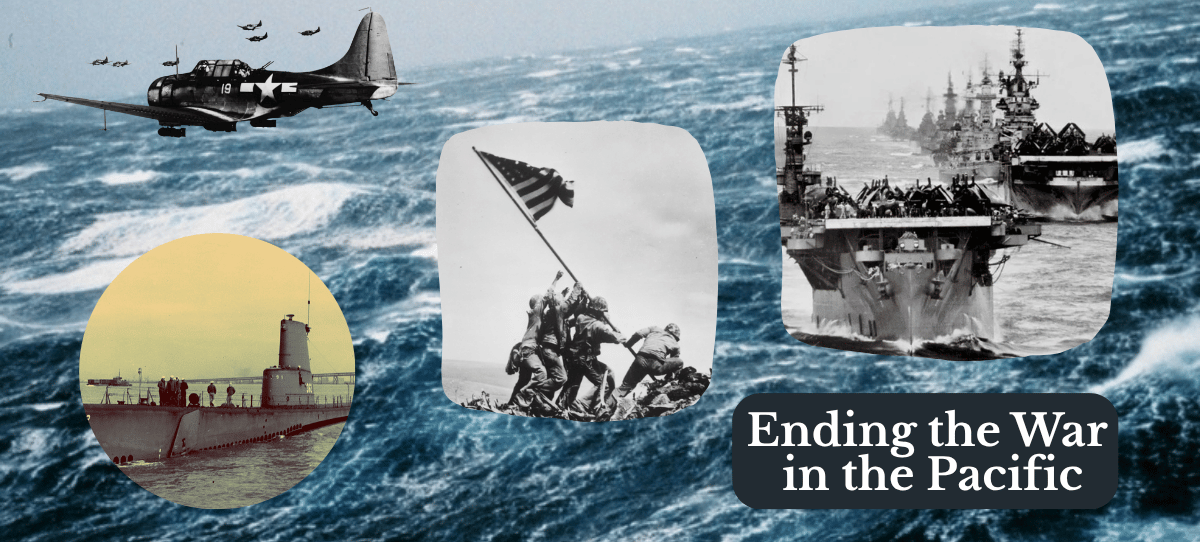
Image credit: various photographs from Naval Aviation Museum, National World War II Museum, and US Navy Archives.
The vast number of islands that were invaded/recaptured by the Allied forces were not highly occupied by civilian populations. Iwo Jima had virtually no inhabitants. Very different experiences were encountered on Saipan, in the Philippines, and on especially on Okinawa whose pre-invasion civilian population was estimated at 300,000 people. Okinawans were Japanese citizens, at least in law.
After the 1879 annexation of the Ryukyu Kingdom, Okinawa was made a prefecture of Japan. By the time of the Allied landings, Okinawans were Japanese citizens in law: subject to conscription, taxation, and wartime mobilization like all other Japanese. Their cultural and social status was something different. The longer and deeper roots of Okinawa were Chinese in custom and perspective and as a result, Okinawans were often regarded by mainland Japanese as a peripheral or inferior people, with distinct language, customs, and history. The Okinawan (Ryukyuan) language was suppressed in schools in favor of standard Japanese. Children caught speaking Okinawan dialects were sometimes punished. Mainland Japanese officials and soldiers stationed in Okinawa frequently treated locals as less disciplined, less loyal, or “not quite Japanese.”
Prior to 1944, Okinawans could join the Japanese military but were rarely assigned to combat ranks, most often serving in labor units, auxiliary roles, or support services. After the fall of Saipan in July 1944, Japan recognized that Okinawa was likely to be the next U.S. target. At that point the 32nd Japanese Army was stationed on Okinawa, and the Japanese authorities began mass mobilization of the Okinawan population. The mobilization had three primary elements:
The Battle of Okinawa which began with the initial invasion on 1 April 1945 was the largest amphibious assault in the Pacific Theater of World War II. It was the bloodiest battle of the Pacific War. The most complete tally of deaths during the battle is inscribed on the Cornerstone of Peace monument at the Okinawa Prefecture Peace Memorial Museum, which identifies the names of each individual who died at Okinawa in World War II. At the time of the June 1995 unveiling 234,183 names were inscribed. Continued historical research leads to the addition of names. Today, the monument lists more than 242,000 names, including 149,634 Okinawans; 77,823 Imperial Japanese soldiers; 14,010 Americans soldiers, Marines and sailors; and smaller numbers of people from other countries.
What is little known is that more naval personnel (4,907) were killed in action than either Army (4,675) or Marine (2,938) soldiers.
Iwo Jima is a small volcanic island about 750 miles south-southeast of Tokyo. The island had two operating airfields from which flew Japanese fighters and bombers. From late 1944 to early 1945, the Japanese stationed fighters and bombers on Iwo Jima. Their mission was to intercept the U.S. B-29s bombing Japan and to conduct night bombing raids on the Mariana airfields to disrupt U.S. bombing operations. Japanese bombers conducted about nine significant raids against the Marianas. The night raids were small in scale, typically 5 to 20 Mitsubishi G4M “Betty” bombers. The raids never seriously curtailed B-29 missions as U.S. forces had ample construction battalions to repair damage quickly. The Japanese air raids from Iwo Jima on the Marianas were annoying but not decisive. Their main effect was psychological and tactical, not strategic.
The island lay virtually under the direct flight path to Tokyo of B-29 bombers operating out of Saipan and Tinian allied airfields. The direct distance was 1,350 miles but in order to avoid Iwo Jima’s fighters, the flight route was 1,700 miles one way. Despite the route, the island served as an early warning station for Japanese mainland defense.
The strategic reason for invading and taking Iwo Jima was to eliminate the early warning capability, the fighter intercepts on the bombers, the nuisance bombing raids on B-29 bases, shorten the route to/from the Japanese home islands for the “finicky” B-29s, and provide an emergency diversion landing site for returning B-29 bombers. This last feature came into use during the intense fighting on Iwo Jima and by war’s end was responsible for saving ~2,400 US Army Air Force pilots and flight crews.

 friarmusings