The island of Saipan in part of the Mariana Islands lies southeast of Tokyo at a distance of 1,450 miles. Its capture was always part of War Plan Orange because of its strategic importance. The capture of the Marianas (Saipan, Tinian, Rota, and Guam) ensured an open sea lane for logistics support from the mainland United States. Guam became one of the major supply depots in the Pacific from August 1944 to the war’s conclusion. Even today every branch of the US military operates out of Guam – notably Submarine Squadron 15/Los Angeles Class fast attack submarines and Seal Team One.
However the real prizes were Saipan and Tinian. Their location allowed the US and Allies to build multiple airfields for the B-29 Superfortress bomber which initiated sustained bombing of Tokyo and the Japanese home islands for the first time.
While Guam had been a U.S. colony, Saipan had been a Japanese colony since it was ceded to Empire of Japan by the League of Nations as a part of its mandated territory of the South Seas Mandate that transferred all Pacific territories to WWI allies – of which Japan technically was one.
In the best of scenarios, the two warring factions agree to meet in the open away from cities, away from civilians, and decide the end result without involving the innocents. Scenes from “Braveheart” come to mind. But even then the winning army goes on to lay siege to the castle while ransacking towns and villages. Whatever the victor’s intent, war has its own purpose and passion. Revenge and retribution seem more powerful than reconciliation. And some things can not be unseen or forgotten by war fighters or witnesses.
The goal of this post is to make the reader aware of one element that was a critical factor in the decision whether (and how) to invade the Japanese home islands in the autumn of 1945 and spring of 1946. But also to let us remember it is individuals who fought the wars in our name and in many cases faced unspeakable evil. They carry the scars of combat – images and memories that challenge their humanity. Catholic just war teaching acknowledges the moral weight is most often borne by those who carry arms. While the national leaders may determine that a war is just, the individual soldier carries the burden of action, decision, and consequence.The dual responsibility of the war fighter — obedience and moral discernment — can place the war fighter in situations of profound moral tension and leave them with life-long memories. The cost of war is carried beyond the battlefield: moral injury, post-traumatic stress, and a deep spiritual dislocation. The battlefield lingers in memory and emotion long after the fighting ends.
Such was the case of the U.S. Marines who witnessed needless civilian deaths on the island of Saipan. While civilians caught in the cross fire is perhaps an inevitability of modern warfare, the intentional blurring of the difference between soldier and civilian by an enemy crosses a line of moral behavior and essential humanity. The disregard of civilian lives by the Imperial Japanese Army (IJA) before the June 1944 invasion of Saipan is well documented. The scope of civilian deaths at the hands and instigation of the IJA staggers the imagination.
Civilian deathscaused by Japanese military actions from 1936 to 1945
To be sure it is difficult to account precisely due to incomplete records, wide geographic scope, and ongoing historical debate. However, historical estimates, based on scholarship, war crimes tribunals, and national archives, provide the following approximate figures:
The above information is provided, not as a means of establishing the basis for punishing the Nation of Japan as punitively as possible nor to justify a wholesale invasion of Japan’s home islands. The post-war tribunals addressed the war crimes and those responsible. But it is presented to reveal the mindset, practice and history of field-level commanders in the Imperial Japanese Army (IJA), especially those operating in the far-flung corners of the Japanese empire.
Among the “junior officers” there was a history of rebellion, assasination, and “taking the initiative” in ways unimaginable in the allied armed forces. It is believed (not proven) that junior officers were most responsible for the July 1937 escalation of armed forces involvement from the incident at the Marco Polo Bridge that is considered the beginning of the Second Sino-Japanese War.
Another glaring example is the forging of orders given to Major General Tomitarō Horii to cross the virtually impassable Owen Stanley Range via the Kokoda Track to attack Port Moresby in Papua New Guinea. The attempt resulted in ~5,000 deaths from combat, disease, exposure, or starvation. Among them were scores of forced laborers from Korea and China.
A concern of the Allied Leaders in July 1945 was the reaction of the IJA outside the home islands in the event of invasion of their homeland. Would there be retaliatory strikes against local civilian populations in Japanese occupied territories? Also, in the event of Japanese surrender, would the IJA surrender arms inside and outside of Japan? Mutinies initiating within the ranks of the IJA had been well documented.
Civilian non-combatant deaths did not become a point of US military experience until the invasion of Saipan in June 1944. The experience of Saipan not only greatly clouded the question of whether “civilian non-combants” were a separate and distinguishable group, but also left indelible marks on the US Marine witnesses. The experience of the invasion of Iwo Jima and Okinawa added to and amplified the Saipan experience. All this justifiably raised the issue of what were the expectations in an invasion of the main home islands as regards “civilians.”
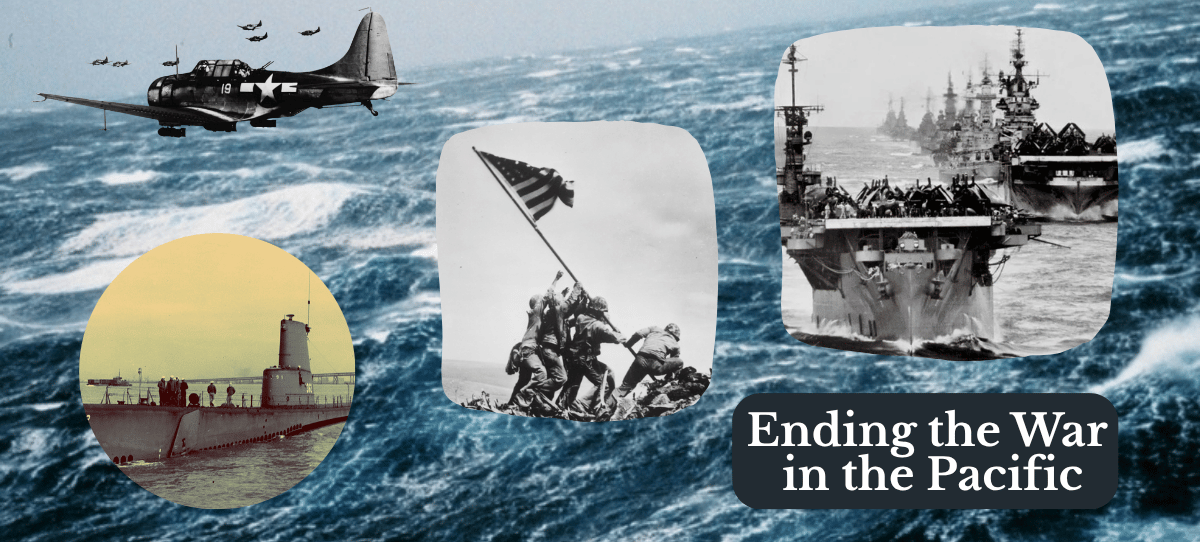
Image credit: various photographs from Naval Aviation Museum, National World War II Museum, and US Navy Archives.
Prior to the attack on Pearl Harbor there was no blockade of Japan. Five months before the Pearl Harbor attack the Dutch, English, and Americans announced an embargo on the sale of oil, steel and scrap metal. An embargo is not an act of war; it is an economic and political tool, enforced primarily through laws, regulations, and diplomatic pressure. Its intent is always to solicit acceptable behavior, which in July 1941 meant for Japan to cease its war actions in Manchuria, China, and Indonesia. All this before Pearl Harbor.
A naval blockade is an act of war. Naval blockades come in two forms: the embargo of selected items and a complete shutdown of ships with cargo of any type. World War I was enmeshed in the endless slugfest of trench warfare when Britain instituted a complete naval blockade to cut off Germany’s access to food, raw materials, and supplies. The Royal Navy blockaded the North Sea, intercepting ships heading to Germany and occupied countries in Europe. This led to severe food shortages and malnutrition among German civilians. It is estimated that 400,000–750,000 German civilian deaths were due to starvation and disease. The blockade contributed significantly to domestic unrest and the eventual German collapse in 1918. The blockade continued even after the armistice (Nov 11, 1918) until the signing of the Treaty of Versailles (June 28, 1919).
Germany’s unrestricted submarine warfare in WWII was an attempt to blockade England from receiving needed supplies including food. Before the war, 70% of Britain’s food supply was imported. In 1942, as German U-boat attacks during the Battle of the Atlantic reached their peak, imports of meat, sugar, fruit, and cereals were drastically cut. This led to severe rationing. Britain successfully avoided famine through a mix of rationing, domestic production, and American aid which began to increase significantly by late 1942 as the Battle of the Atlantic began to turn in favor of the allies.
By early 1942, Japan had established a vast defensive perimeter across the western Pacific, including the Philippines, Dutch East Indies, and parts of New Guinea. After seizing Tulagi in the southern Solomon Islands in May 1942 the Japanese began construction of an airfield on Guadalcanal an island near the southwest end of the Solomon chain. Completion and operation of this airfield would threaten Allied supply and communication lines between the U.S., Australia, and New Zealand – effectively isolating the Allies from each other and placing Australia at risk of invasion.
The U.S. victory at Midway in June 1942 represented the first time Japanese offensive power had been thwarted and opened the possibility for limited Allied offensives. Admiral Ernest King, Commander in Chief of the US Fleet, proposed an offensive in the Solomon Islands and New Guinea. The Joint Chiefs of Staff approved the plan in July 1942. The first phase was the seizure of Guadalcanal, Tulagi, and surrounding islands to deny Japan their strategic airfield. The Guadalcanal operation was codenamed Operation Watchtower. Military historians have suggested that it should have been called Operation Shoestring. Initially planned as a limited operation by the U.S. Marines to preempt the Japanese airfield on Guadalcanal, it evolved into a protracted campaign that lasted from August 1942 to February 1943.
While the U.S. submarine force in the Pacific is credited with sinking one Japanese super aircraft carrier, two fleet carriers, two escort carriers, four heavy cruisers and other combatants. Their role as a naval combatant against Japanese fleet units was always going to be limited: aircraft carriers had a speed of 28-40 knots; a submerged WWII submarine could make only 3-4 running her engines on battery power. The real contribution of the submarine force was against merchant shipping. By the end of the war, U.S. submarines had sunk approximately 50% of all Japanese merchant shipping.
The Nation of Japan agreed to unconditional surrender marking the end of the 2nd World War in the Pacific. Thank you to all the men and women who served, the families that waited for their return. For those who sacrificed their lives and those who mourn their passing, you are remembered in prayer.
While perhaps familiar to many of the readers, it might be useful to offer a brief summary of the early months of the War in the Pacific. In a modification of Japan’s war plan, Kantai Kessen, on December 7, 1941, Japan launched a surprise and devastating attack on the U.S. Fleet at Pearl Harbor, Hawaii. The goal was the decisive battle that would neutralize the U.S. Pacific Fleet and secure freedom of action for the planned offensive in Southeast Asia. The results of the attack are well known, but the battle was not decisive for three major reasons: the U.S. aircraft carriers were not in port, the fuel depot was not attacked, nor was the Pearl Harbor Naval Shipyard. Had the depot and shipyard been destroyed the fleet would have withdrawn to the west coast affording incalculable time for Japan to advance and more firmly secure its war gains.
Japan rapidly expanded across the Pacific and Southeast Asia in a coordinated offensive:
Philippines: Attacked within hours of Pearl Harbor; U.S. and Filipino forces withdrew to Bataan and Corregidor, ultimately surrendering.
Guam and Wake Island: Guam captured quickly; Wake resisted before falling on December 23.
Hong Kong: fell to Japan on December 25, 1941.
Rabaul (New Britain): captured in January 1942, becoming a major forward base.
Burma: Japan advanced to cut off the Burma Road to China – it was the main overland supply route by which the United States and British Empire provided military aid to Nationalist China in its war against the Japanese – a war initiated in 1937.
Malaya and Singapore: Japanese forces advanced swiftly down the Malay Peninsula, capturing Singapore on February 15, 1942
Battle of the Java Sea (Feb 27, 1942): the Allied ABDA Command (American, British, Dutch, Australian) lost the majority of its sea power leaving Java and the Dutch East Indies open to Japanese invasion
Dutch East Indies (Indonesia): Seized for its oil resources; Java fell by March 1942.
Doolittle Raid (April 18, 1942): U.S. bombers struck Tokyo and other cities, a psychological blow to Japan and a factor in their decision to strike Midway.
Battle of the Coral Sea (May 4–8, 1942): a strategic Allied victory in that it stopped the invasion of Port Moresby, New Guinea – a gateway to northern Australia.
Japan planned Operation MI, an operation to lure the U.S. Navy into a decisive battle by attacking and occupying Midway Atoll, a key American base northwest of Hawaii. Their hope was for a decisive Kantai Kessen-style battle that would destroy the last Pacific assets: U.S. aircraft carriers. Victory would cement Japanese strategic dominance in the Pacific.
Station Hapo, Hawaii – using signal intelligence vs. pure code breaking – learned of the attack on Midway and in an “all-in” gamble, Admiral Chester Nimitz committed the U.S. carries to the action that stopped the tide of Japanese advance in the Pacific. At the Battle of Midway (June 4–7, 1942) Japan suffered a catastrophic defeat, losing four fleet carriers and shifting the balance of naval power in the Pacific.
War Plan Orange – greatly revised, but with key elements intact – was now free to work its way westward to prosecute the War in the Pacific on new terms and conditions.
I do not plan to work step-by-step through the war in the Pacific. I will leave the heroic battles of places such as Guadalcanal and Tarawa for you to research. As well, I do not discuss the 1942 naval engagements such as Savo Island, Eastern Solomons, Cape Esperance, Santa Cruz, sea battle of Guadalcanal and Tassafaronga – all in the defense of the Marine Division on the island of Guadalcanal. I would note that the US Navy suffered more killed-in-action than the US Marines during the Guadalcanal campaign.
Moving ahead, I will highlight key several military actions that reveal fundamental shifts in Japanese military tactics and strategy. These shifts will shape planning for an invasion of the Japanese home islands in 1945-1946, an endeavor whose potential for the loss of life – military and civilian – defied estimation.
By the end of 1942 the advance of the Japanese has been stopped. The advent of 1943 would see the allied forces move from the defense to offense. The might of American industrial power in shipping building (combatants and merchants), aircraft, ammunition, and every aspect of logistics support would “come fully on line” as the work of the US submarines interdicted needed critical war supplies from Southwest Asia to Japan.
As noted in the first post, this series is not aimed at concluding with “the atomic bomb was the lesser of all the evils about to be faced.” It is intended to hopefully provide a correct historical understanding available to the 1945 leadership who faced the impossible task of ending a war with an intractable enemy and not repeating the armistice of 1919 that became the next war.
Image credit: various photographs from Naval Aviation Museum, National World War II Museum, and US Navy Archives.
All militaries conduct war games as a means of preparedness, readiness, strategic deterrence, intergovernmental planning, and to provide concrete options to civilian leaders in support of their policy and national security objective. Peacetime planning allows the military to anticipate potential threats and develop responses, systems, and forces before a crisis emerges.
War Plan Orange was one of several plans outlining the United States military’s detailed strategy for a future war. The plans were developed as early as 1919. War Plan Orange was the plan for a potential war in the Pacific. Some have argued that War Plan Orange is evidence that the United States always intended to begin a war with Japan; the logic being why else would you plan a war? The United States had found itself completely unprepared for the First World War and so even as it stood down its wartime military, planning for future wars began. Japan was the natural candidate given its evolving militarism and colonial expansion undertaken by Japan that began in the late 1860s with the Meiji Restoration. This evolution inexorably continued up to and into the start of World War II.
The Plan was part of the Navy War College curriculum. Virtually every senior naval leader in the Pacific had studied Plan Orange and contributed to it as new circumstances, technology, and situations arose. As one historian noted: “it was part of their DNA.”
The effect of the military development efforts associated with the Meiji Restoration were realized in the first Sino-Japanese War (1894–1895). Victory over China ceded Japan the island of Taiwan and established Japan as a regional power. That status was solidified during the Russo-Japanese War (1904–1905) fought over rival imperial ambitions in Manchuria and the Korean Empire. Japan’s victory shocked the West and solidified its status as a major military power – and especially as a naval power with the utter defeat of the Russian fleet at the Battle of Tsushima – a battle that would shape Japan’s own war planning.
In 1910 Japan formally annexed Korea. A few years later, Japan was technically a member of the World War I allied alliance against Germany. Japan’s military, taking advantage of the great distances and Imperial Germany’s preoccupation with the war in Europe, seized German possessions in the Pacific (Micronesian islands) and German holdings in China, but there was no large-scale mobilization of the economy needed to support their ambitions. Politically, the Japanese Empire seized the opportunity to expand its sphere of influence in China, and to gain recognition as a great power in postwar geopolitics.
The roots of Japanese Militarism can be found in the Meiji Restoration (late 1860s). In brief, the Restoration ended the rule of the Shoguns which had dominated Japan for centuries. The leaders of the Meiji Restoration started to reform the system of the country, acting in the name of Japan’s emperor with the goal to restore the emperor’s powers and position – in government and in the identity of Japan. But, the leaders also kept to themselves a number of powers. Even after the Meiji Restoration a small group had the real power and ruled in the name of the emperor. While the governmental form was a constitutional monarchy with the Emperor as leader of the nation, the real power lay in the hands of the military.
Japan rapidly industrialized and modernized its military in response to Western colonial ambitions in the Western Pacific and Asia region. While the process and history is far more complex than this article can describe, it is ironic that Japan’s ambitions – apart from leadership of the Asiatic sphere – was to establish colonies of its own. Japan lacked natural resources (oil, rubber, iron), making it vulnerable to embargoes by western powers and so expansion into Asia was seen as essential for economic security, survival, and growth as Japan took its place among world powers. At the same time rising population in the Japanese home islands led to calls for “living space” for its people. Colonies were viewed as necessary to settle Japanese farmers and laborers – or simply as sources to supply natural resources, including food. One result was the development of an ideology of the “Greater East Asia Co-Prosperity Sphere” which promoted pan-Asian unity under Japanese leadership. This became the justification for imperial rule as a way to liberate Asia from Western colonialism, though the result would be a different form of colonialism.



 friarmusings