
Please REFRESH the screen/page to ensure all posts display
- A Final Postby Friar MusingsTwo nations expanding outward, each for their own reasons, collided in the waters, islands, and nations of the Western Pacific. Before the 19th century, in certain ways, each nation was a stranger to what would become the battle ground of the 20th century Asia-Pacific War. While Japan had “history” in the region, it had self-isolated during much of the 17th and 18th centuries. But then there was always China. Japan had a long off-and-on again relationship with China. The United States was “introduced” to China when the U.S. merchant “Empress of China” arrived in 1784 to begin the long legacy … Continue reading →
- The Aftermath of Pearl Harborby Friar MusingsPearl Harbor was just the beginning of a remarkable series of rapid military victories across the Central and Southwest Pacific and Southeast Asia. From the 1939 occupation of Northern French Indochina, the aim of Japan had always been focused on the oil fields of the Dutch East Indies. The July 1941 occupation of Southern French Indochina was a preparatory move towards Thailand, Burma, the Malay Peninsular, and the city of Singapore. These were preliminary moves to the invasion of the Dutch East Indies. The Path to the Dutch East Indies December 8 December 10: December 22: February 15: British forces … Continue reading →
- Authorizing Warby Friar MusingsIt is one thing to plan war and conduct war games. It is quite another to authorize the war. In the previous posts we have considered what lay behind the scenes in terms of the cultural, political, diplomatic, economic, industrial, and military capabilities – not just in the two nations, but with the factions that created strategy and moved the levers of power – the limitations each faced. Japan needed Southwest Pacific oil to fuel its ambitions. The United States needed Japan to stay “contained” as the defeat of Nazi Germany was the priority. The summer of 1941 had the … Continue reading →
- The Blind Alleyby Friar MusingsThe hostilities of the Asia- Pacific war ended over 80 years ago. It was a war that by most estimates took more than 30 million Asian lives, the vast majority of whom were neither combatants nor Japanese. We have considered the currents of history that brought us to the doorsteps of war, over the threshold into war’s carnage, until its end which was possibly inevitable even from its beginning. Was it inevitable? Some historians answer, “yes,” but there are always choices. It is just that you might not like any of the choices available. By the 1930s it was clear … Continue reading →
- Presumptions and Assumptionsby Friar MusingsIn the previous posts we considered the strategic and tactical plans that began to take shape in 1940 into 1941 – the Imperial Japanese Navy (IJN) war planning and the Germany-first strategy by the United States. Underneath all that, both Japan and the United States approached the coming conflict with deeply rooted presumptions about culture, race, and military capability. These assumptions shaped strategy, diplomacy, and expectations about how the war would unfold. In many cases, they proved to be serious misjudgments on both sides. Japanese leaders believed their society possessed a unique moral cohesion derived from loyalty to the emperor … Continue reading →
- Germany Firstby Friar MusingsFrom early 1941 onward, the Japanese were establishing and refining their war strategy which, as regards the U.S., which translated into a three part movement: attacking the Pacific Fleet in Pearl Harbor, establishing a defensive line across the Central Pacific, and attriting the U.S. fleet when they moved westward. Meanwhile, the United States did not want war with Japan and yet ended up in exactly the war Japan did not want: an extended war of attrition and logistics pitted against the manufacturing power of American industry and resources. The historical record is quite clear that the Roosevelt administration was committed … Continue reading →
- The Imperial Japanese Navy and War Planningby Friar MusingsWhile the Imperial Japanese Army (IJA) lurched into escalation through a series of “incidents” in China and suffered defeat at Nomanhan at the hands of the Soviets, the Imperial Japanese Navy (IJN) followed a very different strategic logic. It was one that was more calculated and globally oriented, though ultimately no less expansionist. Both Japan and the U.S. were adherents of the theories of Alfred Thayer Mahan (1890) who posited that national greatness is inextricably linked to sea power, defined as the ability to control vital maritime trade routes and project naval force. Mahan argued that a large, concentrated, offensive, … Continue reading →
- Japan and Prussiaby Friar MusingsWhen discussing the rise of militarism in Japan’s Meiji Era, it was mentioned in passing that Japan adopted a British model for its Navy and a Prussian model for its Army. Japan’s preference for Prussian/German military models was not accidental or sudden. It grew directly out of choices, experiences, and disappointments made during the late Tokugawa and early Meiji years. By the late Tokugawa Shogunate period there were groups that were imperial loyalists and wanted to end the rule of the shoguns and reform the nation under the Emperor. The tensions ultimately lead to the Boshin War (1868–1869) which pitted … Continue reading →
- Japan Apartby Friar MusingsIn the post China and Japan: A History, it was noted that as early as the late 16th century, Japan believed it had surpassed China as a nation. It was then that Toyotomi Hideyoshi, the most preeminent daimyo, had unified all of Japan, brought an era of internal peace – and set about to invade China. In effect he was planning to claim for Japan the role traditionally played by China as the center of the East Asian international order. His first step was to invade Korea, a vassal state of China, and establish a strategic buffer. The conflict ended … Continue reading →
- The Currents of Historyby Friar MusingsMore than two months ago, we started a companion series to the 2025 series on the Asia- Pacific War. The focus of that series was less about how or why it started, but about its ending. You can read that series here. The focus of this 2026 series has been exploring how the currents of history brought the U.S. and Japan to the events of December 7, 1941 that was a final domino to fall and bring the United States into the firestorm that was the already on-going Asia-Pacific War. In the previous post, Dialogue to War, described the departure … Continue reading →
- From Dialogue to Warby Friar MusingsOn November 26, Hull presented what became known as the Hull Note, demanding full Japanese withdrawal from China and Indochina and adherence to multilateral principles. Within Japan, the note was discussed in emergency meetings and ultimately rejected as unacceptable. Hull delivered what was seen within Japan as an ultimatum. It required Japan to: For leaders who had already committed themselves to war preparation, it confirmed that diplomacy could not secure Japan’s objectives. Japan’s leaders viewed this ultimatum as humiliating and as requiring them to give up everything they had fought for since 1931. Yet, Japan’s oil reserves were running out. … Continue reading →
- The Hull Noteby Friar MusingsThe Hull note, in its essence, was the same four principles that Secretary Hull had presented to the Japanese since 1937. The note, in part, reads as follows: The Government of the United States and the Government of Japan both being solicitous for the peace of the Pacific affirm that their national policies are directed toward lasting and extensive peace throughout the Pacific area, that they have no territorial designs in that area, that they have no intention of threatening other countries or of using military force aggressively against any neighboring nation, and that, accordingly, in their national policies they … Continue reading →
- November 1941by Friar MusingsIn late September into early October, 1941Prime Minister Konoe floated the idea of a summit meeting with President Roosevelt. Konoe was increasingly convinced that Japan could not win a prolonged war with the United States, diplomacy through normal Foreign Ministry channels had stalled, and only a direct leader-to-leader meeting might override military rigidity on both sides. Konoe-Roosevelt Summit? Roosevelt was intrigued but cautious. One of the great “what ifs” of the run-up to war was what if Roosevelt and Konoe had met. One of the problems for Konoe/Japan was the U.S. has already broken the Japanese diplomatic code (MAGIC). It … Continue reading →
- October 1941by Friar MusingsOctober in Tokyo Throughout October, most Japanese military leaders at cabinet level, at one point or another, left ample evidence of their doubt of success – but these doubts were not expressed at council meetings. In an October joint staff conference, Admiral Fukudome noted that if a war with the U.S. extended into a third year, at-sea losses and limited shipbuilding capacity meant that Japan’s merchant shipping capacity would be nil. At the same conference Admiral Ngano, Chief of Navy staff, reported that Fleet Commander Admiral Yamamoto, the architect of the Pearl Harbor attack, had informed hom that there was … Continue reading →
- Momentum to Warby Friar MusingsIn Washington August 1941, Ambassador Nomura continued discussions with Secretary of State Cordell Hull. Nomura emphasized Japan’s desire for peace and mutual understanding, but he lacked clear negotiating authority and often received delayed or contradictory instructions from Tokyo. Hull, meanwhile, insisted on his four principles: withdrawal from China, respect for sovereignty, non-aggression and interference in another country’s internal affairs, and equality of commercial opportunity in the Asia-Pacific region. While the tone remained civil, the substance hardened. Hull increasingly doubted Japan’s sincerity, particularly as intelligence suggested that military timetables were advancing regardless of diplomacy. The Imperial Conference The Imperial Conference of … Continue reading →
- The Turning Pointby Friar MusingsThe previous posts attempted to lead the reader through the labyrinth of thoughts and attitudes that formed the currents of Japanese-U.S. relationship from the beginning of 1941 until June 1941. Within the U.S. government, the key figures were already in place and would remain so for the remainder of 1941 as would their views and recommendations. Within the Japanese government the same could not be said. There were changes in the Foreign Ministry, Navy Ministry, and in the office of the Prime Minister. These changes are a reflection of the changing and narrowing of Japanese options. In May of 1941, … Continue reading →
- Dialogue within Japanby Friar MusingsThe previous posts focused on the internal dialogue within the United States government during the period January into June, 1941. The focus was limited to the Departments of State, Treasury, Army (War) and Navy; the office of the President of the United States; and even included independent non-governmental agents helping/confusing depending on one’s perspective. The positions and approaches on how to best engage the Japanese government were varied, sometimes inconsistent, and largely reactive to Japanese actions. The State Department under the leadership of Cordell Hull consistently advanced Hull’s “Four Principles” which were end-states of diplomacy without interim checkpoints and thus … Continue reading →
- The White Planby Friar MusingsI wonder how many readers know the name “Harry Dexter White.” Not a lot I suspect. I know that I didn’t before researching and writing this series. White is best known as the high-ranking U.S. Treasury official and influential economist who served as a primary architect of the postwar international financial system. As a key aide to Treasury Secretary Henry Morgenthau Jr., White was the creative mind that led to the creation of the International Monetary Fund (IMF) and the World Bank agreed to at the 1944 Bretton Woods Conference. He served as the first U.S. executive director of the … Continue reading →
- The Historiography of 1941by Friar MusingsThis is intentionally a post for a Saturday morning. It is longer than average and traces the “history” of how historians have treated the year 1941 as regards U.S.-Japanese relationships. As with most things, even when historians can agree on the events and sequence of events, the role of historian is more than a news reporter. A historian’s role is to research, analyze, interpret, and write about the past. They gather and critically evaluate primary sources (letters, records, artifacts, photos) and secondary sources (other historians’ work). They then determine the authenticity, significance, and context of historical information to form a … Continue reading →
- When Dialogue Became Distractionby Friar MusingsThe previous post ended by comparing the current and flows of the events of 1941 as an “external and internal dynamics [that make] the path to diplomatic resolution akin to walking a moonless night in the wilderness with but only a lighted candle to show the way. There is light but its glow only reveals so much of the dark night. And as we will see in the next post, there are lots of things that “go bump in the night.” In the final months before Pearl Harbor we find one of those “bumps.” In 1941 U.S.–Japanese diplomacy operated on … Continue reading →
- President Roosevelt: Mixed Signalsby Friar MusingsBetween 1939 and 1941, President Franklin D. Roosevelt confronted a central strategic dilemma: how to oppose Nazi Germany and keep Britain in the war while U.S. public opinion overwhelmingly opposed entering another European conflict. Roosevelt’s response was a policy of incremental engagement on economic, military, and political level, all designed to shift the balance of power without formally declaring war. This strategy succeeded in sustaining Britain and positioning the United States as the decisive future belligerent in Europe, but it also produced ambiguity and mixed signals both within his own administration and abroad, particularly affecting Secretary of State Cordell Hull … Continue reading →
- Dropping a Pinby Friar MusingsIn the flow of this series we have worked our way into 1941 as we covered several key events/periods on the way. There is a lot going on – probably best to “drop a pin” to locate us in this flow of history. Another recent post discussed the unintended consequences of the financial freeze action, not only in Japan’s response, but in the less-than-unified action/reaction with the U.S. Departments of State and Treasury as there were too many “cooks in the kitchen” – Hull, Morgenthau, Hornbeck, Acheson, Grew and the list goes on. We also introduced a lot more background … Continue reading →
- The Year Before Pearl Harborby Friar MusingsIn previous posts, we have tried to trace the Japanese strategic commitment to the southern strategy focused on the resource rich Southeast Asia mainland and Pacific Islands. The movements into Indochina brought about increasingly more stringent export controls and licensing for Japanese concerns, ratcheted up and hardened positions inside and outside government – especially within Japan where when the “military coughed, the Japanese cabinet developed pneumonia and collapsed.” With each cycle, the military was increasingly dominant in Japanese policy and strategy. There was a lot going on… The “roadmap” above is nowhere as complex as the underlying reality and labyrinth … Continue reading →
- At Cross Purposesby Friar MusingsThis second phase of the series on the Asia-Pacific War began with a goal of discovering if there was merit to the claims made by some historians that in the summer and autumn of 1941 the United States missed diplomatic opportunities that could have avoided war with Japan and at the same time took a series of economic actions that brought about U.S. involvement in the Second World War. The exploration has taken us from the pre-history to Japan of the early 20th century discovering currents, trends, events, personalities and changes that brought that nation to 1937. Along the way … Continue reading →
- Iconicby Friar MusingsOn this day in February 1945 on Iwo Jima, four days after the initial landings, Harold G. Schrier led a 40-man patrol up Mount Suribachi with a small American flag provided by Chandler Johnson. After a brief firefight with Japanese defenders, the flag—reportedly obtained from the attack transport USS Missoula (APA‑211)—was raised over the crater. Later that day, a larger eight-foot ensign from the tank landing ship LST‑779 replaced it. As Marines struggled to hoist the second flag, John H. Bradley and fellow servicemen were captured on film by Associated Press photographer Joe Rosenthal, creating one of the most iconic … Continue reading →
- Prince Konoeby Friar MusingsThe Japanese – U.S. relationship was difficult, ambiguous, conflicted at times and never seemed to find a “spot” where simple co-existence had any endurance. There were many actors in this drama, but one actor is often overlooked in the popular understanding of the dynamics leading up to Pearl Harbor: Prince Fumimaro Konoe. Prince Konoe was one of the most influential, and in a way, one of the most tragic figures in Japan’s descent into total war from 1937 until 1945. A scion of one of Japan’s oldest aristocratic families, Konoe served three times as prime minister (1937–1939, January–July 1940, and … Continue reading →
- The Financial Freezeby Friar MusingsIn the previous post, we considered the actions taken by the United States in response to the Japanese occupation of Southern Indochina. In short, with the Export Control Act of 1940 already in place, in July 1941 President Roosevelt authorized the Treasury to freeze all Japanese assets held in US institutions. The export of goods to Japan required an export license and the approval of the FFCC (Foreign Funds Control Committee) to release funds to pay for the commodities – including and perhaps especially oil. Edward S. Miller’s book, Bankrupting the Enemy, was an in-depth and interesting exploration of the … Continue reading →
- Unintended Consequencesby Friar MusingsThis post is not a summary of all the actions with unintended consequences that step-by-step drew the U.S. into the Asia-Pacific War. Perhaps the entire history of Japanese-U.S. relations has been marked by these. At one level it is not surprising given cultural differences. Compared to Japan, the United States was an infant country without substantive history, traditions, and a society that most readily ignored boundaries and traditions that did not seem to suit our future. The U.S. was a cauldron of immigrants, settlers and pioneers – all from somewhere else – completely committed to the idea that there were … Continue reading →
- Indochina: The Irreversible Hinge of Historyby Friar MusingsBetween July 1940 and the Summer of 1941, the war in China continued. The military situation in China was characterized by a transition into a brutal war of attrition against Japanese occupation, alongside a significant internal breakdown in the alliance between Chinese Communist and Nationalist forces. Among major actions was the “Hundred Regiments Offensive” (Aug 1940 to Jan 1941). It was the largest Communist-led offensive of the war, involving roughly 400,000 troops. It targeted Japanese-held infrastructure, specifically railroads and mines, in northern China to disrupt supply lines. In retaliation, the Japanese initiated the “Three Alls” policy: kill all, burn all, … Continue reading →
- The Path to Export Controlsby Friar MusingsBy June 1939 Japan was deeply entrenched in China with a military stalemate, the Chinese willing to fight a war of attrition, and there was no political settlement in sight. Japan had just suffered a major defeat at Nomonhan, though this was not fully appreciated in Washington at the time, and elements of Japanese leadership were increasingly suspicious of Western intentions. That same month the U.S. formally notified Japan it would terminate the 1911 Treaty of Commerce and Navigation, effective January 1940. This did not impose sanctions immediately but freed the U.S. legally to restrict trade later. The purpose of … Continue reading →
- The Nomonhan Incidentby Friar MusingsIn the summer of 1939 Japan was increasingly bogged down in combat with China. As you can see in the map below, Japan controlled not only Manchukuo (Manchuria) but swaths of Inner Mongolia and China. Importantly, Japan also controlled almost all major seaports facing the East and South China Sea. Manchukuo presented its own control issues, largely centered around rampant banditry, but all the other areas required the Kwantung Army (Imperial Japanese Army on the mainland) to provide occupation and policing forces in areas they had conquered. At the same time the Kwantung Army continued offensive operations in Northern China. … Continue reading →
- The U.S. State Department: 1937 until Spring 1939by Friar MusingsAfter the Marco Polo Bridge Incident (July 1937) the United States took measured but meaningful actions in support of China, while still stopping well short of alliance or military intervention. The pattern is best described as moral, diplomatic, and limited material support, shaped and heavily limited by existing U.S. neutrality laws and the general sense of isolationism among the American people and Congress. Given the mood and legal constraints facing the Roosevelt administration there was little to be done if the goal was to avoid military actions. What actions were taken are best described as nonrecognition and positioning. To that … Continue reading →
- The Second Sino-Japanese Warby Friar MusingsSo far in this series we have worked our way up to 1937. From the summer of 1937 until Pearl Harbor the conflict in mainland China is the dominant factor that drives and animates Japan’s relationships (or lack thereof) with China, the United States, Britain, the Netherlands, and all the nations of the Asia-Pacific region. The ebb and flow of this conflict known as the Second Sino-Japanese War is really the beginning of the Asia Pacific War that will become World War II upon the 1939 outbreak of war on the European continent and the entry of the United States … Continue reading →
- American Diplomacy in 1937by Friar MusingsIt would be a herculean task to consider all the elements and forces in the boiling pot that was the Asia Pacific region in the summer of 1937. And even then to understand the levers available to the U.S. to affect the military action in China and Manchuria that was initiated by Japan. Historians argue for or against financial leverage, military leverage, diplomatic leverage and a host of other factors. A book has been written that argues a coalition of merchant shipping companies could have been assembled that could have been effective in controlling Japan because of Japan’s dependence on … Continue reading →
- The Showa Emperor – Hirohitoby Friar MusingsWe have slowly been working our way through the early 20th century in Japan in search of key currents and views that were shaping Japan leading up to the 1937 start of the Asia-Pacific War. The 1860s movement from the Shogunate era to the Meiji Restoration was not a move to a constitutional republic that we know and accept in the United States. It is a complex topic best described by dedicated historians. To be clear, historians do not fully agree on the role Hirohito was playing and would play in the path to the Asia Pacific War. Nonetheless, some … Continue reading →
- Always Chinaby Friar MusingsIn the 2026 posts I have been working to go into more depth on the events prior 1941 that drew the U.S. to become involved in the Asia-Pacific War. In the first post of the new series I wrote that I wanted to explore: “…the currents and eddies of history that brought Japan its wars with China (1894-1895 and 1937-1945), with Russia (1904-1905), the annexation of Korea, Manchuria and French Indochina, and to wider war in the Pacific that stretched from Hawaii to Australia and nations in between, notably the Philippines, Malay, Borneo and the Dutch East Indies.” And more, … Continue reading →
- Governance by Assassinationby Friar MusingsAfter the First World War Japan experienced a political shift as liberal and democratic thinkers and politicians gained popularity. While there are many reasons for the shift, at the popular level it was clear that the winners of the war were the liberal democracies triumphant over the militaristic nations. At the same time there were currents within the Imperial Japanese Arm (IJA) that felt such a move might imperil the nation. While the political arm of the nation sought to form foreign relations, take their cooperative place in the world order of nations, the military continued to operate out of … Continue reading →
- Naval Factionsby Friar MusingsThe previous posts have focused on the Japanese military in the period 1905-1930. After the conclusion of the Russo-Japanese War in 1905, the Imperial Japanese Army (IJA) was implanted in Korea (annexed in 1910) and in Manchuria with control of vital sea ports of Liaodong and the connected South Manchuria Railroad. This was the foundation of Japanese settlement in those areas and the start of exporting resources and food supplies to the home islands. This was part of Japan’s strategic buffer, but when Japan became dependent on the exports, the strategic buffer needed to expand, giving additional mission focus to … Continue reading →
- Naval Treatiesby Friar MusingsIn the previous post, it was noted that at the end of the First World War the Imperial Japanese Navy (IJN) had expectations but were realistic. They expected that their coalition work with the British in the Indian Ocean, Mediterranean, and taking on maritime security in the Pacific had earned them recognition, respect and parity with the western navies. They had just successfully operated as a “global navy.” They also recognized that maintenance and expansion of their fleet was directly tied to shipyard capacity, raw materials and industrial throughput. These were industrial limits impossible to ignore and were not limitations … Continue reading →
- Japan after World War Iby Friar MusingsThe first concerns itself with the international situation, particularly in regard to China. The second deals specifically with Japan and how this conflict affected it. At the time, World War I was widely regarded within Japan as “an opportunity that comes once every thousand years” because it produced assured profitability for the nation and for its industries, unprecedented industrial and financial opportunity, and minimal obligation and commitment. Japan, before 1914, was poor. The country was obliged to import British and German steel because it was cheaper than steel made in Japan, and there were very few shipyards that could build … Continue reading →
- Imperial Rivalryby Friar MusingsIn previous posts there have been references to internal dynamics within the governance structures of Japan. By the 20th century that structure would best be described as a constitutional monarchy, somewhat akin to Great Britain which served as the model for the Meiji Constitution. Akin, but not exactly a match. The differences involved the role of the king/emperor and the makeup of the cabinet. If you’d like to learn more, take a look at the post, In the Beginning. In more recent posts there have been references to the rise of ultra-nationalism, militarism, and other movements within Japanese society. The … Continue reading →
- Immigrationby Friar MusingsIn the previous post we explored the Taft-Katsura Agreement between Japan and the United States. The purpose was to use that as an example of two nations seeking a means to “keep a lid” on a pot that seems to be forever threatening to boil over. Immigration of Japanese to U.S. territories and the mainland was a flame that seemed to keep the pot at or near boiling. The Chinese Exclusion Act The first significant wave of 19th-century Chinese immigration to America began with the California gold rush of 1848–1855 and continued with subsequent large labor projects, such as the … Continue reading →
- The Illusion of Detenteby Friar MusingsAt the start of the 20th century, U.S. and Japanese interests appeared to be aligned both nations supported the idea of an “open door” for commercial expansion in China. After the Russo-Japanese War of 1904–05, U.S. President Theodore Roosevelt acted as a mediator at Japan’s request, and the two sides of the conflict met on neutral territory in Portsmouth, New Hampshire. In the same year, U.S. Secretary of War William Howard Taft met with Prime Minister Katsura Taro in Japan. The two concluded the Taft-Katsura Agreement, in which the United States acknowledged Japanese rule over Korea and condoned the Anglo-Japanese … Continue reading →
- East Asia in the Early 20th Centuryby Friar MusingsAt this point in the series we have reached 1905. The Russo-Japanese War had just concluded with a peace settlement reached, moderated by the United States. China was technically at peace, but as we’ll explore later in this post, there was a lot of conflict ongoing within China’s borders – foreign states fighting one another and internal actors seeking to overthrow the Chinese Qing Dynasty government (the last of the Chinese imperial governments established by the Manchu people of northern China). What becomes confusing is the ebb-and-flow of the control of “areas” of China in the first half of the … Continue reading →
- The Russo-Japanese Warby Friar MusingsThe First Sino-Japanese war marked Japan as a military power – but was Japan capable of engaging a western military power? That question would be put to the test in the Russo-Japanese War of 1904–1905. In the previous post we noted that the transfer of Liaodong Peninsula and its warm water Port Arthur were ceded to Japan in the treaty that ended the First Sino-Japanese War. Via the “Triple Intervention,” (of which Russia was the primary animator), Japan reluctantly agreed to return Liaodong to China in 1895, the same year the war ended. In 1898 the ports of Liaodong and … Continue reading →
- The First Sino-Japanese Warby Friar MusingsThe series to this point has attempted to “paint a picture” of the nation of Japan at the doorstep of the 20th century. In one way it can be viewed as Japan’s experience and reaction to the western world. There was a point in time when Japan, as the apprentice, looked to China as the master of knowledge, spirituality, statecraft, governance, and the model of Japan’s aspirations. But by the late 9th century AD, the apprentice had matured and the master diminished. Japan stopped official missions to China. For the next 800 years or so, until the late 16th or … Continue reading →
- Building the Japanese Militaryby Friar MusingsWhen the Meiji era began in 1868, just as the nation was in transition from the Shogunate to a Constitutional Monarch, the Japanese military was undergoing a similar radical transformation. The underlying impetus was national survival. Having witnessed the fate of China in the face of more modern and powerful western militaries, Japan concluded that they too required a modern, Western-style military. They dismantled the Tokugawa samurai-based system and built a centralized national force modeled on European powers. At the beginning of the Meiji period the army was a fragmented, transitional force composed largely of former samurai from the victorious … Continue reading →
- Bushidō and the Japanese Militaryby Friar MusingsIt would not be accurate to describe the evolution of the Japanese military in the latter half of the 19th century. It was a radical revolution. After the Meiji Restoration (1868), Japan’s leaders concluded that national survival required a modern, Western-style military. They dismantled the Tokugawa samurai-based system and built a centralized national force modeled on European powers. This was made possible by Universal male conscription (1873) replacing hereditary samurai service, creating a national military loyal to the emperor rather than to domains or lords. In order to accomplish this radical change, Japan looked to the nations it considered threats … Continue reading →
- Japan and Social Darwinismby Friar MusingsIn the previous post we considered the late 19th-century events in Hawaii that led to the overthrow of the Hawaiian constitutional monarchy and eventually the annexation of Hawaii as a U.S. territory. The post ended with the Japanese reaction to these events. This post explores the lens through which the Hawaii events were seen and the rationale for the coming wars with China (1894-1895) and Russia (1904-1905). It also forms the basis on how the United States will be increasingly seen from Japan’s point of view. If you ask most people who coined the phrase “survival of the fittest,” the … Continue reading →
- Hawaii: a view from Japanby Friar MusingsThe history of how Hawaii came to be part of the United States is not, in my opinion, a shining moment in our nation’s history. The Hawaiian archipelago consists of five major islands and a number of smaller islands – including Midway at the extreme northwest. The five major islands and several smaller ones in proximity were united under the great King Kamehameha in 1795. It was not a bloodless unification, but the Kamehameha dynasty was the reigning monarchy of the Hawaiian Kingdom. The Kingdom was formally recognized by the United States in 1846 and as a result of the … Continue reading →
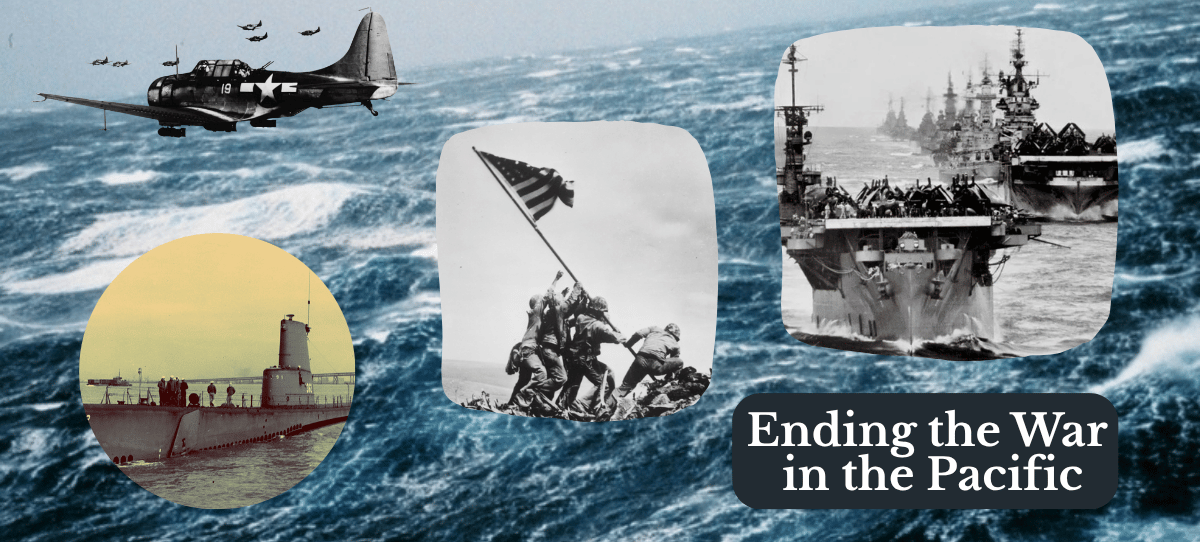
- To those reading the new World War 2 postsby Friar MusingsThanks to all who have been reading the series. I wanted to let you know that I have divided the series “Ending the Asia Pacific War” into different categories as I ran into a technical limit on the blog for showing previous posts on their own page with an associated menu item. Enjoy Image credit: various photographs from Naval Aviation Museum, National World War II Museum, and US Navy Archives
- The United States in the Central and Western Pacificby Friar MusingsIn the previous post we considered Japan’s 19th century transition from the Tokugawa Shogunate to the Meiji Restoration which transformed the nation of Japan to an outward facing nation, under the Imperial guidance of the divine Emperor, with a moral obligation to bring order and harmony to the Asian world in the face of western colonial power. In this post, we need to “back up” and catch up with U.S. activities since the time of Admiral Perry’s 1853 visit to Tokyo Bay. In a previous post we noted that making the journey to China and maintaining the U.S. presence there … Continue reading →
- From Shogunate to Meijiby Friar MusingsAt this point in the series we have tried to give some sense and introduction to the currents of history that led the political, economic, and military stew that was the Asia-Pacific region in the mid-19th century. Some of the key elements include (and certainly not limited to): Via Dutch traders, Japan was aware of the Opium Wars in China, the unequal treaties that forced foreign trade upon China, and what the foreign powers were willing to do via military advantage. It became aware of how unprepared it was should these same foreign powers turn to Japan with the same … Continue reading →
- There’s Something about Chinaby Friar MusingsThe post title might cause you to wonder if there is a veiled reference to the 1998 movie, “There’s Something About Mary.” Nothing veiled about it. The basic plot of the movie is the infatuation of a host of suitors for a woman named Mary: Ted, Patrick, Dom, Norm (aka Tucker) and Brett. I would explain the plot but it is way too complicated – funny, but complicated. The basic plot of this post is that “China” is wooed and pursued by a host of suitors: Japan, Britain, France, Holland, Germany, Russia, and the United States. The plot is complicated … Continue reading →
- China Trade and US Expansion in the Pacificby Friar MusingsU.S. merchants had been sailing to China since the first U.S. merchant, Empress of China, departed from New York on February 22, 1784. In its wake came a steady flow of merchants in search of wealth. During the first decades of the 19th century, U.S. merchants amassed sizable fortunes. As this trade grew, U.S. traders built a small outpost in China and their interactions with Chinese subjects became more complex and occasionally contentious. The U.S. Government realized that it had to establish formal diplomatic ties in order to protect the interests of its citizens. In the wake of war between … Continue reading →
- The Americans in the Western Pacificby Friar MusingsCommodore Perry’s mission was not the first American overture to the Japanese. In the 1830s, the Far Eastern squadron of the U.S. Navy sent several missions from its regional base in Guangzhou (Canton), China, but in each case, the Japanese did not permit them to land, and they lacked the authority from the U.S. Government to force the issue. In 1851, President Millard Fillmore authorized a formal naval expedition to Japan to return shipwrecked Japanese sailors and request that Americans stranded in Japan be returned to the United States. Perry first sailed to the Ryukyus and the Bonin Islands southwest … Continue reading →
- An interim thoughtby Friar MusingsAt the beginning of the Edo Period, Daimyo Hideyoshi had grand visions of a Pan-Asia empire that included China. Under the leadership of the Tokugawa Shogunate, the country set clear restrictions that mostly isolated Japan from face-to-face contact with the world. The nation remained open to commercial trade but not to social corruption from outside influences. Through the Dutch in Nagasaki, the advances in science and technology were available to them. But their world was largely an “internal” world. What was the impact of all this on their self-view vis-a-vis other peoples and nations? With the advent of the Asia-Pacific … Continue reading →
- Japanese Isolationby Friar MusingsIn the previous post, in the broadest of terms, we traced the relationship of China (and by extension Korea) and Japan from pre-history up to the 17th century and the beginning of the Edo period of Japanese history. Also known as the Tokugawa period, this was a period in Japan’s history which experienced prolonged peace and stability, urbanization, economic growth, and expansion of the arts and culture. During this period (1601-1868) the country was under the rule of the Tokugawa shogunate and some 300 regional daimyo, or feudal lords. The shogunate believed that the source of the previous era’s instability … Continue reading →
- China and Japan: A Historyby Friar MusingsAt the end of the previous post, a question was posited: “How did the currents of history bring the U.S. and Japan to this point in history when sanctions and an embargo were the final domino that moved the flames of war to become the firestorm that was the Asia-Pacific War from December 1941 until September 1945?” There is a lot of history upstream of the 1930s and 1940s to consider, but when one reads widely about the period, one recurring topic is China. Japan seemed to be possessed by an inexorable attraction for China. Look at a modern map … Continue reading →
- The Start of the Asia-Pacific Warby Friar MusingsDepending on how one phrases and frames the question, one will arrive at different and often conflicting conclusions. While writing and posting the series on World War II in the Pacific (late August – early November, 2025) one of the recurring comments was that the United States started the conflict with its complete oil embargo on Japan on August 1, 1941. This followed the freezing of Japanese financial assets held in the United States during July 1941. Some folks asserted that those two actions were a blockade, which by international agreement is an act of war – hence the U.S. … Continue reading →
- More on the Asia-Pacific Warby Friar MusingsLast year (2025) I explored World War II in the Pacific in order to consider the moral framework of the war considering the counter-factual that no atomic weaponry was available. If you are interested in the series you can read (or review) it here. In the course of reading and research I came across lots of other interesting information. Some was related to specific campaigns, others to strategy, and others still to a range of topics large and small. But there were also questions. Some of the questions I received most often was allocating some share of the blame for … Continue reading →
 friarmusings